Choose Right Fullerene C60 CAS No. 99685-96-8 or Sublimation‑Grade Powder
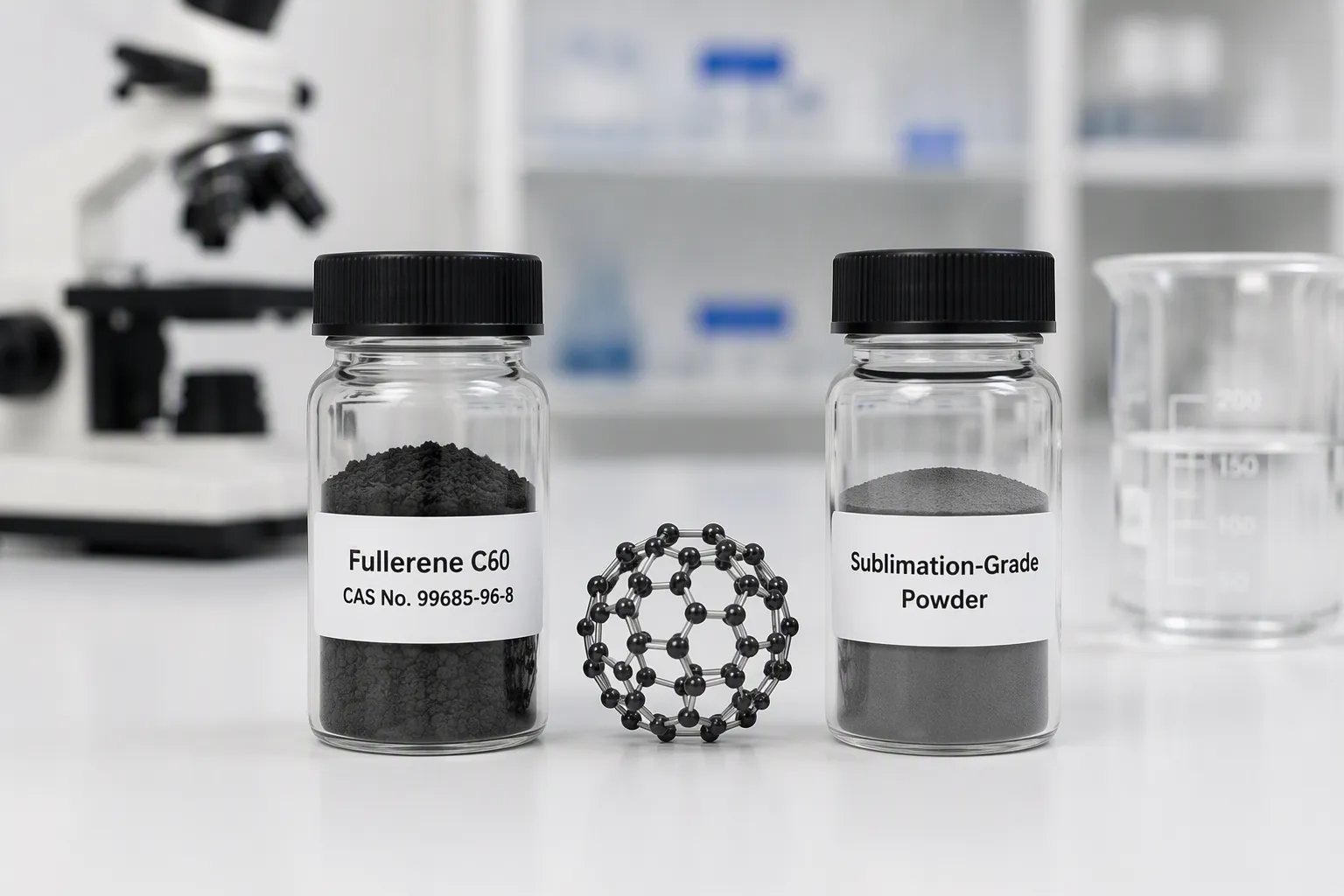
You need the right grade for your project. Sublimation-grade Fullerene C60 CAS No. 99685-96-8 and Sublimation‑Grade Fullerene C60 powder deliver 99.9% purity, which boosts electron mobility by 2.44 times in electronics. Conventional 99.5% grade works for cosmetics and lubricants. The market grows at 19.6% CAGR, so choosing correctly saves money and ensures performance.
Key Takeaways
- Choose sublimation-grade fullerene C60 for electronics, batteries, and advanced research. Its 99.9%+ purity ensures no solvent residues, boosting device performance and consistency.
- Choose conventional-grade fullerene C60 for cosmetics, lubricants, and basic studies. Its 99.5% purity works well and costs less than sublimation-grade.
Purity and Production: What Actually Differs?
Conventional-Grade Fullerene C60 (99.5% Purity)
Conventional-grade fullerene C60 contains 99.5% pure material. Manufacturers extract this product using organic solvents like toluene or chlorobenzene. These solvents leave trace residues behind. You receive a product with small amounts of chemical contamination. This grade suits applications where minor impurities do not affect performance. Lubricants, cosmetics, and basic research tolerate these trace compounds. The production process costs less because it skips additional purification steps.
Sublimation-Grade Fullerene C60 (99.9%+ Purity)
Sublimation-grade material undergoes a completely different refinement process. Manufacturers place the crude fullerene in a vacuum chamber. They heat the material until it vaporizes without passing through a liquid state. This process, called vacuum thermal gradient sublimation, separates pure C60 molecules from impurities based on their different vaporization temperatures. The result delivers exceptional purity. A 2024 Nature study documented purity enhancement from approximately 99.75% to 99.95% using this method. HPLC analysis confirmed the results. MTR Ltd. reports achieving purity up to 99.99% through sublimation purification.
| Source | Purity Increase | Residual Solvent Levels |
|---|---|---|
| MTR Ltd. | Up to 99.99% | 100% solvent-free |
| Nature (2024) | 99.75% → 99.95% | Solvent-free process |
Why Residual Solvents and Impurities Matter
Residual solvents alter material properties in measurable ways. Trace toluene molecules disrupt electron transport pathways in thin films. They create charge traps that reduce device efficiency. Impurities also affect reproducibility. Two batches with different impurity profiles behave differently in experiments. This variability ruins comparative studies and manufacturing consistency. For high-performance applications, you need material with zero solvent contamination. Sublimation achieves this because the process uses no solvents at all. The choice between Fullerene C60 CAS No. 99685-96-8 and Sublimation‑Grade Fullerene C60 powder ultimately comes down to your tolerance for impurities. Know your application's requirements before you purchase.
Application Fit: Where Each Grade Excels
Sublimation-Grade for Organic Photovoltaics and OFETs
You need the highest purity material for organic photovoltaics (OPV) and organic field-effect transistors (OFETs). These devices depend on clean electron transport pathways. Trace impurities disrupt these pathways and create charge traps. Each trap reduces device efficiency and stability. High-purity pristine carbon cage Fullerene C60 (99.5% to 99.99% purity) is engineered as the premier electron acceptor for organic photovoltaics (OPV) and semiconductor thin-films. You should select the purity level based on your specific device requirements.
| Purity Grade | Product Code |
|---|---|
| ≥ 99.50% | SOL5060X |
| ≥ 99.90% | SOL5060W |
| ≥ 99.95% (Ultra-High Grade) | SOL5060Y |
| ≥ 99.99% | SOL5060YY |
| ≥ 99.99% (Sublimed) | SOL5060S |
The sublimed grade (SOL5060S) delivers the best performance for research-grade devices. You achieve consistent results batch after batch. This consistency matters when you compare experimental data across multiple studies. The 99.99% purity eliminates solvent-related variability completely. Your thin films form uniform crystalline structures. Your devices operate at maximum theoretical efficiency.
Sublimation-Grade for Lithium-Ion Battery Anodes
Lithium-ion batteries demand exceptional material purity for anode applications. You need fullerene C60 that forms stable, conductive networks. Impurities interfere with lithium-ion intercalation. They also accelerate electrolyte decomposition at electrode surfaces. Sublimation-grade material prevents these problems. The solvent-free production process leaves no organic residues behind. Your anodes maintain capacity over hundreds of charge cycles. You achieve higher coulombic efficiency from the first cycle onward. The 99.9%+ purity also reduces side reactions with the electrolyte. This translates to safer batteries with longer operational lifetimes. Researchers consistently choose sublimation-grade material for next-generation energy storage prototypes.
Sublimation-Grade for High-End Research and Analytical Standards
You need reference materials with certified purity for analytical chemistry. Sublimation-grade fullerene C60 serves as a calibration standard for HPLC and mass spectrometry. Your instruments require known concentrations of pure analyte. Any impurity skews your calibration curve. This leads to inaccurate measurements across your entire experiment. Sublimation-grade material provides a reliable baseline. You can also use it for fundamental physics studies. Researchers investigating quantum effects or molecular electronics need defect-free crystals. The 99.99% purity ensures your results reflect intrinsic material properties. You avoid artifacts caused by impurities. Your findings become publishable in high-impact journals. The reproducibility of sublimation-grade material also supports multi-institutional collaborations. You can share results knowing your material matches your colleagues' samples.
Conventional-Grade for Industrial Lubricants and Machinery Coatings
You do not need ultra-high purity for lubrication applications. Conventional-grade fullerene C60 (99.5%) performs excellently as a solid lubricant additive. The fullerene molecules act as microscopic ball bearings between moving surfaces. They reduce friction and wear effectively. Trace impurities do not interfere with this mechanical function. You also benefit from lower material costs. Industrial applications consume larger quantities of material. The cost difference becomes significant at scale. You can formulate lubricants with conventional-grade material confidently. Your machinery coatings maintain their protective properties. The 99.5% purity provides consistent performance across production batches. This grade also works well for anti-corrosion coatings and surface treatments.
Conventional-Grade for Cosmetics and Antioxidant Formulations
The cosmetics industry relies on conventional-grade fullerene C60 for antioxidant products. You need material that delivers proven benefits without excessive cost. Clinical studies demonstrate significant wrinkle reduction using fullerene formulations. An 8-week randomized, double-blind, placebo-controlled trial (n=23 Japanese women, mean age ~39) using 278 ppm LipoFullerene twice daily showed significant wrinkle reduction vs. placebo at week 8 (p<0.05). Participants also experienced improved hydration, elasticity, and reduced TEWL. No severe side effects occurred during the trial.
| Evidence Category | Key Data Point |
|---|---|
| Clinical Efficacy (RCT) | 8-week randomized, double-blind, placebo-controlled trial (n=23 Japanese women, mean age ~39) using 278 ppm LipoFullerene twice daily; significant wrinkle reduction vs. placebo at week 8 (p<0.05); improved hydration, elasticity, reduced TEWL; no severe side effects. |
| Antioxidant Capacity | 172× Vitamin C equivalent in electrochemical assays; neutralizes ~34 methyl radicals per molecule vs. 1 for Vitamin C; scavenges superoxide, hydroxyl, singlet oxygen, and peroxyl radicals. |
| Safety Profile | Pure C60 shows no acute toxicity; SCCS flags incomplete genotoxicity data for fullerenes; earlier toxicity findings attributed to solvent impurities; recommends solvent-free, >99.5% HPLC purity. |
| Stability & UV Protection | Chemically stable in formulation; absorbs UV and neutralizes UV-induced ROS. |
| Collagen Impact | Preserves collagen by inhibiting MMP-inducing ROS. |
| Cosmetic Concentration Range | 0.001–0.1% (10–1000 ppm); purity ≥99.5% standard, ≥99.9% premium; heavy metals ≤10 ppm total (Pb ≤1, As ≤1, Hg ≤0.1). |
The antioxidant capacity of fullerene C60 is remarkable. It measures 172 times the Vitamin C equivalent in electrochemical assays. Each molecule neutralizes approximately 34 methyl radicals. Vitamin C neutralizes only one. This makes conventional-grade fullerene highly effective for anti-aging formulations. You can formulate products within the 0.001–0.1% concentration range. The 99.5% purity meets industry standards for cosmetic ingredients. Heavy metal limits remain below 10 ppm total. Your products deliver proven benefits while maintaining safety compliance.
Industry guidance emphasizes that credible adoption of fullerene C60 depends on documented ingredient specifications (purity, particle characteristics, residual contaminants, batch consistency), validated analytical and toxicological testing, evaluation of dermal and photoreactivity risks, and confirmation of performance in the intended vehicle—rather than relying solely on raw-material data. Responsible commercialization requires consistent quality, suitable formulation design, robust safety assessment, and restrained claims.
Conventional-Grade for Basic Material Science and Education
You can use conventional-grade fullerene C60 for educational demonstrations and basic research. University teaching laboratories benefit from the lower cost. Students can explore fullerene chemistry without budget constraints. The 99.5% purity works well for nanoparticle research. One study used fullerene C60 (99.5%) for one-pot photoetching to control size and surface oxygen groups. This demonstrated that 99.5% purity is suitable for nanoparticle research and materials science applications. Another study used fullerene C60 with purity >99.5% for drug delivery nanocarrier (fullerenol assembled with doxorubicin) in chemotherapy. The results showed that 99.5% purity is sufficient for biomedical applications without significant performance loss.
Environmental science research also tolerates this grade. Studies used fullerene nanocrystals (C60, 99.5%, <100 nm) for multi-omics analysis of hormetic response in Daphnia pulex. Additional research used fullerene nanocrystals (C60, 99.5%) to investigate acute toxicity to Daphnia magna. These studies indicate that 99.5% purity is acceptable for environmental science and aquatic toxicology studies. The vendor explicitly states that Type A (>99.5%) is well suited for most dispersion, derivatization, and bulk applications. These fields tolerate 99.5% purity without performance loss.
You can confidently choose conventional-grade for these applications:
- Drug delivery & biomedicine
- Superconducting materials
- Optical materials
- Gas storage
- Cell protection & oxidation resistance
- Environmental science
- Cosmetics
The choice between Fullerene C60 CAS No. 99685-96-8 and Sublimation‑Grade Fullerene C60 powder depends entirely on your application requirements. You save money by selecting conventional-grade for these uses. You achieve excellent results without paying for unnecessary purity.
Cost and Availability: The Practical Trade-Offs
Price Per Gram: Why Sublimation Costs More
You will notice a clear price difference between the two grades. Conventional-grade fullerene C60 typically costs between $95.00 and $99.00 per gram. Sublimation-grade material runs $125.00 to $150.00 per gram. Fisher Scientific lists Fullerene C60, 99.9% at a promotional price of $117.30 for 250 mg. That price equates to $469.20 per gram. The higher cost reflects the additional purification steps. Vacuum thermal gradient sublimation requires specialized equipment and significant energy input. You pay for the removal of every trace impurity.
| Purity Grade | Price Range (per gram) |
|---|---|
| Conventional (Carbon Fullerenes C60) | $95.00 - $99.00 |
| Sublimation (Fullerenes C60 99.9) | $125.00 - $150.00 |
Supply Chain Differences: Commercial vs. Controlled Lab Production
Conventional-grade material comes from large-scale commercial extraction facilities. These facilities process tons of carbon soot each year. They prioritize throughput over absolute purity. You receive consistent batches at competitive prices. Sublimation-grade production operates differently. Manufacturers run smaller, controlled batches in vacuum chambers. Each batch requires careful temperature monitoring and extended processing time. This limits production capacity. You may encounter longer lead times for sublimation-grade orders. You also face stricter supplier qualification requirements. Many suppliers only sell sublimation-grade material to verified research institutions.
Hidden Costs of Using the Wrong Grade
Choosing the wrong grade creates hidden expenses that exceed the purchase price. You might buy conventional-grade for an electronics project. Your devices will show reduced efficiency and shorter lifespans. You will need to repeat experiments or scrap defective batches. These failures cost you valuable lab time and materials. You might also purchase sublimation-grade for cosmetic formulations. You will pay a premium for purity your product does not need. That overspending reduces your profit margin without improving performance.
The true cost of fullerene C60 includes your application's failure risk. Calculate the total cost of a failed experiment before you decide which grade to purchase.
You should evaluate your application requirements first. Then compare prices against your budget. This approach ensures you select the most economical grade for your specific needs.
How to Verify You're Getting the Right Grade
Requesting a Certificate of Analysis (CoA)
You must request a Certificate of Analysis before you purchase. This document confirms the exact purity of your batch. Reputable suppliers provide this document without hesitation. The CoA should list the batch number, production date, and test results. You need this paperwork for your records and for regulatory compliance. Without a CoA, you cannot verify what you receive matches what you ordered.
Key Tests: HPLC Purity and Residual Solvent Analysis
High-Performance Liquid Chromatography (HPLC) serves as the industry standard for purity verification. This technique separates fullerene molecules from impurities based on their chemical properties. You should look for HPLC results that confirm your material meets the stated purity grade. Suppliers typically offer two HPLC-verified grades: Type A (>99.5 wt%) and Type B (>99.9 wt%). Every lot should undergo characterization using three techniques: HPLC, Mass Spectrometry (MS), and Ultraviolet-Visible Spectroscopy (UV-Vis). These combined methods provide complete confidence in your material.
| Method | Principle | Achievable Purity |
|---|---|---|
| Preparative HPLC | Fullerene-specific stationary phases (e.g., pyrenyl, phenothiazine, pentabromobenzyl) | 99.9%–99.99% |
You also need residual solvent analysis for conventional-grade material. This test detects trace toluene or chlorobenzene left from extraction. Sublimation-grade material requires no such testing because the process uses no solvents.
"Purity is expressed of fullerene content compared to other carbon fullerenes content. Tested by HPLC (High Performance Liquid Cartography)."
Red Flags in Supplier Documentation
You should watch for warning signs in supplier documents. A missing Safety Data Sheet (SDS) or Technical Data Sheet (TDS) signals poor quality control. Vague purity descriptions without HPLC data should raise concerns. Suppliers who cannot provide batch-specific results likely sell inconsistent material. You also need clear information about the Fullerene C60 CAS No. 99685-96-8 and Sublimation‑Grade Fullerene C60 powder specifications. Always confirm the CAS number matches your requirements. Ask for third-party testing if you have doubts. Your research depends on reliable material.
Choose sublimation-grade for electronics, energy storage, and rigorous research. Choose conventional-grade for lubrication, cosmetics, and general applications. Purity directly affects device efficiency and safety. Follow this checklist: define your performance threshold, verify purity via CoA, and balance cost against failure risk. Always request batch-specific data. This approach ensures you select the right Fullerene C60 CAS No. 99685-96-8 and Sublimation‑Grade Fullerene C60 powder for your needs.
FAQ
Can I use conventional-grade for my electronics project?
You should not use conventional-grade for electronics. Trace solvents create charge traps that reduce device efficiency. Sublimation-grade delivers the clean electron pathways your devices need for optimal performance.
How do I confirm the purity grade before purchasing?
You request a Certificate of Analysis from the supplier. Check the HPLC purity results and residual solvent data. Batch-specific documentation confirms you receive exactly what you ordered.
Does the CAS number differ between grades?
No, both grades share the same CAS number 99685-96-8. The CAS number identifies the molecule itself. Purity level and production method determine the grade, not the CAS identifier.
See Also
Industrial Applications and Solubility of 2 5-Furandicarboxylic Acid
Evidence-Based Strategies to Enhance 2 5-Furandicarboxylic Acid Sustainability
Unexpected Methods for Fixing Sulfur Recovery Catalyst Issues
Contemporary Synthesis Techniques and Industrial Uses of Aminoguanidine Bicarbonate
Key Facts About WT20 Thoriated Tungsten Electrodes for Improved TIG Welding