Exploring the Technology Behind Modern Fish Bone Detection Systems
Fish bone detectors use advanced imaging and sensor technologies to spot tiny bones hidden in processed fish. These systems protect consumers from potential hazards and help companies maintain product quality. Manufacturers rely on innovations in detection methods to ensure that fish products meet strict safety standards.
Fish Bone Detector Technologies

X-ray Imaging
Fish bone detector systems often rely on X-ray imaging to identify bones in processed fish. X-ray technology differentiates bones from surrounding tissue based on density and shape. The following table summarizes key aspects:
| Aspect | Details |
|---|---|
| Density | Fish bones are denser than surrounding tissue, allowing for detection in X-ray images. |
| Shape | The shape of fish bones differs from that of the surrounding tissue, aiding in differentiation. |
| Limitations | Effectiveness is limited by fillet thickness and fish type; detection is challenging in processed products like fish floss. |
| Inspection Method | Reliance on human inspection increases due to the similar appearance of bones and tissue in processed products. |
X-ray imaging struggles with small or thin bones due to their low density and minimal mineral content. Traditional X-ray systems often lack the resolution needed for minute bones, making detection difficult in some species.
Raman Hyperspectral Imaging
Raman hyperspectral imaging identifies fish bones by analyzing their molecular composition. The process involves several steps:
| Step | Description |
|---|---|
| 1 | Analyze the Raman spectra of fish bones and fish meat to determine differences in molecular composition. |
| 2 | Estimate the penetration depths of the fish bone Raman signal through fish meat for optimal sample thickness. |
| 3 | Select optimal band information using a fuzzy-rough set model based on the thermal-charge algorithm (FRSTCA). |
| 4 | Develop a classification model for automated fish-bone detection using support vector data description (SVDD). |
| 5 | Detect the composition of each pixel in the Raman hyperspectral image to create a distribution image of fish bones in fillets. |
| 6 | Achieve a detection accuracy of 90.5% for fish bones at depths less than 2.5 mm. |
This method demonstrates high accuracy, especially in grass carp fillets, and outperforms many traditional detection techniques.
UV Fluorescence
UV fluorescence technology detects fish bones by targeting calcium carbonate, a major component of bones. When exposed to UV light at specific wavelengths, the calcium emits fluorescence, which stands out from the surrounding meat. Studies show that UV fluorescence achieves a detection ratio of over 90% in cod fillets, surpassing traditional candling methods.
Machine Vision Systems
Machine vision systems use advanced image processing to enhance fish bone detection. These systems acquire images, preprocess them, segment regions of interest, extract features, and classify potential bones. Dual-energy X-ray sensors improve visibility by reducing interference from fish meat. This approach increases the accuracy of fish bone detector solutions, especially for fine bones.
- Detection accuracy can reach up to 94.7% with a 95% confidence interval of ±1%.
- Large, medium, and small bones show detection rates of 100%, 98.5%, and 93.5%, respectively.
Artificial Intelligence Integration
Artificial intelligence plays a vital role in modern fish bone detector systems. Deep learning, particularly convolutional neural networks (CNNs), automates image analysis and feature extraction. Algorithms such as Faster-RCNN, Alexnet, VGG16, and VGG19 have proven effective in identifying residual bones in species like Atlantic salmon. These AI-driven methods increase speed and accuracy, setting new standards for fish bone detection.
How Fish Bone Detectors Work
Principles of X-ray Detection
X-ray detection forms the backbone of many fish bone detector systems. This technology operates by passing X-rays through fish products. Denser materials, such as bones, absorb more X-rays and appear as darker regions on the resulting image. Less dense materials, like fish meat, allow more X-rays to pass through and appear lighter. This contrast enables operators to identify bones and other foreign objects within the product. The ability to differentiate materials based on density remains crucial for effective detection. X-ray systems provide rapid, non-destructive inspection, making them suitable for high-throughput production environments.
Raman Imaging Process
Raman hyperspectral imaging leverages the unique molecular signatures of fish bones and meat. The process begins with the collection of Raman spectra from both bone and tissue. Analysts then estimate the penetration depth of the Raman signal to optimize sample thickness. Advanced algorithms, such as fuzzy-rough set models, select the most informative spectral bands. A classification model, often based on support vector data description, automates the detection of bones. The system examines each pixel in the hyperspectral image, generating a detailed map of bone distribution. This approach achieves high accuracy, especially for bones located near the surface of fillets.
UV Fluorescence Mechanism
UV fluorescence detection targets the calcium carbonate present in fish bones. When exposed to ultraviolet light at specific wavelengths, calcium emits a distinct fluorescent signal. Fish bone detector systems capture this fluorescence, which stands out against the background of fish meat. Operators can quickly identify bones, even those embedded within the fillet. This method offers a non-invasive and efficient alternative to traditional visual inspection. Studies have demonstrated that UV fluorescence achieves high detection ratios, particularly in species like cod.
Machine Vision and Pattern Recognition
Machine vision systems enhance fish bone detection by automating image analysis. These systems acquire high-resolution images of fish fillets and preprocess them to improve contrast. Segmentation algorithms isolate regions of interest, while feature extraction techniques highlight potential bones. Pattern recognition models, including deep learning architectures, analyze these features to distinguish bones from other structures. For example, instance segmentation models identify specific regions corresponding to fish bones. A subsequent re-classification step uses image classification models to improve accuracy. This layered approach allows the system to detect even small or partially obscured bones.
Visualization tools play a key role in machine vision workflows. They help operators understand complex data patterns and optimize detection strategies.
Role of AI in Enhancing Detection
Artificial intelligence has transformed the capabilities of modern fish bone detector systems. Deep learning models, such as convolutional neural networks, automate the identification of bones with minimal human intervention. These models learn from large datasets, improving their accuracy over time. AI-driven systems can adapt to variations in fish species, fillet thickness, and processing conditions. They also integrate seamlessly with other detection technologies, creating hybrid solutions that maximize performance.
- Integrating time-motion analysis with statistical process control reveals workflow inefficiencies.
- Pairing process mapping with comparative benchmarking identifies superior workflow variations.
- Visualization tools enhance the understanding of complex data patterns.
| Detection Technology | Workflow Complexity | Operational Complexity |
|---|---|---|
| Basis Path Testing | High | Moderate |
| Time-Motion Analysis | Moderate | Low |
| Process Mapping | Low | High |
AI integration streamlines operations and reduces the likelihood of missed bones. As a result, fish bone detector systems continue to set new standards for food safety and quality.
Performance and Effectiveness of Fish Bone Detectors
Accuracy and Detection Rates
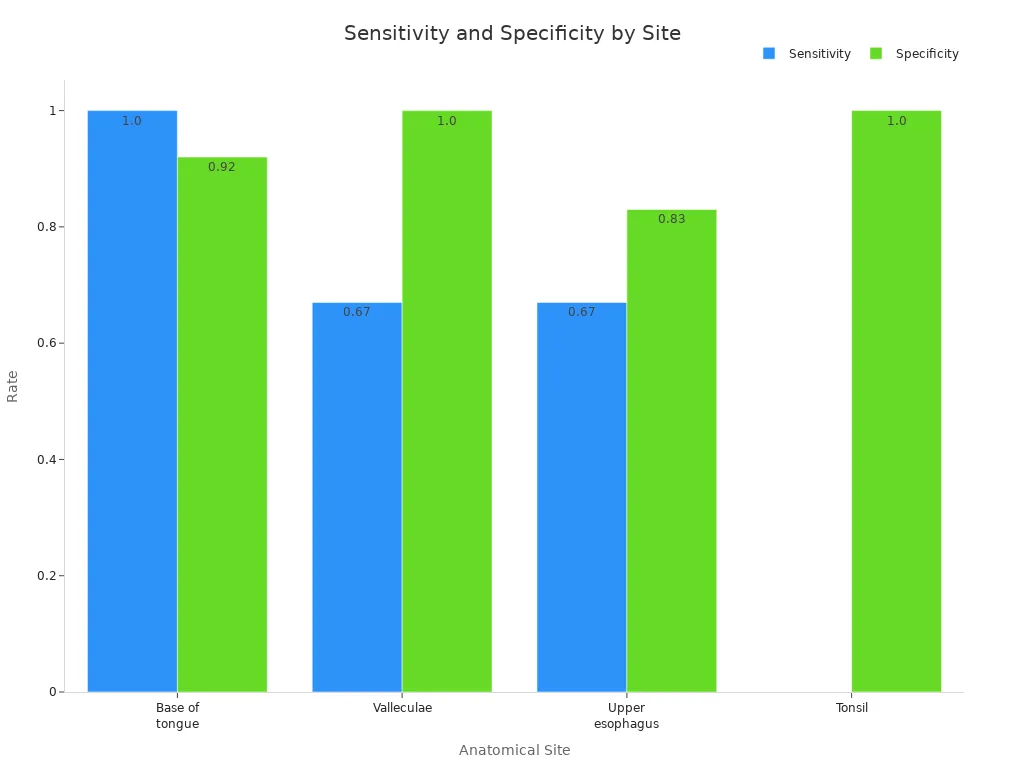
Modern detection systems achieve high sensitivity and specificity, but performance varies by anatomical site and technology. The following table summarizes reported rates:
| Site | Sensitivity (95% CI) | Specificity (95% CI) |
|---|---|---|
| Base of tongue | 1.00 (0.44–1.00) | 0.92 (0.65–0.99) |
| Valleculae | 0.67 (0.21–0.94) | 1.00 (0.76–1.00) |
| Upper esophagus | 0.67 (0.21–0.94) | 0.83 (0.55–0.95) |
| Tonsil | 0.00 (0.00–0.56) | 1.00 (0.76–1.00) |
| Overall Accuracy | 66.67% (38.38–88.17) | N/A |
Speed and Throughput
Manufacturers require rapid inspection to maintain production efficiency. Dual-lane x-ray systems double output or allow simultaneous processing of different products. These systems reduce bones in boneless seafood to nearly zero, supporting high-volume operations.
Tip: Upgrading to advanced x-ray inspection systems increases reliability and simplifies maintenance for processing plants.
Depth and Size Limitations
Detection effectiveness depends on bone size, composition, and depth. CT imaging nearly reaches 100% accuracy for calcified bones, especially with thin slices. However, non-calcified or deeply embedded bones remain challenging. Enhanced imaging and multiplanar reconstruction improve identification, but some fragments may escape detection.
Real-World Case Studies
A study analyzing 126 patients demonstrated AI models correctly identified 12 out of 20 cases of bone impaction. Some cases were missed due to obscured or out-of-field bones. In industry, the Eagle x-ray machine reduced bones in boneless products to almost zero and increased throughput with dual-lane systems. Companies plan to prioritize x-ray systems for future upgrades due to their reliability and ease of use.
Innovations and Future Trends in Fish Bone Detection

Advances in AI Algorithms
Recent developments in artificial intelligence have transformed fish bone detection. Deep learning models now outperform traditional methods in sensitivity, specificity, and accuracy. The following table highlights these improvements:
| Metric | AI Model | Traditional Methods |
|---|---|---|
| Sensitivity | 96% | N/A |
| Specificity | 90% | N/A |
| Accuracy | 93% | N/A |
These advancements allow systems to identify even the smallest bones, reducing the risk of contamination and improving overall product quality.
Integration with Production Lines
Modern processing plants integrate detection systems directly into automated production lines. Marel’s SensorX Fish system detects bones in whitefish fillets, ensuring food safety and reducing customer complaints. TDI Packsys offers high-configuration x-ray systems that find bones as small as 0.2mm x 2mm, available in both manual and automated setups. Hyperspectral imaging also enhances detection capabilities, supporting consistent quality control throughout the production process.
Emerging Imaging Methods (e.g., Terahertz Imaging)
Researchers continue to explore new imaging technologies. A study by Hu et al. demonstrated that terahertz imaging and spectroscopy can detect fish bones and other foreign bodies with an accuracy of 99.56%. This method uses advanced algorithms to extract spectral features, providing rapid and non-destructive detection. Terahertz images clearly illustrate foreign objects, confirming the potential of this technology for future fish bone detector systems.
Industry Adoption and Impact
Widespread adoption of advanced detection technologies has significantly reduced food contamination risks. Manufacturers now identify and eliminate contaminants more effectively, which lowers the frequency of product recalls and enhances consumer safety. Experts stress that rigorous standards and proactive detection protect both consumers and brand reputation.
Fish bone detector systems improve seafood safety and quality. Advanced X-ray inspection and efficient processing methods support industry growth. Supermarkets demand bone-free products, driving innovation. The table below highlights projected trends in fish bone detection technology.
| Trend/Technology | Description |
|---|---|
| Market Growth | The global seafood market is projected to reach $134 billion by 2026. |
| X-ray Inspection | Advanced X-ray methods detect smaller bones, improving safety and quality. |
| Processing Efficiency | Technologies enhance processing efficiency and quality standards. |
| Consumer Demand | Supermarkets push for bone-free products, increasing need for detection. |
FAQ
How do fish bone detectors identify bones in processed fish?
Fish bone detectors use imaging technologies like X-ray, Raman, and UV fluorescence. These systems analyze density, molecular composition, or fluorescence to locate bones.
What is the smallest bone size modern detectors can find?
Advanced X-ray systems detect bones as small as 0.2mm x 2mm. Detection accuracy depends on bone composition, depth, and the technology used.
Are fish bone detectors safe for food products?
Manufacturers design fish bone detectors for non-destructive inspection. These systems do not alter fish quality or safety during the detection process.
See Also
Is It Worth Investing in Automated Virus Sampling Lines?
Three Methods to Enhance System Performance with PHE Plates
How Computer Chips Showcase the Designers' Creative Talents