Duplex 2507 vs UNS S32750 Flanges What's the Real Difference
Engineers in demanding industries like oil and gas, chemical processing, and seawater desalination often specify a high-performance material with two names. Duplex 2507 is the common trade name, while UNS S32750 is its official designation in the Unified Numbering System. This creates a frequent point of confusion. The selection between Duplex 2507 Flanges and UNS S32750/ S32760 Flange involves different considerations than for SS 904L Flanges.
Note: For flange selection, the two designations are identical. A flange specified as Duplex 2507 is completely interchangeable with one specified as UNS S32750.
Key Takeaways
- Duplex 2507 and UNS S32750 are the same material. Duplex 2507 is a trade name. UNS S32750 is its official name.
- UNS S32760 is a special type of super duplex steel. It has added tungsten and copper. These additions help it resist strong acids better than S32750.
- Engineers choose S32750 for many tough jobs. They pick S32760 for very harsh places. These include areas with strong acids or extreme salt water.
- Always check a Material Test Report (MTR). This report shows the material's exact details. It makes sure the flange is correct and safe for use.
The Name Game: Why Two Names for One Material?
The existence of two names for a single alloy often causes confusion, but this practice is standard in the metals industry. Each name serves a distinct purpose. One name provides marketing clarity and ease of use, while the other offers precise technical identification for global standardization. Understanding both is key to accurate material specification.
What is a Trade Name?
A trade name is a commercial brand name assigned by a manufacturer to make a product memorable and easy to identify. "Duplex 2507" is a classic example. This name is far simpler to recall and communicate in daily operations than its lengthy official designation. It effectively brands the material, highlighting its key features in a concise format that resonates with engineers, purchasers, and fabricators.
What is a UNS Number?
The Unified Numbering System (UNS) provides a standardized method for identifying metals and alloys. The system's administration is a shared responsibility between SAE International and ASTM International. A UNS number eliminates ambiguity across different suppliers, standards, and countries.
The designation for stainless steels follows a specific structure:
- It begins with the prefix letter 'S'.
- A five-digit number follows, placing the material in the heat and corrosion-resistant category (
S00001toS99999).
For UNS S32750, the 'S' identifies it as a stainless steel, and '32750' is its unique identifier within that category. This system ensures that a flange specified as S32750 meets a precise chemical and mechanical profile, regardless of the manufacturer.
Decoding '2507'
The trade name '2507' is more than just a random number; it is a clever shorthand for the alloy's primary composition. This naming convention gives engineers a quick insight into the material's fundamental properties.
The numbers directly reference the nominal percentages of two critical alloying elements:
- 25: Indicates an approximate 25% Chromium (Cr) content.
- 07: Refers to an approximate 7% Nickel (Ni) content.
This simple code immediately communicates the high chromium and nickel levels that give this super duplex grade its exceptional strength and corrosion resistance.
Identical Twins: Comparing 2507 and S32750
Since Duplex 2507 and UNS S32750 are the same material, their technical specifications are identical. A deep dive into their chemical composition, mechanical properties, and corrosion resistance confirms that there is no difference between them. Any flange manufactured to one designation meets the exact requirements of the other.
Chemical Composition Breakdown
The performance of any alloy begins with its chemical recipe. For UNS S32750, a precise balance of elements creates its signature duplex microstructure and superior properties. The material specification, such as ASTM A182 for flanges, dictates strict percentage ranges for these key elements.
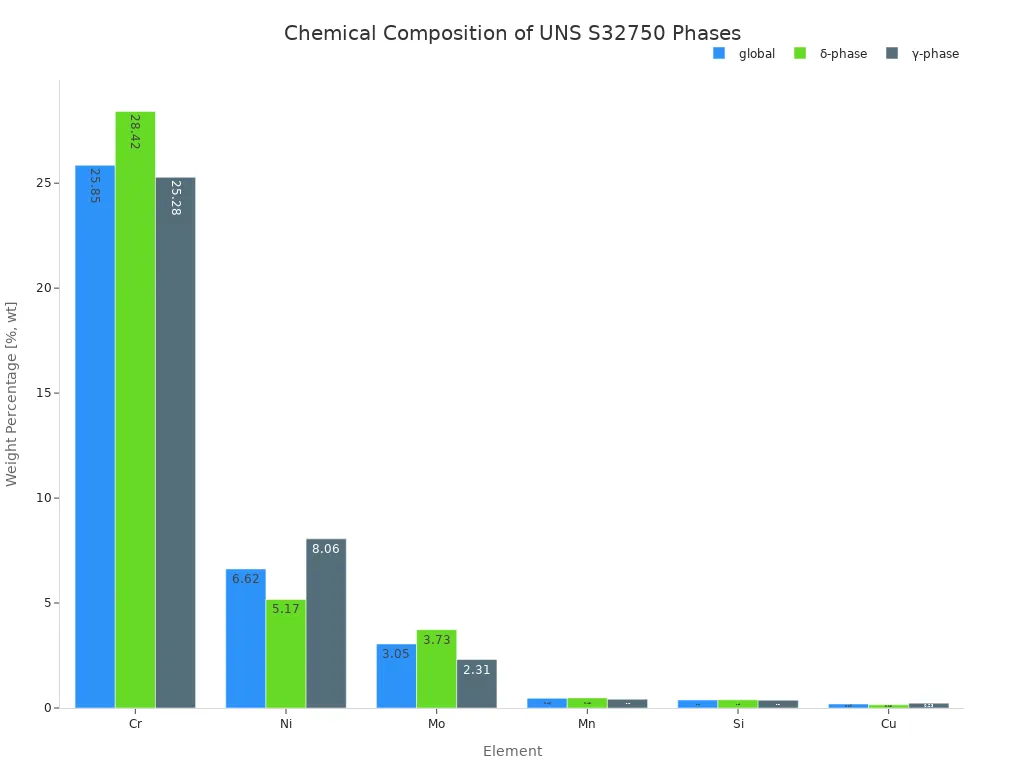
These elements work together to form a "duplex" microstructure, which is a balanced mix of austenite and ferrite phases.
- Chromium (Cr) and Molybdenum (Mo) are ferrite formers, enhancing strength and resistance to pitting corrosion.
- Nickel (Ni) and Nitrogen (N) are austenite formers, improving weldability and general corrosion resistance.
This elemental partitioning is fundamental to the alloy's performance. The ferrite phase contains higher concentrations of Chromium and Molybdenum, while the austenite phase is richer in Nickel. This balanced structure gives the material the best of both worlds: the strength of ferritic steels and the corrosion resistance of austenitic steels.
Mechanical Strength and Hardness
Super duplex 2507 / S32750 flanges deliver exceptional mechanical strength. Their high yield strength is often more than double that of common austenitic stainless steels like 304 or 316. This superior strength allows engineers to design lighter and more compact piping systems without compromising on safety or pressure-handling capabilities.
The minimum mechanical properties for UNS S32750 are clearly defined in international standards.
Key Strength Metrics for UNS S32750
- Tensile Strength: The maximum stress a material can withstand before breaking.
- Yield Strength: The stress at which the material begins to deform permanently.
This high strength, combined with excellent ductility and toughness, makes S32750 flanges a reliable choice for high-pressure and high-stress applications.
Corrosion Resistance (PREN Value)
A key measure of a stainless steel's resistance to localized pitting corrosion is its Pitting Resistance Equivalent Number (PREN). This value is calculated from the alloy's chemical composition. For duplex stainless steels, the industry widely accepts the following formula:
PREN = %Cr + 3.3(%Mo) + 16(%N)
This formula highlights the critical roles of Chromium, Molybdenum, and Nitrogen in fighting corrosion.
What makes it "Super"? 💡 To be classified as a "super duplex" stainless steel, a material must have a PREN value of 40 or higher. This high PREN indicates outstanding resistance to pitting and crevice corrosion, especially in chloride-rich environments like seawater, brine, and chemical processing streams.
With its high concentrations of Cr, Mo, and N, Duplex 2507 / UNS S32750 easily exceeds this threshold. Its typical PREN value ranges from 40 to 45, confirming its status as a top-tier material for the most demanding service conditions.
Meet the Cousin: Introducing UNS S32760
While Duplex 2507 and UNS S32750 are identical, the super duplex family has another important member: UNS S32760. This grade is a close relative, often considered a specialized "cousin" to S32750. It shares the same high-strength, corrosion-resistant foundation but includes specific elemental modifications. These changes give it an edge in certain highly aggressive service environments where S32750 might not be the optimal choice.
What Makes S32760 Different?
The primary distinction between UNS S32750 and UNS S32760 lies in the chemical composition. UNS S32760 builds upon the S32750 recipe of chromium, nickel, and molybdenum. It then introduces small but significant additions of tungsten (W) and copper (Cu). These elements are not accidental; engineers include them to enhance performance against specific corrosive threats. This makes S32760 a targeted solution for some of the most challenging industrial applications, particularly those involving high-salinity and highly acidic conditions.
The Role of Tungsten (W)
Tungsten is a powerful alloying element that bolsters the material's defenses. The addition of tungsten, typically between 0.5% and 1.0% by weight, directly improves the alloy's resistance to localized corrosion. It works alongside chromium and molybdenum to increase the material's overall robustness.
Enhanced Performance Metrics 📈 The inclusion of tungsten helps UNS S32760 achieve a Pitting Resistance Equivalent Number (PREN) of at least 40. This signifies superior resistance to pitting and crevice corrosion. It also contributes to the alloy's high mechanical strength, with a typical yield strength reaching up to 600 MPa.
The Impact of Copper (Cu)
The addition of copper provides a significant boost to the alloy's performance, especially in acidic environments. Copper makes UNS S32760 particularly effective at resisting corrosion from non-oxidizing acids, a known challenge for many stainless steels. This makes it an ideal choice for critical infrastructure in chemical processing plants.
Key benefits from the copper addition include:
- Enhanced resistance to reducing acids like sulfuric and phosphoric acid.
- Superior performance in sour service (H₂S) environments.
- Improved resistance to erosion-corrosion, especially in very hot seawater.
This targeted enhancement makes UNS S32760 flanges a premier choice for highly concentrated acidic process streams where other grades may fall short.
Performance Showdown: S32750 vs. S32760
Choosing between UNS S32750 and UNS S32760 requires a detailed look at their performance in specific conditions. While both are premier super duplex grades, their minor compositional differences create distinct advantages. This showdown compares their resistance to corrosion, behavior in aggressive chemicals, and fabrication characteristics.
Pitting and Crevice Corrosion
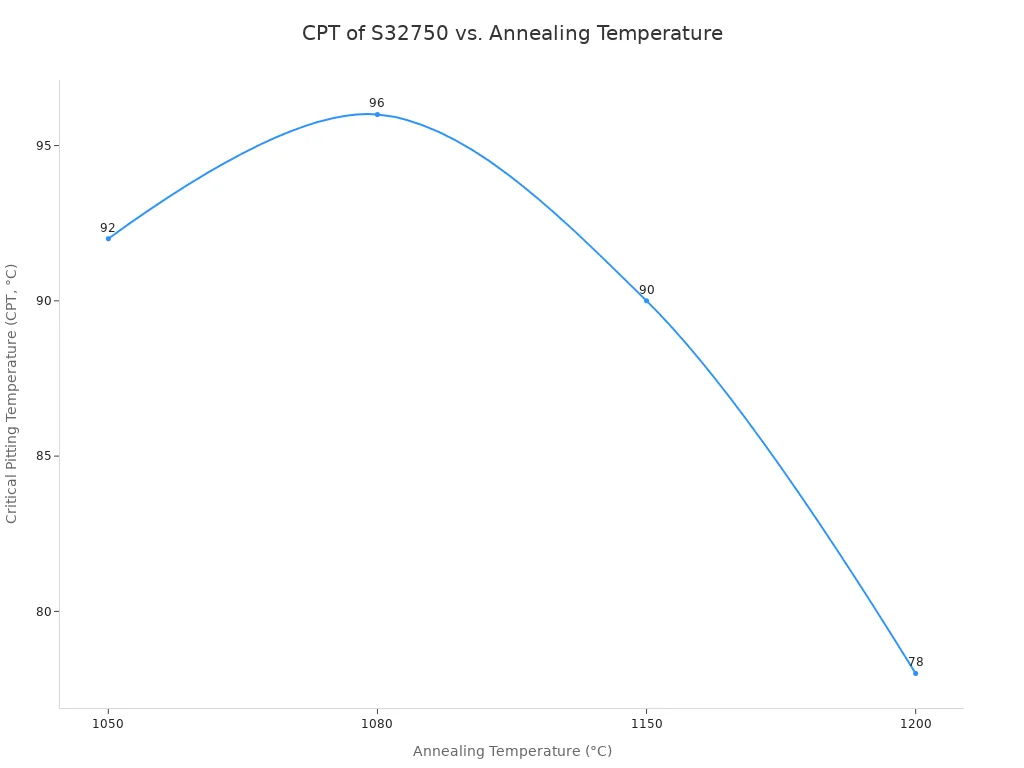
Both S32750 and S32760 offer elite resistance to pitting and crevice corrosion, a primary reason for their use in chloride-rich environments. A key metric for this is the Critical Pitting Temperature (CPT). The CPT is the lowest temperature at which pitting corrosion begins in a standardized chloride solution.
For UNS S32750, the CPT is highly dependent on the heat treatment process, specifically the annealing temperature. Proper heat treatment optimizes the alloy's microstructure, maximizing its corrosion resistance.
| Material | Annealing Temperature (°C) | CPT (°C), 1 M NaCl |
|---|---|---|
| S32750 | 1050 | 92 |
| S32750 | 1080 | 96 |
| S32750 | 1150 | 90 |
| S32750 | 1200 | 78 |
As the data shows, an annealing temperature around 1080°C yields the highest CPT for S32750. Deviating from this optimal temperature can reduce the material's resistance.
For crevice corrosion, industry standards like ASTM G48 provide a rigorous testing framework.
ASTM G48 Test for Super Duplex Steels
- Test Temperature: Weld samples are typically tested at 40°C.
- Duration: A 24-hour test is common for super duplex products.
- Acceptance Criteria: The material passes if there is no pitting observed under 20X magnification and the weight loss is less than 1.5 g/m².
Both S32750 and S32760 are expected to meet these stringent requirements, confirming their suitability for services where crevices (like those under flange gaskets) are unavoidable.
Resistance to Aggressive Chemicals
The most significant performance difference between S32750 and S32760 appears in their resistance to certain aggressive chemicals. This is where the targeted additions of tungsten and copper in S32760 make a crucial impact.
UNS S32760 demonstrates superior performance over UNS S32750 in reducing acids, most notably sulfuric acid. The copper content (0.5–1.0%) in S32760 is specifically included to enhance resistance against these types of acids. This makes S32760 flanges a more robust choice for chemical processing streams involving sulfuric or phosphoric acid, where S32750 might be more susceptible to corrosion. The tungsten in S32760 further bolsters its defense against localized corrosion in these harsh chemical environments.
Weldability and Fabrication
Proper welding and fabrication procedures are critical to maintaining the integrity of super duplex stainless steels. Both S32750 and S32760 follow similar best practices.
Welding Temperature Control is Key 🌡️ Preheating is generally not required for either alloy, except to remove condensation from cold metal surfaces. The most critical parameter is the interpass temperature, which is the temperature of the workpiece between welding passes. This temperature should not exceed 150°C (300°F), with some procedures recommending a stricter limit of 100°C. Exceeding this limit risks the formation of brittle intermetallic phases that degrade both mechanical properties and corrosion resistance.
After welding, a Post-Weld Heat Treatment (PWHT) is often essential to restore the material's properties. The heat from welding can disrupt the balanced austenite-ferrite microstructure in the weld and the heat-affected zone (HAZ). PWHT corrects this imbalance.
A proper PWHT cycle for S32750:
- Restores the optimal phase balance.
- Redistributes alloying elements.
- Improves pitting corrosion resistance, toughness, and strength.
The specific temperature and duration depend on the welding method used.
| Welding Process | Heat Treatment Temperature | Duration | Key Outcome |
|---|---|---|---|
| Laser Beam Welding (LBW) | 1050 °C | 2 hours | Increases austenite, improves corrosion resistance. |
| Submerged Arc Welding (SAW) | 1100 °C | 1 hour | Achieves acceptable phase ratio and pitting resistance. |
| Gas Tungsten Arc Welding (GTAW) | 1080 °C | 3 minutes | Optimizes phase balance and delivers the best pitting resistance. |
Following PWHT with rapid cooling, such as water quenching, is vital. Slow cooling can cause the precipitation of the detrimental sigma phase, which severely compromises corrosion resistance.
Choosing the Right Super Duplex 2507 Flanges
Selecting the correct super duplex grade is a critical engineering decision. The choice between UNS S32750 and UNS S32760 depends entirely on the specific service environment, project budget, and supply chain considerations. Making the right choice ensures long-term asset integrity and operational safety.
When to Use Duplex 2507 / S32750
Engineers specify Duplex 2507 / S32750 as the default high-performance solution for a vast range of demanding industries. Its excellent combination of high strength and broad corrosion resistance makes it a reliable and cost-effective choice. These Duplex 2507 Flanges are the standard for applications where resistance to chloride-rich media is paramount.
Key industries rely on S32750 for its proven performance. It is the go-to material for:
- Oil and Gas Sector: Used in offshore platforms, heat exchangers, and process water systems.
- Desalination Plants: Essential for high-pressure reverse osmosis (RO) equipment and seawater piping.
- Chemical Processing: Applied in pressure vessels, piping, and reactors handling various chemicals.
- Marine Applications: Utilized for its superior resistance to seawater corrosion.
- Power Generation: Found in Flue Gas Desulfurization (FGD) systems and industrial scrubbers.
When to Specify UNS S32760
Project specifications call for UNS S32760 when the service conditions exceed the capabilities of S32750. This grade is a specialized problem-solver for the most aggressive environments. The additions of tungsten and copper give it a distinct advantage in specific corrosive scenarios.
Engineers should specify UNS S32760 for:
- Aggressive Chemical Service: Environments containing reducing acids like sulfuric or phosphoric acid.
- Extreme Chloride Conditions: Subsea equipment and seawater handling systems where erosion-corrosion is a concern.
- High-Pressure and High-Temperature Projects: Applications where maximum resistance to pitting and crevice corrosion is non-negotiable.
Cost and Availability in 2025
Looking ahead to 2025, market dynamics continue to influence material selection. Duplex 2507 / S32750 remains the more widely produced and readily available super duplex grade. This generally translates to a lower cost and shorter lead times for standard Duplex 2507 Flanges.
In contrast, UNS S32760 is a specialty alloy with fewer manufacturers. Its enhanced composition and lower production volume typically result in a higher price point and longer delivery schedules. Project managers must factor these commercial aspects into their procurement strategy, especially for time-sensitive projects.
How to Verify Your Material
Confirming the authenticity of a super duplex flange is a non-negotiable step in quality assurance. Engineers rely on a clear documentation trail and physical markings to guarantee that the material received matches the project specifications. This verification process protects against material substitution and ensures asset integrity.
Reading a Material Test Report (MTR)
The Material Test Report (MTR) is the cornerstone of material verification. This formal document, certified by the manufacturer, provides a complete summary of the material's properties. An MTR compliant with standards like EN 10204 3.1 gives engineers the data needed to confirm a flange meets all requirements.
An MTR must include specific details for proper validation:
- Chemical Analysis: A breakdown of the alloy's elemental percentages.
- Mechanical Properties: Critical data such as Tensile Strength, Yield Strength, Hardness, and Toughness.
- Heat Treatment Processes: Information on procedures like annealing or quenching.
- Material Grade and Dimensions: Confirmation of the specified grade and size.
Key ASTM Standards for Flanges
ASTM International standards provide the technical rules for manufacturing flanges. ASTM A182 is a key standard governing forged or rolled alloy steel pipe flanges, fittings, and parts for high-temperature service. This standard specifies the requirements for super duplex grades like ASTM A182 Gr. F53 (UNS S32750) and F55 (UNS S32760). It covers a wide range of flange types, ensuring consistent quality for components like:
- Socketweld and Slip On Flanges
- Blind and Threaded Flanges
- Weld Neck and RTJ Flanges
Adherence to ASTM A182 ensures that a flange has the correct chemistry, mechanical strength, and heat treatment for its intended application.
Ensuring Full Traceability
Full traceability links a finished flange back to its origin. The key to this process is the Heat Number. This unique code, assigned by the mill during the melting process, acts as a fingerprint for a specific batch of steel. Manufacturers physically mark the heat number on each flange using methods like stamping or etching. This number directly corresponds to the MTR, allowing anyone to trace the component from the job site back to its metallurgical birth certificate. This unbroken chain of custody is essential for quality control and compliance.
Engineers can specify Duplex 2507 and UNS S32750 interchangeably, as they are the same material. The critical choice is between UNS S32750 and UNS S32760, which depends on the service environment. For the most severe conditions, UNS S32760 provides superior durability for Duplex 2507 Flanges.
Key Advantages of UNS S32760
- It contains copper and tungsten for enhanced corrosion resistance.
- It offers a higher pitting resistance equivalent number (PREN > 40).
- It is better suited for severe chloride environments like subsea pipelines.
Ultimately, project teams must always verify specifications for Duplex 2507 Flanges with a Material Test Report (MTR) to ensure compliance and safety.
FAQ
What is the difference between Duplex 2507 and UNS S32750?
There is no difference. Duplex 2507 is the common trade name for the material officially designated as UNS S32750. A flange specified with one name is completely identical and interchangeable with the other, sharing the exact same chemical and mechanical properties.
When should engineers choose UNS S32760 over S32750?
Engineers specify UNS S32760 for more aggressive service conditions. Its added tungsten and copper provide superior resistance to reducing acids like sulfuric acid. This makes it the preferred choice for highly corrosive chemical processing and extreme subsea applications where S32750 may be insufficient.
Why is a Material Test Report (MTR) essential for flanges?
A Material Test Report (MTR) is the primary quality assurance document. It provides certified proof of a flange's chemical analysis and mechanical strength. Engineers rely on the MTR to verify that the material meets all project specifications, ensuring asset integrity and operational safety.
What makes a duplex stainless steel "super"?
A duplex stainless steel achieves "super" status when its Pitting Resistance Equivalent Number (PREN) is 40 or higher.
PREN = %Cr + 3.3(%Mo) + 16(%N)
This high PREN value signifies elite resistance to localized corrosion, particularly pitting and crevice corrosion in chloride-rich environments like seawater.
See Also
Mastering Pass Partition Plate Welding: Expert Strategies for 2025 Success
Hygienic Design Standards: A Comparison of EHEDG and 3A SSI Guidelines
Assessing Molybdenum Plugs: Enhancing Seamless Steel Pipe Production in 2025
Industrial Applications: A 2025 Guide to Semi-Welded Plate Heat Exchangers
Comparing Top-Tier End Plates for Optimal AR-15 Rifle Performance