Top reasons to use a dumpling machine in 2026
The dumpling machine transforms commercial kitchens and home cooking. Industry reports highlight rapid adoption as the dumplings market is projected to reach $56.05 billion in 2026.
- Market analysts expect a 12.7% CAGR for fully automatic dumpling machines, reflecting increased demand for efficiency and quality in food preparation.
Dumpling Machine Efficiency and Quality
Faster Production and Labor Savings
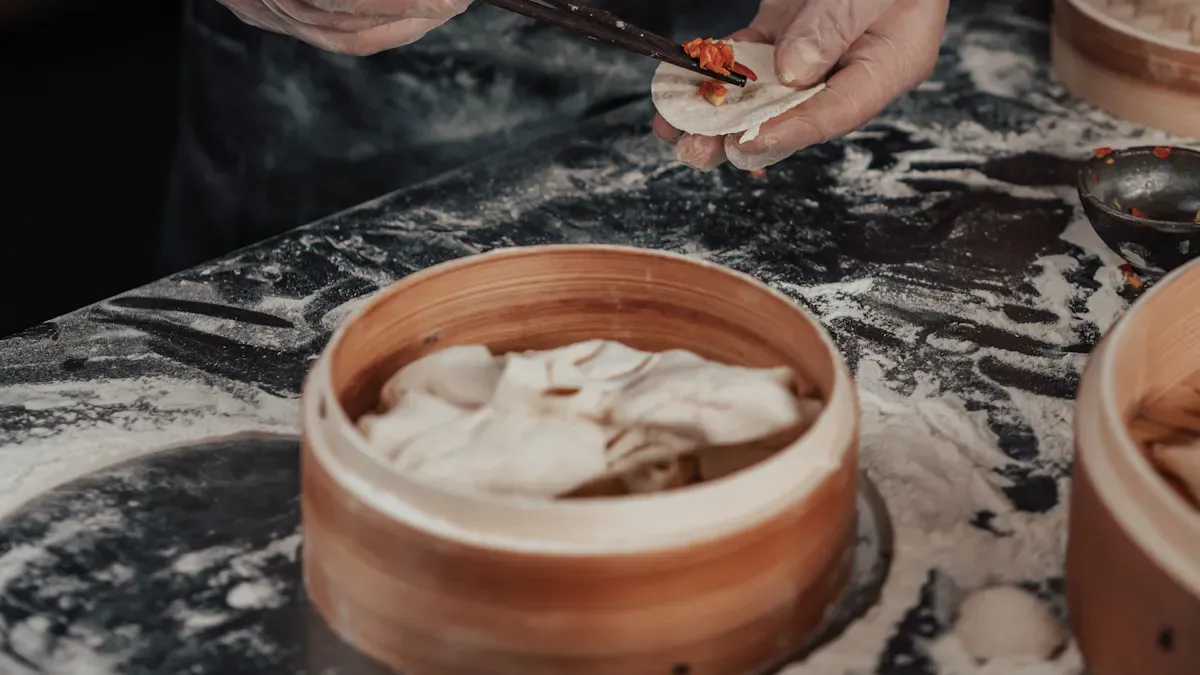
A dumpling machine dramatically increases production speed in both commercial and home kitchens. Operators can prepare large batches of dumplings in a fraction of the time required for manual methods. Recent studies show that a dumpling machine can reduce preparation time by up to 70%. Manual dumpling making often takes three to four hours, while a machine can complete the same task in under an hour.
- Kitchens can serve more customers during peak hours.
- Staff can focus on other essential tasks, improving overall workflow.
- Businesses can reduce labor costs and minimize fatigue among workers.
This efficiency allows restaurants and catering companies to meet high demand without sacrificing quality or consistency.
Consistent Size and Shape Every Time
Uniformity in dumpling production is critical for both presentation and cooking quality. A dumpling machine ensures each piece meets exact specifications, regardless of operator skill level. The following table highlights the differences between machine-made and handmade dumplings:
| Feature | Dumpling Machine | Handmade Dumplings |
|---|---|---|
| Dough Thickness | Precise control | Variable based on skill |
| Filling Proportion | Maintained accuracy | Inconsistent |
| Sealing Pressure | Stable and controlled | Dependent on technique |
| Size and Shape Consistency | Uniform and standardized | Varies with each dumpling |
Uniform dough thickness and accurate filling proportion guarantee even cooking and a professional appearance. Stable sealing pressure prevents leaks and maintains the integrity of each dumpling. Consistent shape and size also help with portion control and customer satisfaction.
Customizable Settings for Different Dumplings
Modern dumpling machines offer a wide range of customization options to suit various culinary needs. Operators can adjust settings to create different dumpling styles, shapes, and sizes. The following table outlines some of the most common customization features:
| Customization Feature | Description |
|---|---|
| Adjustable Size & Shape | Interchangeable molds or adjustable settings for different dumpling styles |
| Filling Flexibility | Variable filling pumps for a wide range of fillings without clogging |
| Dough Thickness Control | Adjustable dough thickness for thin or thick-skinned dumplings |
| Multi-Function Models | Ability to produce buns, bao, spring rolls, or empanadas, enhancing product diversity |
Customizable settings allow restaurants to cater to diverse consumer preferences and dietary needs. Operators can adjust size, shape, dough type, and filling options, which enhances production flexibility. These features help small producers preserve traditional recipes while meeting market demand. Catering companies can prepare large quantities with consistent quality, reducing stress during events and allowing for menu customization.
Tip: Customizable dumpling machines enable chefs to experiment with new recipes and adapt quickly to changing trends in the food industry.
Dumpling Machine Convenience and Versatility
Easy Operation and Simple Maintenance
Modern dumpling machines feature intuitive controls and ergonomic designs that simplify operation for users at any skill level. Manufacturers equip these machines with only four operation buttons, allowing staff to master the process with minimal training. The following table highlights the user-friendly features that streamline daily use:
| Feature | Description |
|---|---|
| Ergonomic Design | The machine features only four operation buttons, making it user-friendly. |
| Simplified Controls | Minimal training is required for production personnel to learn operation. |
| Efficient Cleaning Mechanism | Tool-free quick-disassembly design allows for easy cleaning in under 30 minutes. |
Cleaning and maintenance require less time compared to traditional equipment. Many commercial models include removable parts that are dishwasher-safe, which further reduces downtime and labor. The ease of cleaning and maintenance plays a significant role in machine selection for busy kitchens.
- Removable parts allow for quick disassembly and thorough cleaning.
- Dishwasher-safe components save time and ensure hygiene.
Tip: Regular cleaning not only extends the machine’s lifespan but also maintains food safety standards.
Enhanced Food Safety and Hygiene
Food safety remains a top priority in any kitchen. Dumpling machines use materials that facilitate easy cleaning and sanitization, which significantly reduces the risk of contamination. Automation minimizes human contact with ingredients, creating a safer environment for food preparation. Automated filling systems eliminate manual handling during critical production phases, lowering the risk of contamination and supporting compliance with food safety regulations.
Smooth, seamless surfaces and rounded corners prevent food particle accumulation. These design elements help operators maintain strict hygiene standards with less effort.
Multiple Dumpling Types and Cooking Methods Supported
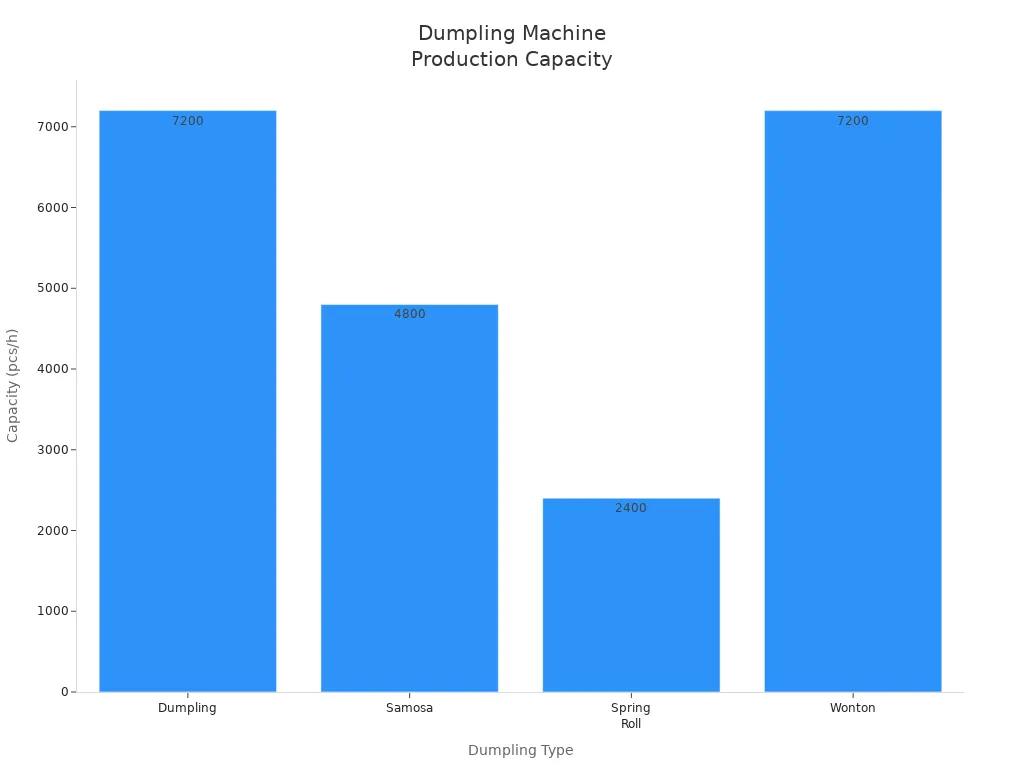
Versatility stands out as a defining feature of advanced dumpling machines. Operators can produce a wide range of dumpling types, including dumplings, samosas, spring rolls, and wontons, all with a single model. The table below demonstrates the impressive production capacity for each type:
| Dumpling Type | Capacity (pcs/h) |
|---|---|
| Dumpling | 7200 |
| Samosa | 4800 |
| Spring Roll | 2400 |
| Wonton | 7200 |
Dumpling machines also support multiple cooking methods. Operators can choose frying for snacks or fast food, or steaming for dim sum and ready-to-eat meals. The following table summarizes the supported cooking methods:
| Cooking Method | Description | Applications |
|---|---|---|
| Frying | Automated frying with consistent browning | Fast food, snacks |
| Steaming | High capacity for various types of dumplings | Dim sum, ready-to-eat |
This flexibility allows businesses to expand their menus and adapt to changing consumer preferences.
Space-Saving, Durable, and User-Friendly Design
Manufacturers design dumpling machines to fit seamlessly into kitchens of all sizes. Compact footprints maximize output even in limited spaces. The table below lists the dimensions and weights of popular models suitable for small kitchens:
| Model | Weight (kg) | Dimensions (mm) |
|---|---|---|
| CMJ-210 | 330 | 2220 x 700 x 1300 |
| JGB-10 | 550 | 1360 x 1480 x 1400 |
| CMJ-160 | 157 | 1675 x 590 x 1015 |
| XSJ10A | 550 | 1360 x 1550 x 1400 |
| XSJ10A | 650 | 1400 x 1660 x 1600 |
Durability comes from high-grade stainless steel construction, which resists corrosion and stands up to heavy use. Hygienic designs with smooth surfaces and rounded corners prevent food buildup. Modular components allow for quick disassembly and thorough cleaning. Integrated features such as smart sensors, auto-shutdown, and jam detection enhance safety and efficiency. Some models even offer self-cleaning modes, reducing manual labor further.
Note: Space-saving and user-friendly designs make these machines ideal for both large commercial kitchens and smaller establishments.
Dumpling machines deliver higher productivity, consistent quality, and unmatched convenience. Businesses report streamlined operations and reduced labor costs. The table below highlights key productivity improvements:
| Productivity Improvement | Description |
|---|---|
| Automation | Streamlines production and boosts output rates. |
| Enhanced Operational Efficiency | Reduces labor costs and meets rising demand. |
| Innovations in Machine Design | Offers adjustable filling and multi-shape features. |
Growing consumer demand for convenience foods drives adoption. Modern machines support hygiene standards and smart technologies. Every kitchen can benefit from easier, faster dumpling making.
FAQ
How many types of dumplings can a dumpling machine produce?
A dumpling machine can produce various types, including classic dumplings, wontons, siomai, and lace skirt gyoza. Operators can switch molds for different shapes.
Is cleaning a dumpling machine difficult?
Most modern dumpling machines feature tool-free disassembly. Staff can clean all parts quickly. Many components are dishwasher-safe, which saves time and ensures hygiene.
Can a dumpling machine handle different cooking methods?
Yes. The machine supports boiling, steaming, and frying. Operators can prepare dumplings for diverse menus and customer preferences.
See Also
Top Folder Gluer Innovations for Carton Lines in 2025
Essential Industrial Vacuum Cleaners For Every Business in 2025
Key Capsule Checkweighers To Explore For 2025 Purchases
Benefits And Cost Breakdown Of Plate Packs For 2025
Enhancing Pharma Efficiency With Advanced Capsule Decapsulation Machines