DTF Printing Vs Screen Printing For Small Business Needs
Small businesses must weigh their printing options carefully. For small, custom, multi-color orders, dtf printing presents a versatile and cost-effective choice. The Digital Textile Printing Market Report forecasts a 13.8% annual growth, showing its rising importance. Conversely, screen printing provides better economies of scale for large, simple bulk orders.
Key Takeaways
- DTF printing is best for small orders and custom designs. It has low startup costs and no minimum order quantity. This makes it good for new businesses and personalized items.
- Screen printing is better for large orders with simple designs. It costs less per item when you print many. This method is good for uniforms and event merchandise.
- Consider your business needs to choose. DTF offers flexibility and design freedom. Screen printing offers cost savings for bulk production.
Cost Breakdown for Small Businesses
Analyzing costs is crucial for any small business. The financial implications of each printing method vary significantly based on initial investment and order volume.
Startup Investment and Equipment
Screen printing requires a substantial upfront investment. Businesses need to purchase screens, a screen press, exposure units, and various inks. Each new design color demands a separate screen, adding to the initial and ongoing costs. In contrast, a dtf printing setup generally has a lower entry cost. The primary equipment includes a specialized printer and a heat press, making it a more accessible option for startups.
Per-Item Cost for Small Batches
For small batches, DTF holds a clear financial advantage. The digital process has minimal setup, allowing businesses to print a single shirt or a small run without incurring high costs. This makes it ideal for custom orders and on-demand fulfillment. Screen printing is less cost-effective for small quantities. The labor and materials needed to prepare screens for just a few items make the per-item price prohibitively high.
Per-Item Cost for Large Volumes
The cost dynamic shifts with larger orders. Screen printing achieves excellent economies of scale. Once the screens are prepared, the cost per print drops significantly, making it the more profitable choice for bulk production. The tables below illustrate the price difference for a 500-unit order.
| Printing Method | Price Per Print |
|---|---|
| DTF | $2.00 - $5.00 |
| Screen Printing | $1.50 - $3.00 |
| Printing Method | Price Per Piece |
|---|---|
| DTF | $1.05 - $1.95 |
| Screen Printing | $0.60 - $1.20 |
Design Capabilities and Color Freedom
A printing method's design capabilities directly impact a small business's product offerings. The choice between DTF and screen printing often comes down to the complexity and color requirements of the artwork.
Handling Complex, Photorealistic Designs
DTF printing excels at producing photorealistic designs with high resolution and millions of colors. It is the perfect method for intricate, full-color artwork, offering virtually unlimited detail. This makes it ideal for businesses creating merchandise with complex imagery.
Popular Photorealistic DTF Products:
- Memorial shirts featuring detailed portraits of loved ones.
- Pet portraits on sweatshirts or tote bags.
- Landscape photography from vacation destinations.
- Realistic reproductions of fine art.
While designs are often created in a vibrant RGB color space, printers use a CMYK ink set. This means some ultra-bright colors, like neon greens, cannot be perfectly reproduced, a practical limitation for any print method.
Working with Limited Color Palettes
Screen printing is most efficient for designs with a limited color palette. Each color in a design requires its own screen, which adds significant setup costs. Print shops often charge a one-time fee of $15 to $30 per screen for each color, making multi-color jobs expensive. In contrast, the cost for a dtf printing transfer remains consistent regardless of the number of colors. The digital process prints the entire design in a single pass, eliminating screen-related labor and material costs.
Detail and Gradient Reproduction
The reproduction of fine details and smooth color transitions is a key differentiator. DTF is superior for handling gradients and intricate lines that screen printing cannot easily replicate. Screen printing struggles with smooth gradients and can suffer from registration errors when layering multiple colors, potentially causing misalignment. DTF technology, however, prints all colors simultaneously, ensuring crisp details and flawless gradients every time.
Why DTF Printing Excels for Small Orders
Direct-to-film (DTF) technology provides small businesses with unparalleled flexibility and efficiency. Its operational model is perfectly suited for custom work, on-demand production, and rapid fulfillment, giving startups a competitive edge.
On-Demand Fulfillment Model
The on-demand model allows businesses to print products only after a customer places an order. This approach minimizes inventory risk and upfront costs. An Austin-based Etsy brand, for example, shifted its top designs to bulk DTF transfers. This change reduced their fulfillment time from over a week to just 2–4 days. The faster delivery and higher print quality resulted in an 18% increase in repeat purchases, showing how automation and local fulfillment boost customer retention.
No Minimum Order Quantity
A significant advantage of dtf printing is the absence of minimum order quantities (MOQs). Screen printing requires extensive setup for each color, making single-item orders unprofitable. DTF, however, prints full-color designs in one pass. This allows a business to produce a single custom t-shirt just as cost-effectively as a small batch. This capability is essential for businesses offering personalization or testing new designs without financial risk.
Quick Turnaround for Custom Jobs
The streamlined digital workflow of DTF enables remarkably fast production times. With no screens to prepare or align, businesses can move from a digital file to a finished garment in minutes. This speed is a powerful asset for custom orders.
Case Study: San Diego Fashion Boutique
- Challenge: Needed a reliable partner for small-batch custom shirts with vibrant colors and fast shipping.
- Solution: A DTF provider offered same-day production for orders placed before 9 AM.
- Results: The boutique saw a 35% sales increase, achieved 100% customer satisfaction, and gained weekly repeat orders.
Durability, Feel, and Fabric Compatibility

The final product's quality depends on more than just looks. The print's feel, durability, and fabric compatibility are critical factors for customer satisfaction and brand reputation.
Print Feel on the Garment
Screen prints often feel softer on cotton garments. The ink partially absorbs into the fabric fibers, creating a finish that can be less noticeable to the touch. In contrast, dtf printing applies a thin, flexible film on top of the fabric. While modern DTF transfers are remarkably soft and lightweight, they typically have a distinct, smooth feel that sits on the material's surface rather than bonding with it.
Wash and Wear Longevity
Both methods produce durable prints when executed correctly. A high-quality plastisol screen print can easily last over 50 washes, often outliving the garment itself. Similarly, premium DTF prints can match this longevity, showing excellent resistance to cracking and fading. The primary vulnerability for DTF is potential edge peeling if the transfer is not pressed at the correct temperature and pressure.
Pro Tip: To maximize the life of any printed garment, wash it inside out with cold water and tumble dry on low heat. This simple step protects the print from abrasion and heat damage.
The table below compares the durability of properly applied prints.
| Test Criteria | Screen Printing (Properly Cured) | DTF Printing (Properly Pressed) |
|---|---|---|
| Wash Cycles Survived | 50+ | 50+ |
| Cracking Over Time | Low (on cotton) | Very Low |
| Fading Risk | Medium | Very Low |
| Peel Resistance | High | Very High |
Versatility Across Different Materials
Fabric compatibility is a major differentiator. Screen printing works best on cotton and cotton-poly blends. Printing on 100% polyester or other synthetic materials requires specialized inks and processes. DTF, however, offers superior versatility. The adhesive powder allows transfers to bond with a wide array of fabrics, including cotton, polyester, fleece, nylon, and even hard surfaces like wood, making it a more adaptable solution for diverse product lines.
Making the Final Decision
Selecting the right printing method is a strategic choice that directly impacts a small business's profitability, workflow, and brand potential. The final decision hinges on a company's specific business model, target market, and production volume.
Choose DTF for Your Business
A business should choose DTF printing if its model revolves around customization, e-commerce, and on-demand production. This technology is the superior choice for startups and brands that prioritize flexibility over bulk volume. DTF empowers entrepreneurs to launch product lines with minimal financial risk and cater to a market where personalization is key. A recent survey found that 47% of consumers are willing to pay more for customized products, a trend DTF directly serves.
The operational advantages make DTF a powerful tool for small-scale operations.
- No Minimum Orders: Businesses can profitably accept single-item orders, perfect for personalized gifts or testing new designs.
- Cost-Effective Small Batches: The minimal setup reduces production costs by up to 30% for small runs compared to screen printing.
- Quick Turnaround: A streamlined digital process allows print shops to fulfill custom orders in as little as 24 to 48 hours.
- Design Freedom: The technology flawlessly reproduces intricate, full-color graphics, gradients, and photorealistic images.
- Fabric Versatility: DTF transfers adhere to a wide array of materials, including cotton, polyester, nylon, and blends, expanding product possibilities.
From a financial standpoint, DTF offers a very accessible entry point and a clear path to profitability. Initial investments for a printer and heat press can range from $1,700 to $8,000. Despite these startup costs, the profit potential is significant.
Profit Snapshot: A DTF Operation 📈 With efficient workflow management, a small business can achieve a net profit of over $250 per hour. Operating the printer for just 120 hours a month could generate monthly profits approaching $30,000, with a break-even point of only about three hours of production time.
Understanding cost dynamics is crucial for pricing strategy. The table below shows how different factors influence a business's break-even point.
| Cost Component | How It Affects Break-Even Point |
|---|---|
| Fixed Costs | Higher fixed costs (rent, equipment) increase the break-even point. |
| Variable Costs | Higher material costs lower the profit per item, increasing the break-even point. |
| Sales Price | Raising prices can decrease the number of units needed to break even. |
Choose Screen Printing for Your Business
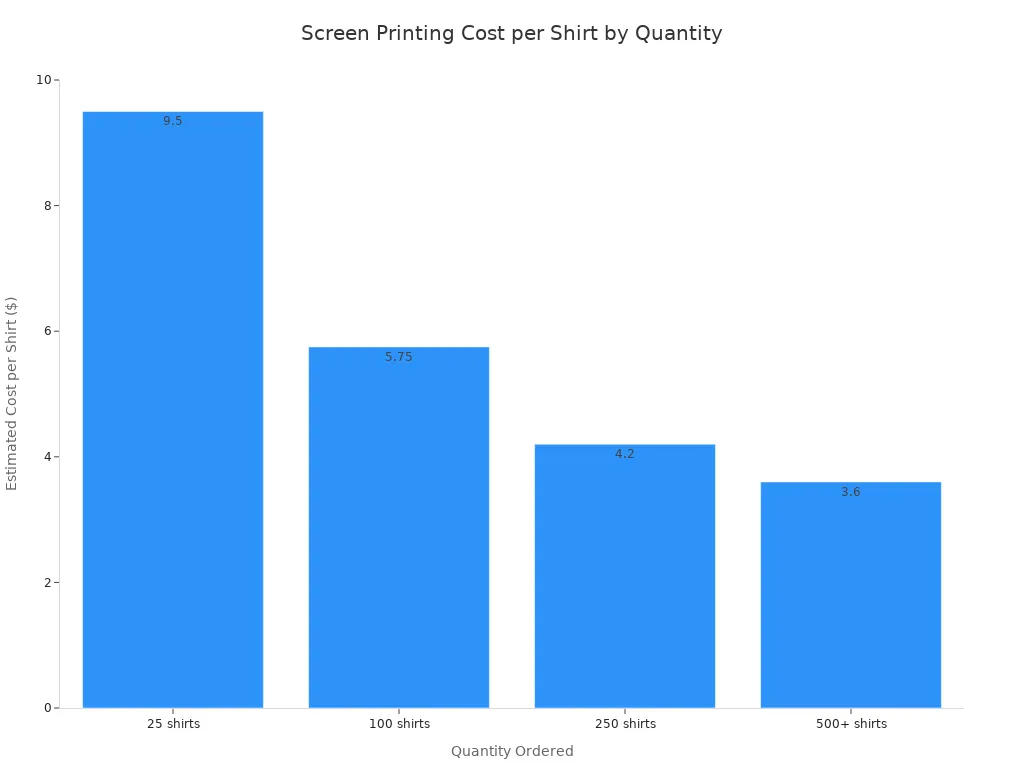
A business should choose screen printing when its core strategy involves high-volume orders with simple, consistent designs. This traditional method remains unmatched for companies that supply uniforms, event merchandise, or branded apparel in bulk. Its primary advantage is its economy of scale, where the cost per item decreases dramatically as the order quantity increases.
For example, investing in bulk printing can shrink the cost per unit by 20-40% or more. This makes screen printing the most profitable option for large production runs. The cost reduction is clear when looking at order quantities.
This pricing structure is ideal for businesses like breweries, bands, and corporations. For them, merchandise is a powerful marketing tool.
Breweries like Dying Breed Brewing and Last Call Brewing use screen-printed apparel to reflect their brand's "gritty, industrious vibe" and create "treasured keepsakes" for customers. Each shirt sold becomes a walking advertisement, extending brand reach far beyond the taproom.
Screen printing is the go-to for any business needing to place large, repeatable orders.
- Uniform Branding: It ensures perfect color and logo consistency across hundreds of garments, which is vital for a professional brand image.
- Event Merchandise: The process is built to handle large batches for concerts, festivals, and corporate events with fast turnaround times.
- Team Uniforms: The prints are highly durable and can withstand the rigors of athletic use, while reusable screens make reordering for new team members cost-effective.
For businesses focused on volume, screen printing delivers a superior return on investment by maximizing profit margins on each bulk order.
Startups and e-commerce stores find DTF printing ideal for its flexibility and low entry cost, perfect for personalized products. Conversely, businesses focusing on high-volume contracts will find screen printing more profitable. The global screen printing market's projected 16.5% CAGR from 2025 to 2032 highlights its enduring value. Aligning the printing method with a core business strategy ensures maximum efficiency.
FAQ
Which printing method is better for beginners?
DTF printing offers a simpler learning curve. It has fewer setup steps and less equipment to master compared to the multi-stage process of traditional screen printing.
Can DTF transfers be applied with a home iron?
A home iron is not recommended. A professional heat press provides the consistent temperature and even pressure needed for a durable, high-quality application that lasts.
How do the environmental impacts compare?
DTF printing generally produces less waste and uses water-based inks. Screen printing involves more chemicals for screen preparation and cleanup, creating a larger environmental footprint.
See Also
Automatic UV Coaters: Essential for High-Speed Printing Excellence
Top 6 Industrial Vacuums Every Business Needs to Consider
2025 Carton Lines: Trending Folder Gluer Features You Need
Custom Cargo Lifts: Weighing Pros and Cons for Your Business