Precision vs Price in Dried Onion Sorting
The global dehydrated onion market is expanding significantly, placing greater emphasis on product quality. Processors must choose the right dried onions sorting solution to compete. Optical sorters deliver superior precision for premium output. Mechanical graders, conversely, present a lower initial investment. This growth trend underscores the industry's potential.
| Metric | 2024 (USD Million) | 2032 (USD Million) | CAGR (%) |
|---|---|---|---|
| Global Dehydrated Onion Market | 751.31 | 1271.71 | 6.80 |
Comparing Defect Detection Capabilities

The fundamental difference between optical sorters and mechanical graders lies in their defect detection capabilities. One technology uses advanced imaging to analyze product quality at a granular level. The other relies on basic physical characteristics for separation. This distinction directly impacts final product quality, safety, and brand reputation.
Optical Sorters: Unmatched Precision
Optical sorters operate as a powerful line of defense for quality control. These machines use high-resolution cameras, specialized lighting, and intelligent software to inspect every piece of dried onion that passes through the line. They analyze the product stream in milliseconds, making decisions far faster and more accurately than any human inspector.
The true power of modern sorters comes from advanced imaging technologies like multispectral (MSI) and hyperspectral imaging (HSI). These systems see light beyond the visible spectrum, revealing defects that are invisible to the naked eye.
- Hyperspectral Imaging (HSI) captures data across hundreds of specific spectral bands. This detailed information allows the sorter to identify the unique "fingerprint" of different materials. Research shows HSI models can classify healthy and diseased onions with superior performance by detecting subtle variations in composition, such as changes in water, sugar, and cellulose content.
- Multispectral Imaging (MSI) captures images at several key wavelengths. While less detailed than HSI, MSI offers higher spatial resolution and is extremely practical for high-speed, real-time sorting applications.
This technology enables processors to remove a vast range of product defects and foreign materials with surgical precision.
| Category | Examples of Detected Items |
|---|---|
| Product Defects | Scorched or burnt pieces, discolored spots, rotten fragments, unwanted stalks, clumps. |
| Foreign Material | Insects, hair, feathers, wood splinters, stones, cardboard, and various plastics. |
By identifying and ejecting these contaminants, optical sorters ensure a premium, safe, and uniform final product.
Mechanical Graders: Basic Size and Density
Mechanical graders operate on much simpler principles. These systems use physical force and mechanics to separate dried onions, primarily relying on screens, shakers, and rollers. Their function is not to inspect for quality but to classify based on physical attributes.
The primary sorting mechanisms include:
- Size: Vibrating screens with different mesh sizes allow smaller pieces to fall through while retaining larger ones.
- Density/Weight: Air jets or vibrating tables can separate lighter or heavier particles from the main product stream.
- Shape: Specialized rollers or belts can help remove items that are significantly longer or rounder than the target product.
Key Limitation: Mechanical graders are fundamentally blind to most critical defects. They cannot distinguish a perfectly good onion piece from a scorched one of the same size. They will fail to remove most low-density foreign materials like plastic, paper, hair, or insects that pose a significant food safety risk.
While some advanced graders may incorporate a basic color sensor, they lack the sophisticated imaging software and spectral analysis capabilities of a true optical sorter. Their purpose is bulk separation, not detailed quality assurance. This makes them unsuitable for processors aiming to meet the stringent quality and safety standards of the premium dried onion market.
Throughput and Operational Efficiency
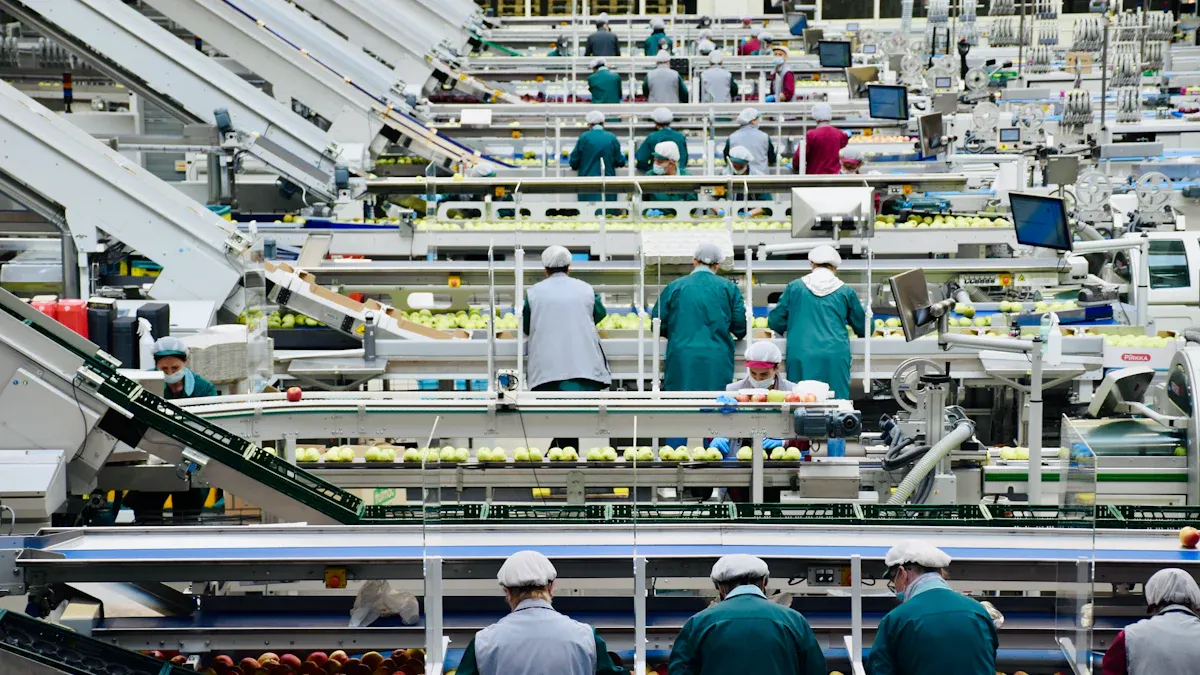
Beyond defect detection, the sheer speed and efficiency of a sorting system directly impact a processor's profitability. The difference in throughput between optical and mechanical sorting is a critical factor in calculating long-term value and production capacity.
The Speed Advantage of Optical Sorting
Optical sorters provide a significant throughput advantage. They operate continuously at high speeds, processing tons of dried onions per hour without breaks or fatigue. This automation dramatically reduces labor requirements and boosts processing rates, leading to substantial savings on wages and associated overhead.
The comparison below highlights the efficiency gains:
| Sorting Method | Labor Required | Processing Rate (Tons/Hour) |
|---|---|---|
| Optical Sorting | ~3 people | 4 to 6 |
| Traditional Hand Sorting | Up to 12 people | 1 to 1.5 |
These automated systems perform tasks that would typically require multiple human workers. This ensures consistent, 24/7 performance and maximizes the total volume of product a plant can process.
The Limitations of Mechanical Grading
Mechanical graders, in contrast, face inherent physical and operational limits. Their processing speed is constrained by the physical movement of screens, shakers, and rollers. These systems are slower by design and introduce several operational inefficiencies.
Operational Bottleneck: Mechanical systems often require frequent manual intervention to clear jams, adjust settings, or perform clean-outs. This downtime directly cuts into production hours and limits overall plant efficiency.
Their reliance on physical separation makes them prone to clogging, especially with irregularly shaped dried onion pieces. Each stoppage for maintenance or cleaning represents lost revenue and reduced throughput, making them less suitable for high-volume, continuous processing environments.
Maximizing Yield and Minimizing Waste
Profitability in food processing depends heavily on maximizing the amount of sellable product from raw materials. The choice of sorting technology directly influences product yield. One method surgically removes only unwanted material, while the other often discards good product along with the bad.
How Optical Sorters Protect Good Product
Optical sorters excel at protecting yield through their incredible accuracy. The system's precise ejectors target and remove only individual defective pieces or foreign objects. This precision minimizes the accidental removal of acceptable product. In comparable food processing applications like tomatoes, optical sorters have increased final product yield by as much as 25%. This gain comes from accurately identifying defects and reducing waste.
Even the most advanced systems can experience "false positives," where the machine incorrectly rejects a good piece of onion. This is also known as the false reject rate. However, this is not a system flaw but an indicator for operators.
Note: A rising false reject rate simply signals that the equipment's settings require optimization to maintain peak sorting efficiency and protect yield.
Where Mechanical Graders Cause Product Loss
Mechanical graders inherently cause product loss due to their indiscriminate nature. These systems cannot differentiate between a good onion piece and a defect of the same size or density. This leads to two primary sources of waste:
- Good Product Rejection: Acceptable onion pieces that are slightly too small or large get screened out with defects and dust.
- Product Damage: The aggressive tumbling and vibrating action can break or chip perfectly good dried onion pieces, turning sellable product into waste.
This consistent loss of valuable product is a form of product shrinkage. The grader's inability to distinguish quality from physical size means processors are constantly losing revenue that optical sorting technology could have saved.
Analyzing the Financial Impact: CapEx vs. OpEx
When choosing sorting equipment, processors often focus on the initial purchase price, or Capital Expenditure (CapEx). A mechanical grader appears financially attractive with its lower upfront cost. However, this view is incomplete. A thorough financial analysis must also account for Operational Expenditures (OpEx)—the ongoing costs of running and maintaining the equipment—and the overall Return on Investment (ROI). The long-term financial picture often reveals a different story.
The Long-Term ROI of Optical Sorters
Optical sorters represent a significant initial investment. An industrial-grade optical sorter for dried onions can have a price ranging from $9,000 to $12,500 per unit. While this CapEx is higher than a mechanical grader's, the technology is engineered for a rapid and substantial return on investment. In fact, many modern optical sorters can achieve a full payback period in under 18 months.
This impressive ROI stems from several key operational advantages:
- Drastic Labor Reduction: Automation directly addresses labor market pressures. Optical sorters perform the work of multiple manual inspectors, ensuring consistent 24/7 quality without the challenges of finding and retaining skilled staff. This allows processors to reallocate employees to more valuable roles, optimizing labor utilization.
- Maximized Throughput and Yield: These systems process enormous volumes, with some capable of handling up to 15 tons of product per hour. By maximizing the recovery of good product and minimizing waste, optical sorters increase the total amount of sellable onions, directly boosting revenue. The profit generated from this increased yield alone can offset the machine's cost within a few years.
- Enhanced Product Value: The superior sorting precision creates a premium final product, which can command a higher price in the market.
A complete optical sorting system, which might combine multiple technologies, demonstrates a clear long-term ROI. The substantial savings on labor costs combined with maximized yields allow such a system to pay for itself within four to five years. 📈
Ultimately, the higher initial investment in an optical sorter translates into greater long-term profitability through superior efficiency, reliability, and output.
The Hidden Costs of Mechanical Graders
The low initial price of a mechanical grader masks a range of significant and recurring operational expenses. These machines are mechanically intensive, and their reliance on physical movement leads to continuous wear and tear. This results in high OpEx that accumulates over the machine's lifetime, eroding any initial savings.
The maintenance burden is extensive and non-negotiable for keeping the machine operational. Key activities include:
- Daily Inspections: Operators must perform comprehensive checks before and after every shift, inspecting parts for wear, cleaning surfaces to prevent rust, and removing solidified material from working components like blades.
- Regular Lubrication: All moving parts, including bearings, hinges, and hydraulic pistons, require frequent lubrication to prevent failure.
- Targeted Replacements: Components like filters, belts, and cutting edges have limited service lives and require scheduled replacement. More complex parts like hydraulic pumps, motors, and electrical sensors also need repair or replacement over time.
The sheer number of maintenance checkpoints highlights the ongoing financial commitment.
| System Component | Representative Maintenance Tasks |
|---|---|
| Engine & Drive Train | Check oil levels, inspect fan belts, check transmission fluid, lubricate drive shafts. |
| Hydraulic System | Inspect hoses for leaks, check fluid levels, clean or replace filters. |
| Blades & Attachments | Inspect for wear/damage, replace cutting edges, lubricate all pins and bushings. |
| Electrical System | Check battery terminals, test all lights and gauges, inspect wiring for damage. |
The True Cost of Operation: Each of these maintenance tasks represents a cost, whether in spare parts, specialized labor, or—most critically—production downtime. Every hour a mechanical grader is stopped for a jam, cleaning, or repair is an hour of lost revenue.
When these hidden operational costs are combined with the product loss from inefficient sorting, the total cost of ownership for a mechanical grader often surpasses that of a far more effective optical sorter.
Finding the Right Dried Onions Sorting Solution
Selecting the ideal dried onions sorting solution requires a clear understanding of a processor's end-market and quality objectives. The choice between advanced imaging and basic mechanics depends entirely on the target product specification and long-term business strategy. One path leads to premium markets, while the other serves foundational processing needs.
Choose an Optical Sorter for Premium Quality
Processors aiming for premium product grades and access to high-value export markets should choose an optical sorter. Top-tier producers invest in AI-powered optical sorting to guarantee batch consistency and meet the stringent quality demands of Quick Service Restaurant (QSR) chains and high-income regions. This technology is essential for serving compliance-first markets.
Key export destinations demanding optically sorted quality include:
- North America & Europe: These regions lead in their demand for premium products and adherence to high food safety standards.
- Asia Pacific (Japan & South Korea): These countries require exceptional processing standards, including low microbial counts.
An optical sorter is the definitive dried onions sorting solution for any business competing on quality, safety, and brand reputation.
A Mechanical Grader for Basic Needs
A mechanical grader can be a sufficient and cost-effective tool for processors with basic needs, such as simple size calibration. These machines offer high work capacity and precision for sorting by physical dimensions, which reduces labor requirements and processing costs for fundamental tasks.
| Metric | Value |
|---|---|
| Sizing Efficiency (avg) | 94.33% |
| Grading Capacity (max) | 1.72 t/h |
| Total Grading Cost | 0.7 US$/t |
Note: While efficient for sizing, these graders cannot detect color defects, foreign material, or spoilage. Their utility is limited to bulk separation, making them a practical choice for operations where detailed quality inspection is not the primary goal.
Optical sorters are the superior dried onions sorting solution for modern processors. Their advanced precision, now enhanced by AI, provides a clear return on investment that outweighs a mechanical grader's low initial cost. For businesses focused on quality and long-term profitability, this advanced dried onions sorting solution is the definitive winner.
FAQ
What is the main advantage of an optical sorter?
Optical sorters use advanced imaging to precisely remove defects and foreign materials. This technology guarantees superior product quality, safety, and consistency for processors.
How quickly can an optical sorter pay for itself?
Many modern optical sorters achieve a full payback in under 18 months. The return comes from significant labor reduction and maximized product yield.
When is a mechanical grader a good choice?
A mechanical grader is a cost-effective tool for basic needs. It efficiently sorts dried onions by physical size but cannot detect quality-related defects.
See Also
Unveiling Plate Pack Benefits and Comprehensive Cost Analysis for 2025
Essential Industrial Checkweighers: The Top 3 for Every Food Processing Plant
Key Capsule Checkweighers Buyers Must Evaluate for Optimal Performance in 2025
Discovering the 8 Best HTN LCD Displays for Superior Performance and Reliability
Ampoule Filling Production Line Manufacturers: A Comprehensive Showdown and Comparison