The Essential Guide to Dried Bell Pepper Sorting Solutions
Selecting the right sorting technology is the most critical factor for processors. A successful dried bell peppers sorting solution precisely matches specific quality standards for color, defects, and foreign material.
Success hinges on a clear definition of "good" versus "bad" product. This definition dictates the technology choice and ensures a high return on investment.
Defining Your Quality and Throughput Requirements
Before selecting a dried bell peppers sorting solution, a processor must first define its operational goals. This foundational step ensures the chosen technology aligns perfectly with production needs and quality targets.
Establishing Your Product Quality Standard
A clear product quality standard is the cornerstone of effective sorting. Processors must define the acceptable color range for their final product. This includes specifying the ideal hue, saturation, and brightness. They also need to set tolerance levels for minor imperfections, such as slight discoloration or small blemishes. This standard becomes the benchmark for calibrating sorting equipment and guarantees product consistency.
Identifying Critical Defects and Foreign Materials
Identifying unacceptable materials is crucial for food safety and brand reputation. Processors must create a comprehensive list of all potential defects and contaminants. Common product-related defects include stems, seeds, and scorched pieces. Foreign materials are an even greater concern. These often include:
- Stones
- Fabrics
- Plastics
- Paper
Note: A zero-tolerance policy for foreign materials is the industry best practice. It protects consumers and upholds the highest quality standards.
Calculating Throughput and Capacity Needs
Processors must accurately calculate their required processing speed. This calculation should account for current production volume and future growth projections. A machine's capacity, measured in kilograms per hour (kg/h), directly impacts operational efficiency. For example, the Fengxiang CD-800 dicing machine can prepare 500–800 kg/h for sorting. The required sorting throughput varies significantly by operational scale.
| Scale | Processing Throughput (kg/h) |
|---|---|
| Small Workshops | 50–100 |
| Mid-scale Production | 200–400 |
| Industrial Spice Factories | 600–1000 |
| Bulk Grinding & Export | 1000–1500 |
Choosing a system with adequate capacity prevents bottlenecks and supports business expansion.
Key Challenges in Sorting Dried Bell Peppers

Processors face several inherent challenges when processing dried bell peppers. The product's natural variability and the potential for contamination require a robust and intelligent dried bell peppers sorting solution to ensure a premium final product.
Managing Color and Shade Variations
Dried bell peppers present a wide spectrum of colors, not a single uniform shade. The drying method itself significantly alters color consistency. For instance, sun-drying often causes greater color loss and reduces redness compared to controlled methods like cabinet-drying. Advanced techniques like freeze-drying offer superior color stability. This wide variation complicates the task of defining a single "good" product color, requiring sorting equipment to handle a range of acceptable hues while rejecting unacceptable discoloration.
Removing Stems, Seeds, and Scorched Pieces
Intrinsic defects are a primary concern. Stems and seeds must be efficiently removed to meet quality specifications. Scorched pieces, which result from drying errors, also degrade product value. Scorching often occurs due to:
- High Temperatures: Oven settings that are too high can cook the peppers instead of properly drying them.
- Poor Airflow: Trapped moisture from inadequate ventilation leads to steaming and browning.
- Insufficient Rotation: A lack of regular flipping causes uneven drying and localized overheating on pan surfaces.
Detecting Foreign Material with Similar Colors
Perhaps the most critical task is identifying foreign materials that mimic the product's color and size. Light brown twigs, beige plastic fragments, or light-colored stones can easily blend in with pieces of dried pepper.
These contaminants pose a direct threat to food safety and can severely damage a brand's reputation. Standard color sorters may struggle to differentiate these low-contrast items from the product, demanding more advanced detection capabilities.
Choosing the Right Dried Bell Peppers Sorting Solution
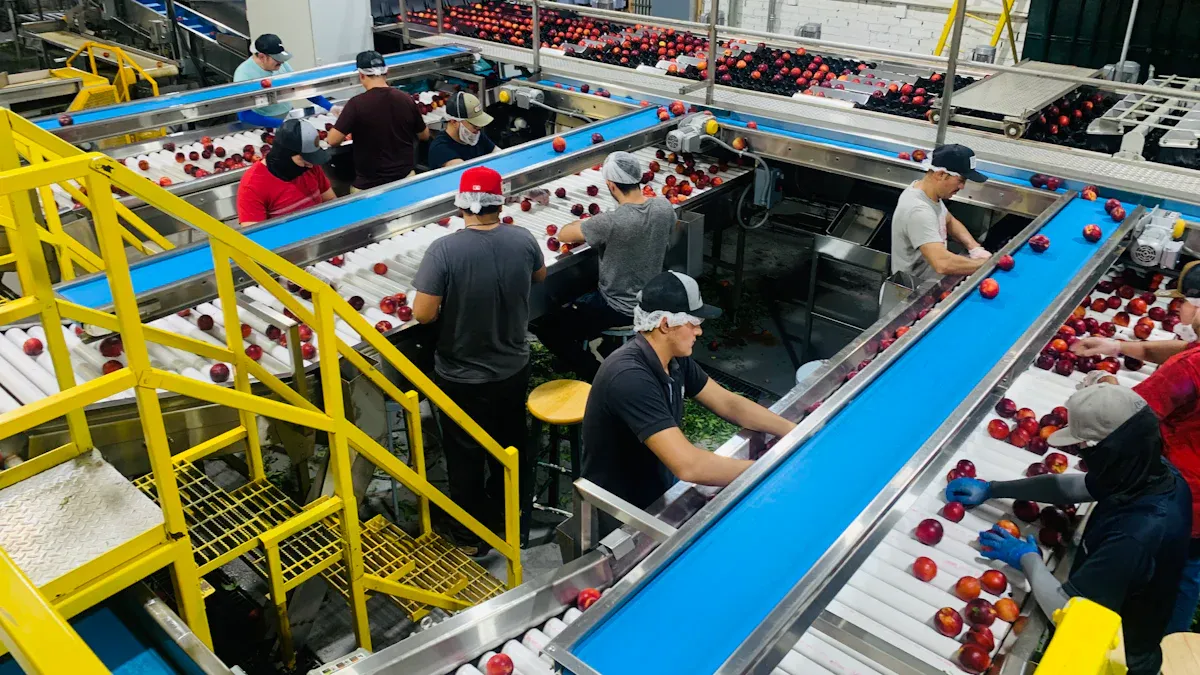
Selecting the ideal technology requires a clear understanding of what each system can and cannot do. Processors must evaluate their specific defects and contaminants to build a comprehensive dried bell peppers sorting solution. The process typically starts with a foundational tool and adds advanced systems to address specific food safety and quality challenges.
Optical Color Sorters: The Primary Tool
Optical color sorters are the workhorse of the dried vegetable industry. These machines use high-resolution cameras to scan each piece of pepper as it passes through the inspection zone. The system compares the color of each piece to the pre-defined quality standard. If a piece exhibits discoloration, scorching, or other color defects, the machine activates a precise burst of compressed air to eject it from the main product stream.
The effectiveness of a color sorter depends heavily on its camera technology. Modern systems have moved beyond lower-resolution cameras to models with five megapixels or more. This advancement eliminates previous performance limitations.
- High-resolution cameras capture incredibly detailed images in real time.
- Advanced lenses, such as 54 mm Phenix lenses, enable the detection of stains and defects as small as 0.04 mm.
- This precision allows the sorter to analyze subtle variations in size, shape, and color with remarkable accuracy.
Leading manufacturers provide specialized equipment for this task. Bühler, for example, offers its Sortex® line of optical sorters for dried vegetables, which effectively removes color defects, stalks, stones, and plastic. Other global manufacturers like WECO provide versatile optical sorting solutions that help processors increase efficiency and reduce costs.
Advanced Technologies: NIR and X-ray Inspection
While color sorters excel at visible defects, some contaminants require more advanced detection methods. Near-Infrared (NIR) and X-ray inspection systems provide solutions for challenges that cameras cannot see.
NIR spectroscopy analyzes the chemical makeup of materials. It can differentiate between dried bell peppers and foreign materials that have a similar color but a different organic composition. This makes it effective for identifying things like wood, nutshells, or certain plastics.
X-ray inspection is the gold standard for detecting dense foreign materials. These systems identify contaminants by measuring differences in density between the product and the foreign body.
X-ray machines are critical for preventing recalls. They reliably find the "Faulty Five" common physical contaminants, including glass and mineral stone.
High-quality X-ray systems can detect a wide range of non-metal contaminants in dried peppers, such as:
- Glass shards
- Stones
- Ceramic fragments
The technology has also evolved. While single-energy X-ray is effective for products with a uniform texture, advanced dual-energy X-ray technology can detect flat glass and stone even in multi-textured foods with high density variations. This capability ensures the highest level of food safety.
Laser Sorters for Structural Defect Removal
Laser sorters offer another layer of protection by analyzing the structural properties of objects. These systems scan materials with lasers and analyze the reflected light. This allows them to identify foreign materials based on their unique structural characteristics, even if their color is identical to the product.
Laser sorters are particularly effective at detecting contaminants that optical systems may miss. Their primary advantage is the ability to find foreign materials that are not visible to the naked eye. This makes them an excellent tool for identifying problematic items like clear or light-colored plastics that can easily blend in with dried bell peppers. By adding a laser sorter to the processing line, a processor can achieve a superior level of purity and safety.
A Step-by-Step Guide to Implementation
Deploying a sorting system is a multi-stage process that extends beyond the machine itself. A successful implementation requires careful planning before, during, and after installation to maximize efficiency and ensure a rapid return on investment.
Upstream Preparation for Optimal Sorting
The performance of any sorting machine depends heavily on the quality of the product fed into it. Processors must optimize their upstream processes to prepare the dried bell peppers for inspection. Effective preparation ensures the sorter can operate at peak efficiency.
Key upstream steps include:
- Pre-Cleaning: Initial screening removes gross contaminants like large sticks, field debris, and clumps of product. This protects the sorter from potential damage.
- De-dusting: Fine pepper dust can coat the sorter's optical lenses and inspection windows, impairing its vision. An aspiration or de-dusting system should be installed just before the sorter to remove this particulate matter.
- Consistent Feeding: The product must be presented to the sorter in a uniform, single layer. A vibratory feeder is essential for spreading the product evenly across the width of the machine, preventing clumps and ensuring each piece is inspected individually.
A stable and consistent product flow is the foundation of accurate sorting. Overloading the machine leads to missed defects, while an inconsistent flow reduces overall throughput.
Installation and System Calibration
Proper installation and precise calibration are critical for transforming the sorting machine from a piece of equipment into a powerful quality control tool. This phase requires both facility preparation and technical expertise.
First, processors must evaluate their facility to ensure sufficient room for the equipment. The installation area needs a level, clean floor and must be clear of obstacles to allow for proper ventilation and maintenance access. Selecting the right system can even help optimize a facility's layout by reducing the need for manual inspection stations. Industrial sorting machines have specific utility requirements.
- Power Supply: A three-phase power supply, typically 220V – 380V at 50/60Hz, is required.
- Dimensions: Machine footprints are often customizable, but significant floor space is necessary.
- Compressed Air: A clean, dry, and oil-free air supply is needed to power the ejection system.
Once installed, the system undergoes a meticulous calibration process to define "good" and "bad" product. This process teaches the machine how to see and sort according to the processor's quality standards.
- Camera Calibration: The process starts by using color standard balls to calibrate the cameras and establish baseline hue value curves.
- Hue Value Determination: The system captures multiple views of each object as it rotates, determining a comprehensive hue value.
- Composite Value Calculation: It then calculates a composite hue value for the object by averaging the data from the individual views.
- Comparison to Criteria: This composite value is compared against pre-programmed grading criteria that define acceptable and rejectable products.
- Dynamic Calibration: The system uses dynamic automatic camera calibration, periodically passing color balls through to adjust for any variations from the standard hue curve.
- Fine-Tuning: Final adjustments fine-tune the calibration to accommodate different product sizes and shapes.
Integrating with Downstream Packaging Lines
An effective dried bell peppers sorting solution does not operate in isolation. It must integrate seamlessly with downstream equipment, such as weighers and bagging systems, to create a fully automated production line. Sorters play a vital role in organizing products before they enter the bagging machine, ensuring each item is correctly positioned for the final packaging process.
A successful integration hinges on creating a cohesive automation workflow. Key steps include:
- Establish Communication Protocols: The sorter, conveyors, and bagging system must communicate with each other. This digital handshake ensures the packaging line speeds up or slows down in response to the sorter's output.
- Design the Automation Workflow: Processors should map out the entire process, from the sorter's reject and accept streams to the final palletizing stage. This ensures a smooth, continuous flow without bottlenecks.
- Implement Continuous Monitoring: Monitoring tools track the performance of the entire line. This allows operators to identify and resolve issues early, minimizing downtime and maintaining efficiency.
By connecting the sorter's output directly to automated packaging, processors can significantly reduce manual handling, improve hygiene, and increase overall throughput.
Optimizing Performance and Calculating ROI
After implementation, processors must focus on maximizing the system's value. Continuous optimization and diligent maintenance ensure the equipment delivers peak performance and a strong financial return.
Fine-Tuning Sorting Recipes
A "sorting recipe" is a set of pre-programmed parameters that tells the machine what to accept and reject. Fine-tuning these recipes is crucial for adapting to different product batches or quality requirements. Modern sorters often use machine learning to automate this process, enhancing accuracy and efficiency. These systems can employ several methods to find the best settings:
- Grid Search: This technique systematically tests every combination of parameters within a defined range.
- Random Search: This approach randomly samples parameter settings, often finding good results more quickly than a grid search.
- Bayesian Optimization: This intelligent method uses previous results to predict which parameters will yield the best performance, reducing the time needed for fine-tuning.
Essential Maintenance and Cleaning Protocols
Regular maintenance prevents downtime and extends the life of the sorting machine. A proactive maintenance schedule is essential. Processors should regularly inspect key components that are prone to wear and tear.
Consistent cleaning is just as important. Dust and product residue can obstruct camera lenses and sensors, leading to poor sorting accuracy.
Key parts requiring routine inspection include:
- Belts and chains
- Rollers and bearings
- Motors and gearboxes
- Hydraulic hoses
- Electrical components like switches and relays
How to Measure Your Return on Investment
Calculating the Return on Investment (ROI) helps justify the capital expenditure. The formula for ROI is straightforward: divide the net income generated by the asset by the initial cost of the investment. For a sorting machine, net income comes from several sources. These include increased revenue from higher product quality, reduced labor costs from automation, and decreased product loss. A positive ROI demonstrates the machine is a profitable asset, not just an expense.
Success begins when processors precisely define their quality standards for color, defects, and contaminants. They must then select the right technology, starting with color sorters and adding advanced systems as needed. A well-implemented dried bell peppers sorting solution becomes a strategic investment, enhancing safety, boosting brand reputation, and unlocking premium markets.
FAQ
What is the first step in choosing a sorter?
Processors must first define their product quality standard. This standard dictates the required technology and ensures the machine meets specific color, defect, and foreign material removal needs.
Can one machine remove all types of defects?
Not always. A color sorter is the primary tool. Processors may need to add X-ray or NIR systems to detect dense foreign materials or contaminants with similar colors.
Why is pre-cleaning important before sorting?
Pre-cleaning and de-dusting protect the sorter's sensitive optics. A consistent product feed ensures the machine can inspect each piece individually, maximizing accuracy and preventing missed defects.
See Also
Essential Guide: Selecting the Right Tablet Sampling Machines for Your Laboratory
Capsule Sorters: Key Equipment for Effective Defect Elimination and Quality Control
Innovative Strategies for Diagnosing and Resolving Sulfur Recovery Catalyst Issues
Breakthroughs in Nitric Acid: Modern Separation and Purification Methods Explored
Ensuring Safety: Best Practices for Storing Nitric Acid Securely