Hydroxyl-Terminated Polybutadiene Propellants and the DDI Curing Advantage
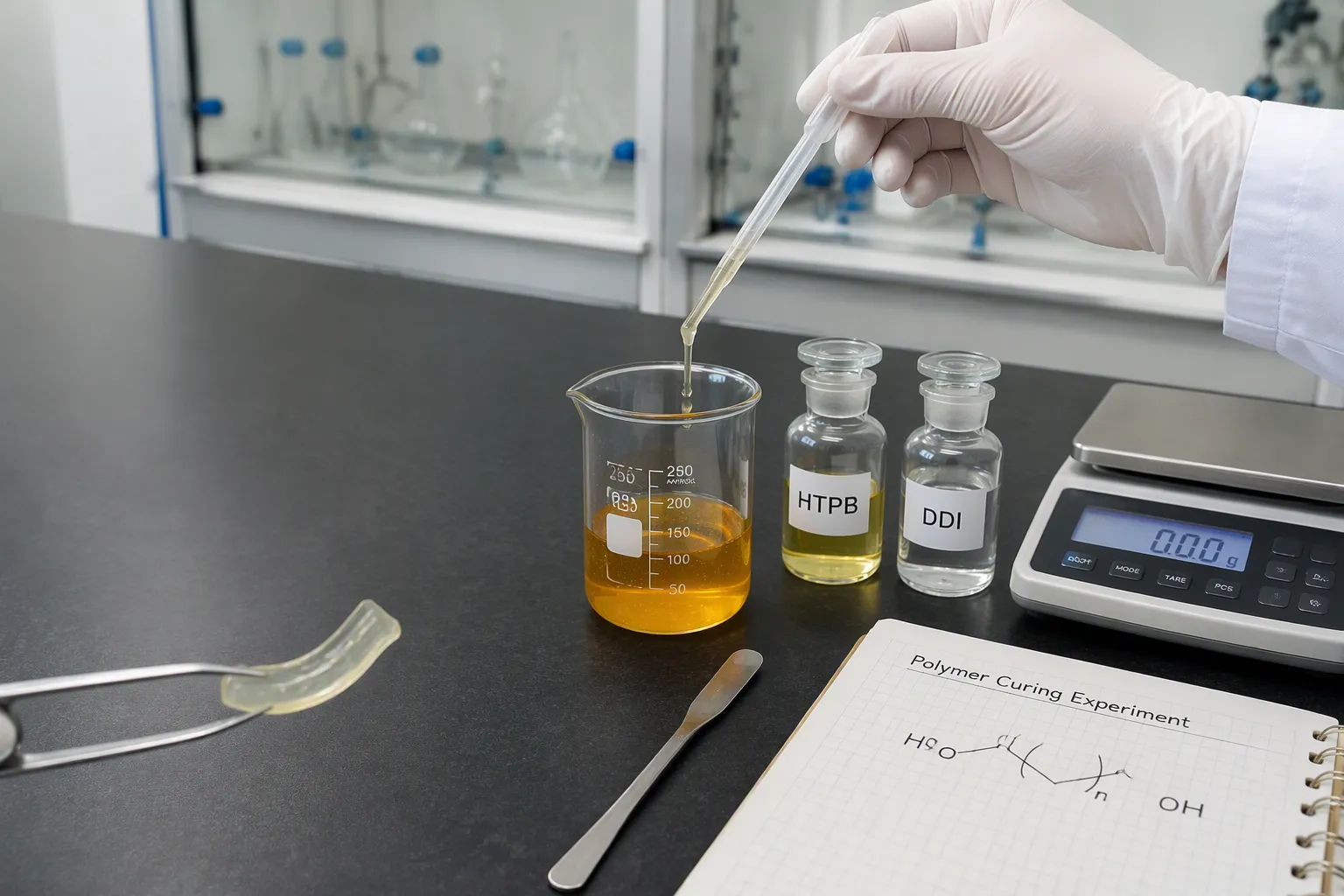
Dimeryl Diisocyanate (DDI) CAS 68239-06-5 used as a curing agent for HTPB binder systems gives formulators a low-toxicity, moderate-reactivity option. It replaces TDI and IPDI with fewer health hazards. DDI delivers comparable mechanical, kinetic, and ballistic performance. Its long flexible chains and balanced reactivity make it a practical drop-in replacement for safer propellant systems.
Key Takeaways
- DDI makes propellant production safer because it has low toxicity and low vapor pressure, reducing health risks for workers.
- DDI creates flexible and tough propellants that stretch well and perform reliably at low temperatures, unlike stiffer curing agents.
- DDI cures at lower temperatures and shorter times, saving energy and making manufacturing easier and more consistent.
Dimeryl Diisocyanate (DDI) CAS 68239-06-5 used as a curing agent for HTPB binder systems: Chemistry and Reactivity
Dimeryl Diisocyanate (DDI) CAS 68239-06-5 used as a curing agent for HTPB binder systems belongs to a class of aliphatic diisocyanates. Its chemical design determines how it reacts with the hydroxyl groups in HTPB. This section explores its molecular architecture and compares its behavior with more common curing agents.
Structure of Dimeryl Diisocyanate
Dimeryl diisocyanate derives from a C36 dimer fatty acid. The chemical structure contains two isocyanate (-NCO) groups linked by a long hydrocarbon backbone. This backbone of roughly 36 carbons gives the molecule a flexible, extended shape. Ordinary diisocyanates such as TDI contain a rigid aromatic ring. DDI, by contrast, presents a long aliphatic chain. The two reactive isocyanate groups sit at opposite ends of this chain.
This geometry affects how the molecule moves and bonds. The long chain can rotate freely. It can bend, stretch, and align itself along the polymer network. Chemists describe the compound as a flexible diisocyanate. This trait sets DDI apart from cyclic or aromatic alternatives.
Reactivity Compared to TDI and IPDI
Dimeryl Diisocyanate (DDI) CAS 68239-06-5 used as a curing agent for HTPB binder systems reacts with hydroxyl groups through a well-known mechanism. The isocyanate group attacks the oxygen-hydrogen bond of the hydroxyl group and forms a urethane link. The speed of this reaction depends largely on the electronic environment around the -NCO group.
TDI (toluene diisocyanate) has an aromatic ring directly attached to the isocyanate. The ring pulls electron density away from the reaction site. This effect makes TDI highly reactive. Cure times run short. The reaction can be difficult to control.
IPDI (isophorone diisocyanate) also belongs to the aliphatic family. Its cycloaliphatic ring provides moderate reactivity. DDI behaves similarly to IPDI. One important difference separates them. The long chain softens the electron-withdrawing effects. Consequently, Dimeryl Diisocyanate (DDI) CAS 68239-06-5 used as a curing agent for HTPB binder systems offers an even calmer reaction profile. Formulators gain a longer gel time and better control over the curing process.
Why Long Flexible Chains Matter
The mechanical performance of a propellant binder depends strongly on the chain length and flexibility of the curing agent. A short, rigid molecule such as TDI forms a tight, stiff network. This network yields high modulus but limits elongation. Impact and thermal shock can crack the binder.
A long flexible chain behaves differently. It introduces mobility into the polymer matrix. The chain acts like an internal spring, absorbing stress and distributing it across the binder. This behavior improves elongation at break and impact resistance.
The flexible chain also affects the packing of solid particles. AP (ammonium perchlorate) and aluminum fillers load at high levels. A flexible binder wets these particles more effectively. It reduces the tendency for brittle failure at particle-binder interfaces.
For these reasons, Dimeryl Diisocyanate (DDI) CAS 68239-06-5 used as a curing agent for HTPB binder systems provides mechanical benefits beyond simple safety. It creates a tough, resilient elastomer that can withstand the rigorous demands of rocket motors.
Mechanical Properties of HTPB/DDI Elastomers and Propellants
The mechanical behavior of a cured propellant decides whether a motor survives storage, transport, and ignition. HTPB/DDI systems offer a distinct mechanical profile. Their long flexible chains change how the binder responds to stress. This section examines the key variables that control stiffness, strength, and stretch.
How the R-Value Controls Modulus and Strength
The R-value describes the ratio of isocyanate groups to hydroxyl groups in a formulation. Formulators write it as NCO/OH. This single number shapes the entire polymer network. A low R-value leaves unreacted hydroxyl groups in the binder. The network stays loose. The elastomer feels soft and stretches easily. A high R-value pushes the reaction toward complete crosslinking. More urethane bonds form. The network tightens. The modulus rises.
DDI responds to R-value changes in a predictable way. Its long chains soften the effect of excess isocyanate. A formulator can raise the R-value without creating a brittle product. This tolerance gives DDI an advantage over rigid curing agents. TDI, for example, produces a sharp modulus increase with small R-value shifts. DDI spreads that response across a wider range.
Most HTPB/DDI propellants use an R-value between 0.85 and 1.0. This window balances strength and elongation. Values below 0.85 yield tacky, under-cured binders. Values above 1.0 add stiffness with diminishing returns. The optimal R-value depends on the filler loading and the target mechanical spec.
Tensile Strength and Elongation Behavior
Tensile strength measures the maximum stress a material withstands before failure. Elongation measures how far it stretches. These two properties often trade off against each other. Stiff materials resist deformation but break early. Soft materials stretch far but carry less load.
HTPB/DDI elastomers reach tensile strengths of roughly 0.6 to 1.0 MPa at ambient temperature. Elongation at break typically falls between 400% and 700%. These values suit solid rocket applications. The binder must flex under thermal cycling. It must also hold solid particles in place during high acceleration.
The flexible DDI chains explain this behavior. Stress applied to the binder distributes along the long hydrocarbon backbone. The chain uncoils rather than snapping. This mechanism delays crack formation. It also blunts crack tips that do form. The result is a tough elastomer with good damage tolerance.
Temperature changes this picture. Cold temperatures stiffen the binder and reduce elongation. DDI's low glass transition temperature helps here. The long chains stay mobile at lower temperatures than short rigid curing agents allow. This trait improves low-temperature performance.
Comparison with HTPB/TDI and HTPB/IPDI Systems
Each curing agent produces a different mechanical fingerprint. TDI creates stiff, strong networks with limited stretch. IPDI sits in the middle. DDI favors flexibility and toughness over raw stiffness. The table below summarizes typical values.
| Property | HTPB/TDI | HTPB/IPDI | HTPB/DDI |
|---|---|---|---|
| Tensile strength (MPa) | 0.8–1.2 | 0.7–1.1 | 0.6–1.0 |
| Elongation at break (%) | 300–500 | 400–600 | 400–700 |
| Modulus | High | Moderate | Low to moderate |
| Low-temperature flexibility | Poor | Fair | Good |
| Toxicity | High | Moderate | Low |
TDI systems win on absolute strength. Their aromatic rings pack tightly and resist deformation. This strength comes at a cost. The stiff network cracks under thermal shock. TDI also carries serious health risks. Workers exposed to TDI vapor suffer respiratory damage.
IPDI improves the safety profile. Its cycloaliphatic structure gives moderate reactivity and moderate flexibility. Mechanical properties land between TDI and DDI. IPDI still requires careful handling. Its vapor pressure is lower than TDI but not negligible.
DDI changes the balance. It sacrifices a small amount of tensile strength. In return, it gains elongation, low-temperature performance, and a much safer handling profile. For many propellant formulations, this trade favors DDI. The binder must survive years of storage and wide temperature swings. Toughness matters more than peak strength in these conditions.
The comparison also depends on formulation details. Plasticizers, bonding agents, and filler content all shift the numbers. A well-tuned HTPB/DDI formulation can match the strength of a typical HTPB/IPDI system. It will still beat that system on elongation and safety.
Reaction Kinetics of DDI with HTPB
Second-Order Reaction Behavior
Kinetic studies describe the cure as a second-order reaction. The rate depends equally on the concentration of isocyanate groups and hydroxyl groups. This relationship holds across common mixing and casting temperatures. No significant side reactions disturb the main urethane formation. Formulators use this clean kinetics to calculate conversion at any time. Batch-to-batch consistency follows naturally.
Lower Activation Energy Than IPDI
Activation energy represents the energy threshold that reacting molecules must cross. A lower threshold lets the reaction start more easily. Arrhenius analysis gives an exact comparison. The table below displays these data.
| Urethane reaction system | Apparent activation energy (kJ·mol⁻¹) | Comparison |
|---|---|---|
| DDI/HTPB | 37.02 | 3.5 kJ·mol⁻¹ lower than IPDI/HTPB |
| IPDI/HTPB | Not reported directly | 3.5 kJ·mol⁻¹ higher than DDI/HTPB |
Dimeryl Diisocyanate (DDI) CAS 68239-06-5 used as a curing agent for HTPB binder systems needs less thermal input to trigger curing. This quality reduces oven energy demand. It also minimizes the chance of incomplete cure at moderate temperatures.
Practical Cure Schedule Implications
The lower activation energy shortens the time needed to reach full cure. Production teams can run DDI/HTPB propellants at lower oven temperatures. Lower temperatures cut energy costs and limit thermal stress on the grain. The moderate reactivity still preserves a workable pot life. Operators gain enough time for mixing, casting, and finishing.
A typical schedule falls near 60°C to 70°C. Cure often completes within three to five days. Faster cures require higher temperatures, but those conditions can create voids. DDI's predictable reaction allows formulators to avoid such defects. They can fine-tune the cycle to meet production constraints. This reliability makes DDI a strong candidate for manufacturing operations.
Burning Rate Characteristics of HTPB/DDI Propellants
The burning rate of a solid propellant determines how fast the motor generates thrust. HTPB/DDI formulations show distinct burning behavior. Their ballistic profile suits many tactical and space applications.
Lower Burning Rates Without Modifiers
HTPB/DDI propellants burn at lower rates than TDI-based systems. The flexible DDI chains create a softer binder matrix. This matrix decomposes at a slower pace during combustion. Formulators often add burn rate modifiers to adjust performance. DDI systems need fewer modifiers to hit target rates. This reduction simplifies the formulation and lowers cost.
Pressure Exponent and Ballistic Consistency
The pressure exponent measures how burning rate responds to chamber pressure. A low exponent means stable combustion across a wide pressure range. HTPB/DDI propellants typically show exponents between 0.3 and 0.5. These values indicate predictable ballistic behavior. Motors resist pressure spikes and combustion instability. The consistent exponent also simplifies motor design calculations.
Formulation Flexibility for Tailored Performance
DDI gives formulators a wide window for tuning burning rate. They can adjust the oxidizer particle size to shift the rate. Fine AP raises the rate. Coarse AP lowers it. The binder-to-oxidizer ratio offers another control lever. Higher oxidizer loading increases the rate. DDI's moderate reactivity tolerates these changes without disrupting the cure. This flexibility lets engineers tailor the propellant to specific mission needs. They can match the burning rate to the motor geometry and thrust profile.
Dimeryl Diisocyanate (DDI) CAS 68239-06-5 used as a curing agent for HTPB binder systems offers a safer path forward. It combines low toxicity with moderate reactivity. Its mechanical and ballistic performance matches or exceeds traditional options. Formulators can replace TDI and IPDI confidently with DDI. Modern propellant formulations indeed benefit from this balance.
FAQ
Is DDI safer to handle than TDI for propellant production?
Yes. DDI has low toxicity and low vapor pressure. Workers face fewer respiratory hazards. TDI poses serious health risks through inhalation. DDI reduces these dangers significantly.
Does DDI match TDI performance in HTPB propellants?
DDI delivers comparable performance. It offers better elongation and low-temperature flexibility. Tensile strength runs slightly lower. Ballistic properties remain reliable. Formulators gain safety without sacrificing mission requirements.
What cure schedule does DDI require with HTPB?
DDI cures at 60°C to 70°C. Full cure takes three to five days. Lower activation energy reduces oven time. Moderate reactivity preserves workable pot life for casting.
See Also
Innovative Applications Of N,N-Dimethyl-N,N-Diphenylurea Across Multiple Industrial Fields
Data-Backed Strategies To Improve 2,5-Furandicarboxylic Acid Sustainability Levels
Plate Pack Benefits And Expense Review For The Year 2025
WT20 Thoriated Tungsten Electrode Insights That Improve TIG Welding Performance
Industrial Use And Dissolution Methods For 2,5-Furandicarboxylic Acid