Exploring the Commercial Viability of Fullerene C60 in 2026

Fullerene C60 shows strong market growth and rising demand. The market size is set to reach $526.82 million in 2025. Recent advances in synthesis and greener production methods support its use in healthcare and electronics. Development Prospects of Fullerene C60 (CAS 99685-96-8) attract industry attention.
| Year | Market Size (USD Million) |
|---|---|
| 2024 | 503.65 |
| 2025 | 526.82 |
| 2033 | 754.94 |
Key Takeaways
- Fullerene C60 is projected to reach a market size of $526.82 million by 2025, driven by its applications in healthcare, electronics, and energy.
- Advancements in nanotechnology and greener production methods enhance the commercial viability of Fullerene C60, making it valuable for drug delivery and high-performance batteries.
- Stakeholders should focus on building strong supply chains and investing in sustainable practices to maximize success in the growing Fullerene C60 market.
Market Forecast for Fullerene C60
Projected Growth and Revenue
Fullerene C60 is expected to see steady market expansion through 2026. Market analysts predict strong revenue growth as industries adopt fullerene-based products. North America will likely lead the market, driven by large investments in research and development. The United States stands out for its focus on advanced materials and healthcare applications. Europe also plays a major role, with countries like Germany, France, and the United Kingdom supporting technological innovation. Asia Pacific is set to experience rapid growth, fueled by industrialization and government support for nanotechnology. Latin America and the Middle East are emerging as promising regions for fullerene manufacturers.
The market size for Fullerene C60 is projected to reach $526.82 million in 2025. By 2033, forecasts suggest the market will grow to $754.94 million. This growth reflects expanding applications in healthcare, electronics, and energy. Companies continue to invest in new production methods and scalable technologies. These efforts help meet rising demand and support the Development Prospects of Fullerene C60 (CAS 99685-96-8).
Market experts note that global research collaborations and increased investor interest are accelerating commercialization. The future looks bright for fullerene products as more industries recognize their value.
Key Market Drivers
Several factors drive the commercial viability of Fullerene C60. Advancements in nanotechnology play a key role. Researchers use C60 to create innovative materials with enhanced properties. These materials are valuable for electronics and coatings. Medical and pharmaceutical applications also contribute to market growth. C60 can encapsulate therapeutic agents, improving their solubility and bioavailability. Its antioxidant properties make it a candidate for treating neurodegenerative disorders and diseases related to oxidative stress.
- C60 can selectively destroy cancer cells when activated by light, which improves treatment efficacy.
- Its high surface area and biocompatibility support drug delivery systems.
- C60's electrical conductivity positions it as a strong option for high-performance batteries and supercapacitors.
- The molecule's stability makes it suitable for water purification and pollution remediation.
- Growing interest in C60's health benefits may lead to its use in wellness products.
Industrialization and government support for nanotechnology in Asia Pacific boost market demand. Europe’s advanced technology and industrial sector also drive adoption. North America’s focus on research and development ensures continued innovation. Latin America and the Middle East offer new opportunities for fullerene manufacturers.
Ongoing research and strategic partnerships help unlock new applications for Fullerene C60. Companies that invest in these areas gain a competitive edge.
Industry Applications with High Commercial Potential

Healthcare and Pharmaceuticals
Fullerene C60 is making progress in healthcare. Scientists are exploring its use in cancer therapy, especially for targeted drug delivery and photodynamic therapy. Its unique structure helps improve treatment results and lowers side effects. Researchers also see potential in personalized medicine, biosensing for early disease detection, and regenerative medicine.
- Targeted drug delivery systems
- Photodynamic therapy for cancer
- Biosensors for diagnostics
- Tissue engineering and wound healing
A short-term oral toxicity study shows that C60 and its derivatives have a good safety profile. Studies also report benefits such as anti-inflammatory effects, life extension, and protection of the nervous system.
Electronics and Nanotechnology
Fullerene C60 is important in electronics and nanotechnology. It is used in organic solar cells, supercapacitors, and lithium-ion batteries. In electronics, it appears in semiconductors, transistors, and LEDs. C60 also improves the sensitivity of biosensors and helps with electron transfer in devices.
| Sector | Application Description |
|---|---|
| Energy | Used in organic photovoltaics (solar cells) for enhanced energy conversion efficiency. |
| Integrated into supercapacitors and lithium-ion batteries for improved performance. | |
| Electronics | Utilized in semiconductors, transistors, and light-emitting diodes (LEDs). |
Energy and Environmental Solutions
C60 supports high-performance batteries and supercapacitors because of its electrical conductivity. Its stable structure makes it useful for water purification and pollution cleanup. These features help advance sustainable energy technologies.
- High-performance batteries
- Supercapacitors
- Water purification
- Pollution remediation
Cosmetics and Personal Care
The cosmetic industry uses C60 in skincare, haircare, and makeup products. It provides antioxidant and anti-aging benefits in serums and creams. In haircare, it protects against damage and improves moisture retention. Makeup products with C60 offer both coverage and skin benefits.
Regulatory bodies like the FDA and European Commission require strict testing for new ingredients. The lack of standardized rules for C60 creates challenges for manufacturers.
Advanced Materials and Coatings
Fullerene C60 enhances advanced materials and coatings. Studies show that adding small amounts of C60 to epoxy resins improves strength and durability. It also boosts anti-corrosion and wear-resistant properties. C60’s unique electronic and optical features support its use in optical computing, lubricants, and display technologies.
| Application Area | Key Features |
|---|---|
| Advanced Materials | Unique electronic and photophysical properties |
| Data Storage | Potential applications in optical computing |
| Display Technologies | Contributions to advanced display technologies |
The Development Prospects of Fullerene C60 (CAS 99685-96-8) continue to attract attention as these applications expand.
Market Dynamics and Competitive Landscape
Growth Drivers and Opportunities
The market for Fullerene C60 continues to grow because of its wide range of uses and new technology. Many industries value fullerenes for their ability to absorb free radicals. This property makes them important in making high-performance lubricants and coatings. The electronics industry uses C60 in transistors and diodes, which increases demand. Government programs, such as the European Union's Green Deal, encourage companies to use sustainable technologies. New opportunities are opening up in energy storage, like supercapacitors and lithium-ion batteries. Medical research also explores C60 for cancer treatment and other therapies. These factors support the Development Prospects of Fullerene C60 (CAS 99685-96-8) and help the market expand.
Challenges and Barriers to Adoption
Companies face several challenges when adopting Fullerene C60. High production costs can limit large-scale use. Some industries need more proof of safety and long-term effects before using C60 in products. Regulations differ by region, which can slow down approval and market entry. Manufacturers must also address concerns about environmental impact and disposal. Limited awareness among end-users may reduce demand in some sectors.
Note: Overcoming these barriers will require more research, better education, and clear rules for using C60.
Major Players and Strategic Partnerships
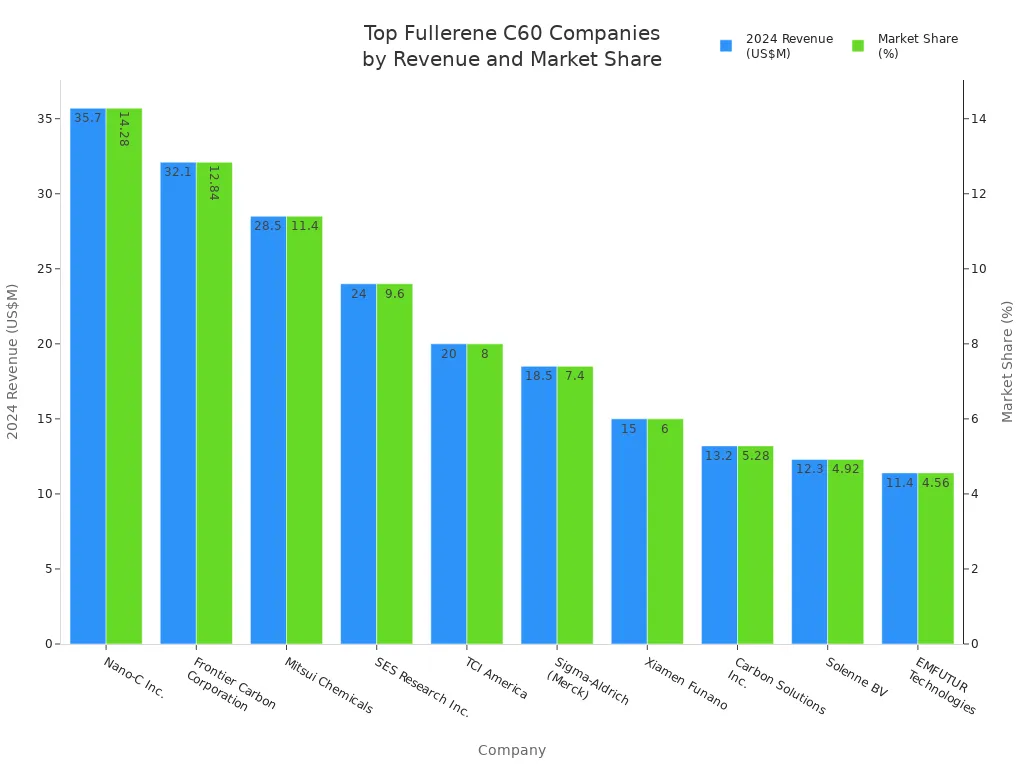
Many companies compete in the Fullerene C60 market. The top five manufacturers control over 60% of the market. SES Research leads with about 18-20% market share. Nano-C follows with 15-17%. BuckyUSA holds around 10-12%. Other companies, such as Carbon Solutions, Luvomaxx Technologies, and American Elements, have smaller shares.
| Company | Headquarters | 2024 Revenue (US$M) | Market Share (%) | Core Product | Key Region |
|---|---|---|---|---|---|
| Nano-C Inc. | Westwood, USA | 35.7 | 14.28 | C60/C70 fullerenes | North America |
| Frontier Carbon Corporation | Tokyo, Japan | 32.1 | 12.84 | High-purity C60 | Asia-Pacific |
| Mitsui Chemicals | Tokyo, Japan | 28.5 | 11.4 | Functional fullerene derivatives | Asia-Pacific |
| SES Research Inc. | Houston, USA | 24 | 9.6 | Carbon 60 powder | North America |
| TCI America | Portland, USA | 20 | 8 | Laboratory-grade C60 | North America |
| Sigma-Aldrich (Merck) | St. Louis, USA | 18.5 | 7.4 | Analytical fullerenes | Global |
| Xiamen Funano | Xiamen, China | 15 | 6 | Bulk C60/C70 | Asia-Pacific |
| Carbon Solutions Inc. | Riverside, USA | 13.2 | 5.28 | Functionalized fullerenes | North America |
| Solenne BV | Groningen, Netherlands | 12.3 | 4.92 | Solar-grade fullerenes | Europe |
| EMFUTUR Technologies | Barcelona, Spain | 11.4 | 4.56 | Nano-dispersion fullerenes | Europe |
Strategic Partnerships
- Nano-C Inc. has partnered with LG Chem for organic photovoltaic materials.
- Frontier Carbon Corporation signed a supply agreement with Samsung SDI.
- Carbon Solutions Inc. licensed technology to Boeing for anti-corrosion resins.
- Solenne BV received an EU Horizon grant to scale up organic photovoltaic production.
- The top five manufacturers control over 60% of the Fullerene C60 market.
- SES Research leads with approximately 18-20% market share.
- Nano-C follows with 15-17% market share.
- BuckyUSA holds around 10-12% market share.
- Other players like Carbon Solutions, Luvomaxx Technologies, and American Elements have market shares ranging from 5% to 8%.
Regional Market Insights
North America
North America maintains a mature ecosystem for Fullerene C60. Companies in this region lead in innovation and have strong access to capital. The market shows steady demand, supported by advanced technology and research facilities. Many organizations focus on healthcare and electronics, which drives adoption. North America stands out for its early adoption of new materials and strong partnerships between industry and universities.
| Region | Growth Rate | Market Characteristics |
|---|---|---|
| North America | Steady demand | Mature ecosystem, advanced technological adoption |
| Asia-Pacific | Fastest-growing | Rapid industrial expansion, increasing adoption of solutions |
| Europe | Steady expansion | Regulatory harmonization, sustainability initiatives |
| Latin America | Emerging market | New opportunities from industrialization |
| Middle East | Emerging market | Infrastructure development fueling growth |
Europe
Europe experiences steady expansion in the Fullerene C60 market. The region benefits from regulatory harmonization and strong sustainability initiatives. Demand from the cosmetics and semiconductor industries continues to rise. The C60 variant holds over 78% of the market share, showing its importance in Europe. Market value is projected to grow from USD 256 million in 2025 to USD 413 million by 2032.
Asia-Pacific
Asia-Pacific represents the fastest-growing market for Fullerene C60. Rapid industrial expansion and government investments drive adoption. Rising consumer demand for advanced materials supports market growth. Countries in this region invest in research and development, which helps increase the use of fullerene-based solutions.
Latin America and Middle East & Africa
Latin America shows strong growth potential for Fullerene C60. Investments in renewable energy, electronics, and healthcare infrastructure support the market. Brazil and Argentina develop local synthesis capabilities with government incentives. However, limited technology and regulatory uncertainties may slow commercialization.
The Middle East & Africa market is emerging. Interest in nanotechnology for energy and environmental applications is growing. Countries like the UAE and South Africa invest in research centers to explore fullerene uses, especially in solar power. Limited manufacturing infrastructure remains a challenge.
Recent Developments and Innovations
Advances in Production and Scalability
Manufacturers have made progress in producing Fullerene C60 at a larger scale. They now use new methods that lower costs and increase output. Many companies focus on making the process more efficient. They also look for ways to reduce waste and energy use. These changes help protect the environment. Scientists continue to study how the production and disposal of fullerene materials affect nature. They want to make sure that the benefits of C60 do not harm the planet. As a result, the industry sees more interest in green chemistry and recycling.
New Applications and Research Breakthroughs
Researchers discover new uses for Fullerene C60 every year. In medicine, they test C60 for treating diseases like cancer and Alzheimer's. Some teams use C60 to deliver drugs directly to sick cells. Others explore its power to fight bacteria and viruses. In electronics, engineers add C60 to solar panels and batteries. This helps devices last longer and work better. Environmental scientists use C60 to clean water and remove pollution. The Development Prospects of Fullerene C60 (CAS 99685-96-8) grow as more people learn about these breakthroughs. Many experts believe that fullerene will play a big role in future technology.
Tip: Students can follow news about fullerene research to see how science changes the world.
Development Prospects of Fullerene C60 (CAS 99685-96-8)

Long-Term Market Opportunities
Fullerene C60 offers many possibilities for future growth. Scientists continue to discover new uses in medicine, electronics, and energy. Companies see value in developing products that use C60 for drug delivery and cancer treatment. Manufacturers use C60 in batteries and solar cells to improve performance. The cosmetics industry adds C60 to skincare products for its antioxidant properties. As more industries learn about C60, demand increases. Investors watch for new breakthroughs in production methods. They expect lower costs and better quality. Governments support research to help companies find safer and greener ways to make fullerene materials. These efforts create a strong foundation for long-term market expansion.
Many experts believe that C60 will become a key material in advanced technology. Its unique structure gives it advantages in many fields.
Strategic Recommendations for Stakeholders
Stakeholders can take steps to maximize commercial success with fullerene products. They should build strong supply chains and work with multiple suppliers. This reduces risks from changes in global politics. Companies can join research groups with universities to share knowledge and speed up innovation. Investing in flexible manufacturing platforms helps them adapt to new market needs. Using green chemistry in production attracts eco-conscious customers. Thought leadership and pilot programs improve brand reputation and help companies reach new markets.
| Recommendation Type | Description |
|---|---|
| Supply Chain Diversification | Forge partnerships with multiple feedstock suppliers to mitigate risks associated with geopolitical shifts. |
| Innovation Acceleration | Establish joint research consortia with academic institutions to facilitate knowledge exchange. |
| Modular Manufacturing Investment | Invest in platforms that can accommodate a range of fullerene derivatives to adapt to evolving demands. |
| Sustainability Integration | Integrate green chemistry principles into synthesis routes to resonate with eco-conscious consumers. |
| Targeted Outreach | Engage in thought leadership and collaborative pilot programs to enhance brand equity. |
Companies that follow these recommendations can build a strong position in the fullerene market.
Future Trends Impacting Commercial Viability
Regulatory Changes and Standards
Regulatory bodies shape the future of Fullerene C60. Agencies in the United States and Europe set strict guidelines for nanomaterials. They require companies to test products for safety and environmental impact. These rules help protect consumers and the planet. Manufacturers must follow standards for purity and labeling. The European Union updates its regulations to include new nanotechnology products. The Food and Drug Administration (FDA) reviews fullerene-based medical devices and cosmetics. Companies that meet these standards gain trust from buyers. Clear rules make it easier for industries to launch new products. Regulatory changes encourage safer production methods and support green chemistry.
Note: Regulatory updates often lead to new opportunities for innovation and market growth.
Evolving Consumer and Industry Demand
Consumer and industry demand for Fullerene C60 continues to change. People want safer medical devices and better drug delivery systems. Medical devices now represent the largest segment in the fullerene market. Researchers use C60 in diagnostics and treatments. Industries invest in renewable energy, especially solar cells. Solar cells are the fastest-growing segment because they offer efficient energy solutions. Companies focus on sustainable practices and eco-friendly synthesis methods. Green chemistry attracts buyers who care about the environment. The market aligns with sustainability initiatives, making fullerene products more appealing. Advancements in nanotechnology drive new uses and increase demand.
- Medical devices and drug delivery systems lead market growth.
- Solar cells and renewable energy applications expand quickly.
- Eco-friendly production methods boost consumer confidence.
Fullerene C60 stands ready for strong commercial growth in 2026. Its applications keep expanding across many industries.
- Investors and industry leaders should watch for new technology and changing regulations.
- Ongoing innovation and strategic partnerships will help shape the future of Fullerene C60.
FAQ
What is Fullerene C60 used for?
Fullerene C60 helps in medicine, electronics, and energy. Companies use it in batteries, solar cells, drug delivery, and skincare products.
Is Fullerene C60 safe for humans?
Studies show that C60 has a good safety profile in short-term tests. Scientists continue to research its long-term effects on health.
How does Fullerene C60 help the environment?
Fullerene C60 cleans water and removes pollution. It also improves energy storage, which supports renewable energy solutions.