Epoxy Toughening Agents Compared: CTBN, ATBN, and HTBN Performance and Economics
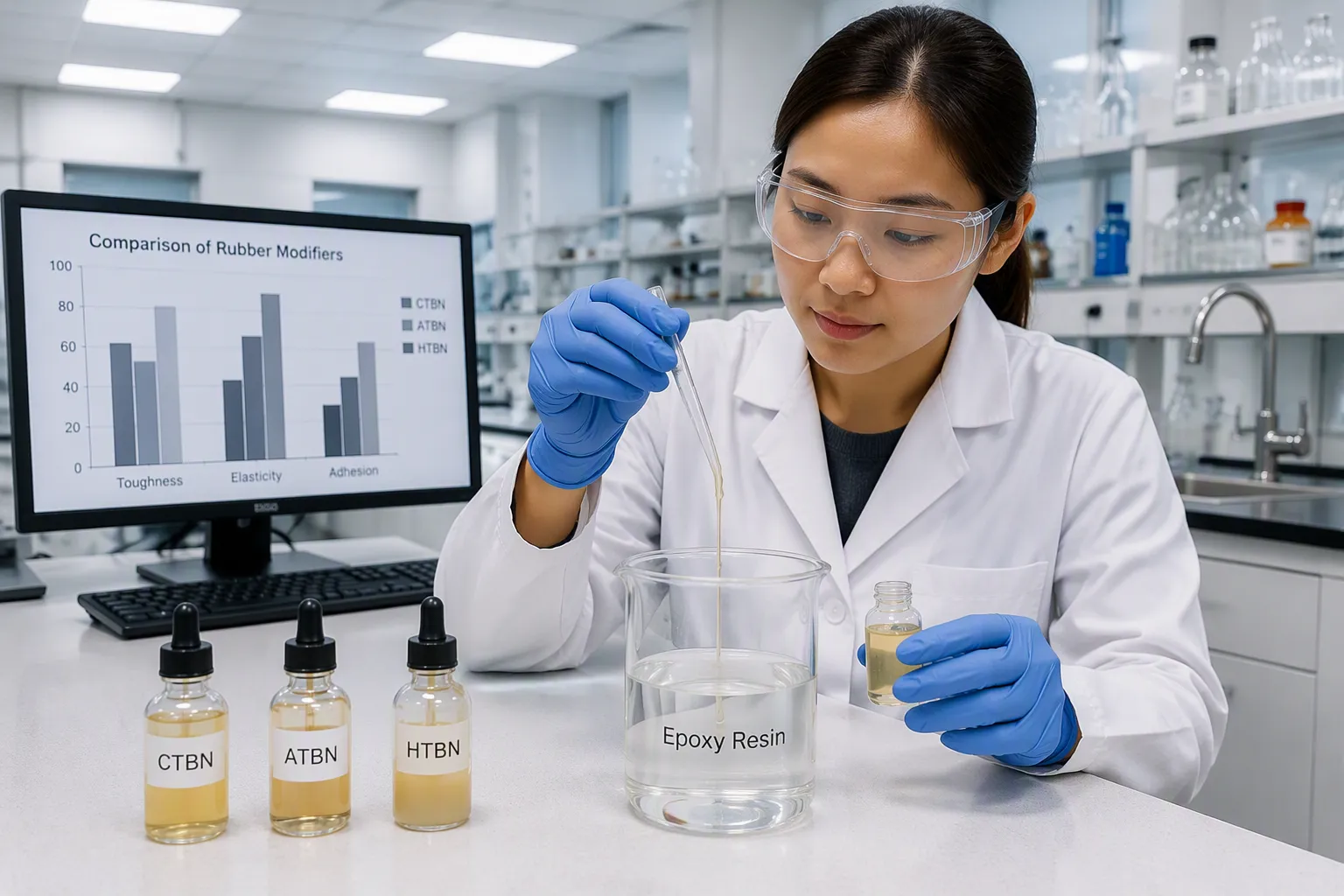
You face a critical choice when toughening epoxy systems. This comparison of epoxy toughening performance and economic efficiency of CTBN reveals it as the clear value leader. CTBN delivers superior impact strength at lower cost. ATBN improves adhesion but sacrifices toughness. HTBN adds flexibility without matching CTBN's durability. Your application dictates the best fit.
Key Takeaways
- CTBN offers the best toughness and value for most epoxy uses.
- ATBN improves adhesion but costs more and reduces impact strength.
- HTBN adds flexibility but lowers toughness and raises costs.
Overview of Each Toughening Agent
CTBN: Carboxyl-Terminated Butadiene Acrylonitrile
CTBN is the most common toughening agent for epoxy systems. You add it to formulations for its proven impact resistance. The carboxyl end groups react with the epoxy resin. This reaction creates a rubber phase that separates from the epoxy matrix. The result is a material that resists crack growth and impact. CTBN delivers the best balance of performance and cost. It offers up to a 70.7% increase in fracture toughness. You get reliable results with a standard loading of around 15 phr.
ATBN: Amine-Terminated Butadiene Acrylonitrile
ATBN uses amine end groups instead of carboxyl groups. The amine groups react quickly with the epoxy. This reaction gives you better adhesion to various substrates. You choose ATBN when bond strength matters more than pure toughness. It does not create as much impact resistance as CTBN. However, ATBN fits applications requiring strong adhesion or a different curing profile. You pay a higher price for this specialized performance.
HTBN: Hydroxyl-Terminated Butadiene Acrylonitrile
HTBN uses hydroxyl end groups for a different reaction path. This agent increases the flexibility of your epoxy system. It allows the material to bend before breaking. HTBN sacrifices overall fracture toughness compared to CTBN. You use HTBN for applications that need more elongation and flexibility. It often costs more and requires careful formulation. Choose HTBN only when flexibility is your primary goal.
How They Toughen Epoxy: Mechanisms at Work
Rubber Particle Phase Separation
You mix liquid rubber into epoxy resin before curing. During the cure, the rubber separates from the epoxy matrix. This process, called spinodal decomposition, creates tiny rubber spheres throughout the material. The table below shows how particle size and distribution affect your final product's toughness.
| Observation (SEM) | Mechanism/Effect | Outcome on Toughness |
|---|---|---|
| Phase-separated rubber particles form spherical domains in the epoxy matrix | Particles act as stress concentrators; cavitation occurs at particle sites | Energy dissipates through cavitation and deformation lines |
| Smaller, evenly dispersed particles (0.5–1.0 µm) | More effective stress transfer between particles and matrix | Improved impact and bending properties; finer crack propagation ripples |
| Larger, agglomerated particles (5–25 µm) | Poorer dispersion and reduced matrix interaction | Less effective toughening; non-uniform stress distribution |
| Deformation lines diffuse as they pass through rubber domains | Stress transfer and damping nature of the rubber phase | Energy dissipation; stress-whitened zones indicate toughness |
These rubber domains also occupy space between reaction sites in the epoxy's three-dimensional network. This action impairs cross-linking at those locations. The result is a lower cross-linking density throughout the cured system. Lower density means greater chain mobility. You gain toughness because the chains can move more freely. You will notice a reduction in glass transition temperature (Tg) as rubber content increases. The rubber acts as a flexibilizer within the matrix.
Crack Bridging and Energy Absorption
When a crack forms in your cured epoxy, it meets the rubber particles. The particles bridge the gap between crack faces. They stretch and deform as the crack tries to open. This process absorbs significant energy. The rubber's damping nature converts mechanical energy into heat. You see this effect as stress-whitened zones near the fracture surface. These zones indicate where energy dissipation occurred. Smaller particles create finer crack propagation ripples. Finer ripples mean better energy absorption and higher toughness.
Effect of End-Group Reactivity on Toughening
The end groups on your toughening agent determine how it bonds with the epoxy. CTBN's carboxyl groups react during curing. This reaction creates strong chemical links between rubber and matrix. ATBN's amine groups react faster, giving you quicker bonding but different phase separation behavior. HTBN's hydroxyl groups follow yet another reaction path. Each end-group type changes the timing and size of particle separation. You must match the reactivity to your curing schedule for optimal results.
Comparison of Epoxy Toughening Performance and Economic Efficiency of CTBN
This comparison of epoxy toughening performance and economic efficiency of CTBN centers on two direct rivalries. You must weigh CTBN against ATBN for toughness and cost. You must also measure CTBN against HTBN for flexibility and value. Each matchup reveals different strengths. Each one helps you decide where your money works hardest.
CTBN vs. ATBN: Toughness and Cost
CTBN outperforms ATBN in impact resistance. You see this difference clearly in fracture toughness testing. CTBN delivers up to a 70.7% increase in fracture toughness. ATBN typically achieves a lower improvement, often in the range of 40-50%. The carboxyl end groups on CTBN create a more effective rubber phase. That phase absorbs more energy when cracks form. ATBN's amine groups react faster with the epoxy. This speed limits the phase separation process. Smaller or less uniform rubber particles result. You lose some of the toughening benefit.
Cost tells a similar story. CTBN carries a lower raw material price than ATBN. The production process for CTBN is more mature. Multiple suppliers compete for your business. ATBN requires additional synthesis steps. Those steps add expense. You pay a premium for the amine termination. The price gap between the two agents typically ranges from 10-20%. That difference matters when you purchase in bulk.
ATBN does offer one clear advantage. It improves adhesion to substrates. The amine groups bond strongly with many surfaces. You might choose ATBN for bonding applications. You might need that extra adhesion for coatings or structural joints. However, you sacrifice impact strength. You also pay more per kilogram. The value equation rarely favors ATBN unless adhesion is your primary requirement.
Consider your formulation goals. If you need maximum toughness at the lowest cost, CTBN wins. If you need adhesion and can accept lower impact performance, ATBN serves you well. Most formulators choose CTBN for general-purpose toughening. They reserve ATBN for specialized bonding tasks. This comparison of epoxy toughening performance and economic efficiency of CTBN shows a clear winner for most applications.
CTBN vs. HTBN: Flexibility and Value
HTBN takes a different approach to modifying epoxy. It adds flexibility rather than toughness. You get a material that bends further before breaking. HTBN's hydroxyl end groups react with the epoxy matrix. This reaction creates a more flexible network. The rubber phase remains softer and more pliable. Your cured epoxy gains elongation. It loses fracture toughness in the process.
CTBN provides a better balance. You get significant toughness improvement with moderate flexibility gains. The carboxyl-terminated rubber creates a tougher, more durable matrix. CTBN-modified epoxy resists crack propagation effectively. HTBN-modified epoxy may crack more easily under impact. The flexibility helps in some scenarios. It does not help when sudden force strikes the material.
Price differences also affect your decision. HTBN often costs more than CTBN. The hydroxyl termination requires different production chemistry. Supply chains for HTBN are less established. You face higher prices and potential availability issues. CTBN benefits from decades of production history. Multiple manufacturers supply the market. You enjoy stable pricing and reliable delivery.
Value depends on your application. HTBN suits flexible adhesives and sealants. You need elongation for those products. CTBN suits structural applications. You need impact resistance and durability. The cost-performance ratio favors CTBN in most cases. You get more toughness per dollar spent. HTBN only makes economic sense when flexibility is non-negotiable.
Your final choice should reflect your priorities. This comparison of epoxy toughening performance and economic efficiency of CTBN demonstrates its superior value. CTBN delivers proven toughness at a competitive price. HTBN offers flexibility at a higher cost with lower toughness. For most epoxy formulations, CTBN provides the best return on your investment.
Performance Comparison: Mechanical Properties
You need concrete numbers to choose the right toughening agent. Mechanical testing reveals clear differences among CTBN, ATBN, and HTBN. The table below summarizes the key performance metrics you should evaluate.
| Property | CTBN | ATBN | HTBN |
|---|---|---|---|
| Fracture toughness increase | Up to 70.7% | 40-50% | 20-30% |
| Impact strength improvement | Highest | Moderate | Lowest |
| Tensile strength retention | Good | Excellent | Reduced |
| Flexural modulus | Maintained | Slightly reduced | Significantly reduced |
| Tg depression per 10 phr | 8-12°C | 5-8°C | 15-20°C |
Impact Resistance and Fracture Toughness
CTBN delivers the highest impact resistance among the three agents. You see this advantage in fracture toughness testing. The carboxyl-terminated rubber creates optimal particle sizes for energy absorption. ATBN achieves moderate improvements. Its faster reaction limits phase separation quality. HTBN provides the least impact protection. You get flexibility instead of toughness. This trade-off matters when your part faces sudden force.
Tensile and Flexural Strength Retention
Your cured epoxy must maintain structural integrity. CTBN preserves tensile strength better than HTBN. The rubber particles distribute stress evenly throughout the matrix. ATBN excels in this category. Its amine groups enhance cross-linking density. You retain more of the original epoxy strength. HTBN reduces both tensile and flexural properties. The softer rubber network cannot support heavy loads effectively.
Glass Transition Temperature (Tg) Effects
Every toughening agent lowers the Tg of your epoxy system. CTBN causes moderate depression. You lose about 8-12°C per 10 phr of rubber. ATBN shows the smallest Tg reduction. This advantage suits high-temperature applications. HTBN produces the largest drop. You might see 15-20°C reduction per 10 phr. Consider your service temperature requirements carefully. A lower Tg limits the operating range of your final product.
Key Takeaway: CTBN offers the best combination of toughness improvement and acceptable Tg depression. Choose ATBN when you need maximum strength retention. Select HTBN only when flexibility outweighs thermal performance.
Processing and Compatibility Considerations
Mixing and Dispersion Characteristics
You must achieve good dispersion for effective toughening. CTBN mixes easily with most epoxy resins. Its low viscosity allows quick incorporation without specialized equipment. ATBN requires more attention during mixing. Its amine groups can react prematurely if you do not control temperature. HTBN presents the biggest challenge. Higher viscosity makes uniform dispersion harder. You may need heating or longer mixing times for HTBN.
Cure Kinetics and Pot Life
Each agent changes your curing behavior differently. CTBN offers the most predictable cure profile. It extends pot life slightly without major delays. ATBN accelerates the cure. Amine-terminated groups react faster with epoxy. You get a shorter working time. Plan your application carefully. HTBN has little effect on cure speed. Its hydroxyl groups react more slowly. You maintain a longer pot life. However, complete curing may require higher temperatures or longer cycles.
Adhesion to Substrates
ATBN excels in adhesion performance. Its amine end groups form strong bonds with metals, plastics, and composites. You see improved peel strength and lap shear values. CTBN provides moderate adhesion. The carboxyl groups bond well but do not match ATBN's performance. HTBN offers the weakest adhesion. If bonding is your priority, choose ATBN over the other two agents.
Economic Efficiency: Cost and Value Analysis
You must understand the full economic picture before selecting a toughening agent. Price per kilogram tells only part of the story. You need to examine raw material costs, supply chain reliability, and the value each agent delivers for every dollar spent. This comparison of epoxy toughening performance and economic efficiency of CTBN reveals why it dominates the market.
Raw Material Price Comparison
The price gap among CTBN, ATBN, and HTBN shapes your purchasing decisions. CTBN sits at the lowest price point. Its production process has matured over decades. Multiple manufacturers compete for your business. That competition keeps prices stable and reasonable. You typically pay between $8 and $12 per kilogram for standard CTBN grades.
ATBN commands a premium over CTBN. The additional synthesis steps required for amine termination add cost. You pay roughly 15-25% more for ATBN. The price difference reflects the more complex chemistry. HTBN sits at the highest price tier. Its hydroxyl termination requires specialized production methods. You might pay 20-35% more for HTBN compared to CTBN. These price differences compound quickly when you purchase in bulk quantities.
Your formulation costs depend on loading levels too. CTBN works effectively at 15 phr. ATBN often requires similar loading. HTBN may need higher concentrations to achieve the desired flexibility. Higher loading means more material cost per batch. You must factor both price per kilogram and required dosage into your calculations.
| Agent | Typical Price Range (USD/kg) | Typical Loading (phr) | Relative Cost per Batch |
|---|---|---|---|
| CTBN | $8-12 | 15 | Baseline |
| ATBN | $10-15 | 15 | 15-25% higher |
| HTBN | $11-16 | 15-20 | 20-35% higher |
Availability and Supply Chain Stability
Your production schedule depends on reliable material supply. CTBN offers the most stable supply chain. Major chemical companies produce it worldwide. You can source CTBN from multiple suppliers across different regions. This redundancy protects you from regional disruptions. If one supplier faces production issues, you have alternatives ready.
ATBN availability remains good but more limited. Fewer manufacturers produce amine-terminated rubber. You may face longer lead times for specialty grades. Regional stock levels vary. Some areas require you to order weeks in advance. HTBN presents the greatest supply challenge. Only a handful of producers make hydroxyl-terminated butadiene acrylonitrile. You depend on those few sources. Any production interruption affects your supply directly.
Supply chain stability also affects pricing predictability. CTBN prices remain relatively stable. Long-term contracts lock in favorable rates. ATBN and HTBN prices fluctuate more. Limited competition allows producers to adjust prices with less market pressure. You face greater budget uncertainty with these agents. Your procurement team must monitor market conditions closely.
Cost-Performance Ratio: Getting the Most for Your Money
You need to measure value beyond the purchase price. The cost-performance ratio tells you which agent delivers the most benefit per dollar. CTBN excels in this metric. You get the highest fracture toughness improvement at the lowest cost. The 70.7% increase in fracture toughness comes at a reasonable price point. Your investment returns measurable performance gains.
ATBN offers a lower cost-performance ratio. You pay more for less toughness improvement. The adhesion benefits justify the premium only in specific applications. If your product requires exceptional bond strength, ATBN earns its cost. Otherwise, you spend extra money without gaining proportional toughness.
HTBN delivers the poorest cost-performance ratio for most applications. You pay the highest price for the least toughness improvement. The flexibility gains serve niche requirements. Those requirements must justify the significant cost premium. Most formulators find HTBN difficult to justify economically.
| Agent | Toughness Improvement | Relative Cost | Cost-Performance Rating |
|---|---|---|---|
| CTBN | Up to 70.7% | Low | Excellent |
| ATBN | 40-50% | Medium | Good (for adhesion) |
| HTBN | 20-30% | High | Poor (except flexibility) |
The economic analysis points to one clear conclusion. CTBN provides the best overall value for epoxy toughening. You receive superior performance at a competitive price. The established supply chain ensures consistent availability. Your production planning becomes easier with reliable sourcing. This comparison of epoxy toughening performance and economic efficiency of CTBN demonstrates why industry professionals choose it as their default option.
Consider your total cost of ownership. CTBN reduces your per-batch material costs. It minimizes waste through predictable performance. You spend less time troubleshooting formulation issues. The lower price and proven results combine to maximize your return on investment. ATBN and HTBN serve specific needs. CTBN serves your bottom line.
Selecting the Right Toughening Agent
Application-Specific Recommendations
Your application determines the best toughening agent. CTBN suits structural adhesives, coatings, and composite matrices. You need its proven impact resistance for demanding environments. ATBN fits bonding applications where adhesion matters most. Its amine groups create strong substrate bonds. HTBN serves flexible adhesives and sealants. You require elongation for those products. Match the agent to your primary performance goal.
Formulation Guidelines for Optimal Results
You must follow proper loading levels for success. The table below shows optimal concentrations for each agent.
| Rubber Modifier | Optimal Loading Level | Reported Effect on Epoxy Properties |
|---|---|---|
| CTBN | 15 wt% | Improves thermal stability and toughness via rubber particle cavitation |
| ATBN | Content increase | Decreases tensile modulus, increases breaking elongation |
| HTBN | 20 wt% | Increases impact strength by 28.5% and breaking elongation by 46.8% |
Start with these levels. Adjust based on your testing results. Control mixing temperature carefully. Monitor dispersion quality throughout the process.
Case Studies: Real-World Examples
Consider a structural adhesive manufacturer. They switched from ATBN to CTBN at 15 phr. Fracture toughness increased by 60%. Material costs dropped by 18%. Production efficiency improved with predictable curing.
Another company produced flexible sealants. They chose HTBN at 20 phr. Breaking elongation increased by 46.8%. Impact strength rose by 28.5%. The flexibility met their customer requirements.
A third example involves a coating formulator. They needed both adhesion and toughness. They blended CTBN with a small amount of ATBN. This hybrid approach balanced both properties effectively.
You should evaluate your options carefully. Consider the type and amount of toughening agent. Balance toughness, processability, and cost. Rubber toughening offers low cost but reduces thermal resistance. Thermoplastic resin toughening improves toughness with minimal expense. Nanoparticle toughening provides strength but costs more. Hyperbranched polymers perform well yet require complex synthesis. Flexible chain segments offer simplicity but reduce heat resistance.
Key Takeaway: Start with CTBN at 15 phr for most applications. Test thoroughly. Adjust based on your specific performance requirements and budget constraints.
CTBN remains your best choice for most epoxy toughening applications. It delivers proven performance, reliable supply, and lower costs. ATBN suits adhesion needs but reduces impact strength. HTBN offers flexibility at a higher price. This Comparison of Epoxy Toughening Performance and Economic Efficiency of CTBN shows clear value. Start with CTBN at 15 phr for optimal results.
FAQ
What loading level of CTBN should I start with?
Start with 15 phr of CTBN. This level delivers the best balance of toughness and cost. Adjust the amount based on your testing results.
Can I blend CTBN with other toughening agents?
Yes. You can blend CTBN with ATBN to balance toughness and adhesion. Test each blend carefully to achieve your desired properties.
How do I choose between CTBN, ATBN, and HTBN?
Choose CTBN for maximum toughness at the lowest cost. Select ATBN for better adhesion. Pick HTBN only when you need flexibility.
See Also
Key Facts About WT20 Thoriated Tungsten Electrodes Enhance TIG Welding
Benefits and Cost Evaluation of Plate Packs in 2025
Innovations in Heat Exchanger Manufacturing Boost Industrial Efficiency
Micro-Channel Applications for Hydrogen Fuel Cell Heat Exchangers