Understanding the Application Variances of Conventional and Sublimed Fullerene C60
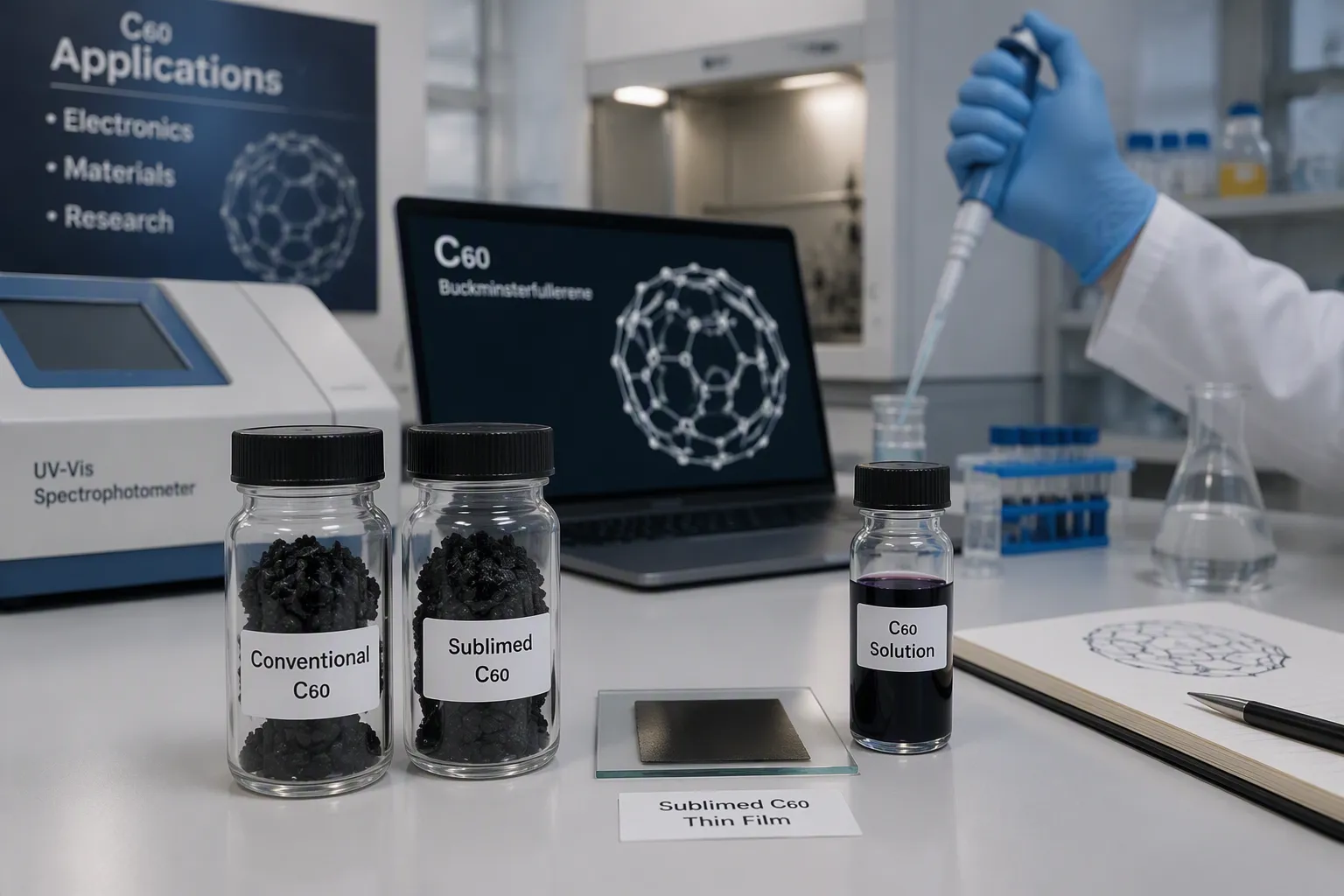
Sublimed fullerene C60 offers high purity necessary for electronics and advanced research. Conventional fullerene C60 fits cost-sensitive applications like cosmetics and lubricants. Fullerene C60 Conventional Grade and Sublimed Grade each suit different application needs. The buyer selects based on required purity level, sensitivity of the application, and budget.
Key Takeaways
- Conventional fullerene C60 fits cosmetics, lubricants, and teaching labs because of its lower cost.
- Sublimed fullerene C60 offers high purity for electronics, biomedical research, and quantum devices.
- Buyers should verify the grade with a certificate of analysis to match the application.
Fullerene C60 Conventional Grade and Sublimed Grade: Key Differences
Purity Levels and Their Origins
Purity separates these two grades. Conventional C60 typically ranges from 99% to 99.9%. Sublimed C60 reaches 99.9% to 99.95+%. Suppliers like Cheap Tubes recommend sublimed-grade 99.95+% for applications where trace solvent residue or sublimation contaminants matter.
| Grade | Purity Range | Example Listings |
|---|---|---|
| Conventional (non-sublimed) C60 | 99% – 99.9% | Fullerene - C60, Min. 99%; Fullerene C60 (purity: 99.5wt%); Fullerene C60 (purity: 99.9wt%) |
| Sublimed C60 | 99.9%+ – 99.95+% | Fullerene Powder, Sublimed, 99.9+% C60; sublimed-grade 99.95+% |
Production Methods: Sublimation vs. Standard Synthesis
Standard synthesis produces conventional C60. This method leaves behind impurities. Interstitial oxygen molecules occupy octahedral voids in C60 crystals. Oxygen also forms stable complexes with fullerene, including epoxide (C60O), annulene configuration, and ether-bridged dimer (C60-O-C60). Water adsorption presents another challenge. C60 exhibits a high affinity for water, with a free energy of hydration of −90.5 mJ/m². The binding energy of H2O to isolated gas-phase C60 is 0.34 eV. This value increases to 0.56 eV when H2O sits in the octahedral interstitial void. Sublimation removes these contaminants through repeated heating and condensation cycles.
How Purity Affects Material Properties
Impurities disrupt electron transport. They create physical barriers and energetic traps that capture electrons. In organic field-effect transistors (OFETs), unpurified C60 introduces a high density of charge-carrier traps. This reduces mobility and causes inconsistent device performance. Unpurified C60 typically shows a threshold voltage around 17.9 V. Adding an ultra-low concentration of an n-dopant (about 10^-3 relative to fullerene) fills existing traps. The threshold voltage then drops dramatically to 4.7 V. Higher purity reduces trap density and improves electron transport behavior.
| Purity Grade | Product Code | Relevance to Electron Mobility |
|---|---|---|
| ≥ 99.50% | SOL5060X | Suitable for exploratory work, but may still contain enough impurities to affect charge transport. |
| ≥ 99.90% | SOL5060W | Higher purity for more reliable semiconductor behavior. |
| ≥ 99.95% (Ultra-High Grade) | SOL5060Y | Reduces impurity-related traps and improves consistency. |
| ≥ 99.99% | SOL5060YY | Very high purity for demanding organic electronic applications. |
| ≥ 99.99% (Sublimed) | SOL5060S | Best performance for research-grade devices; eliminates solvent-related variability. |
Applications of Conventional Fullerene C60
Conventional fullerene C60 serves industries that prioritize cost efficiency over ultra-high purity. Cosmetics, lubricants, and educational settings represent three major areas where this grade performs well. Each application tolerates the trace impurities that remain after standard synthesis. The sections below examine how conventional C60 functions in these roles.
Use in Cosmetics and Skincare
The cosmetics industry embraces conventional fullerene C60 for its antioxidant properties. C60 molecules scavenge free radicals that damage skin cells. This activity slows visible signs of aging. Formulators dissolve C60 in carrier oils such as squalane to create stable emulsions.
Clinical research supports these claims. A randomized, matched-pair, double-blind trial tested a cream containing highly purified, organic solvent-free fullerene-C60 dissolved in olive-oil-derived squalane at a near-saturated concentration of 278 ppm. The study enrolled 23 Japanese women in an 8-week trial. Participants applied the cream twice daily to one half of the face and a placebo cream to the other half. The fullerene cream increased skin moisture and supported anti-wrinkle formation. It showed no effect at week 4. By week 8, it performed significantly better than placebo (p < 0.05) without severe side effects. The roughness-area ratio improved significantly from baseline to week 8. The authors concluded that this formulation could serve as an active ingredient for wrinkle-care cosmetics.
Actual concentrations in commercial products vary widely. A survey of off-the-shelf cosmetics detected C60 in four out of five products. Concentrations ranged from 0.04 to 1.1 μg/g (ppm).
| Sample ID | Matrix | LLE (μg-C60/g) | Toluene Sonication (μg-C60/g) | SPE (μg-C60/g) |
|---|---|---|---|---|
| 1 | Serum | 1.0 ± 0.3 | 0.40 | 0.42 |
| 2 | Serum | ND | 0.04 | 0.24 |
| 3 | Cream | 1.1 ± 0.2 | 0.48 | 0.04 |
| 4 | Cream | ND | ND | 0.04 |
| 5 | Water | ND | NA | ND |
ND = No Detection; NA = Not Analyzed.
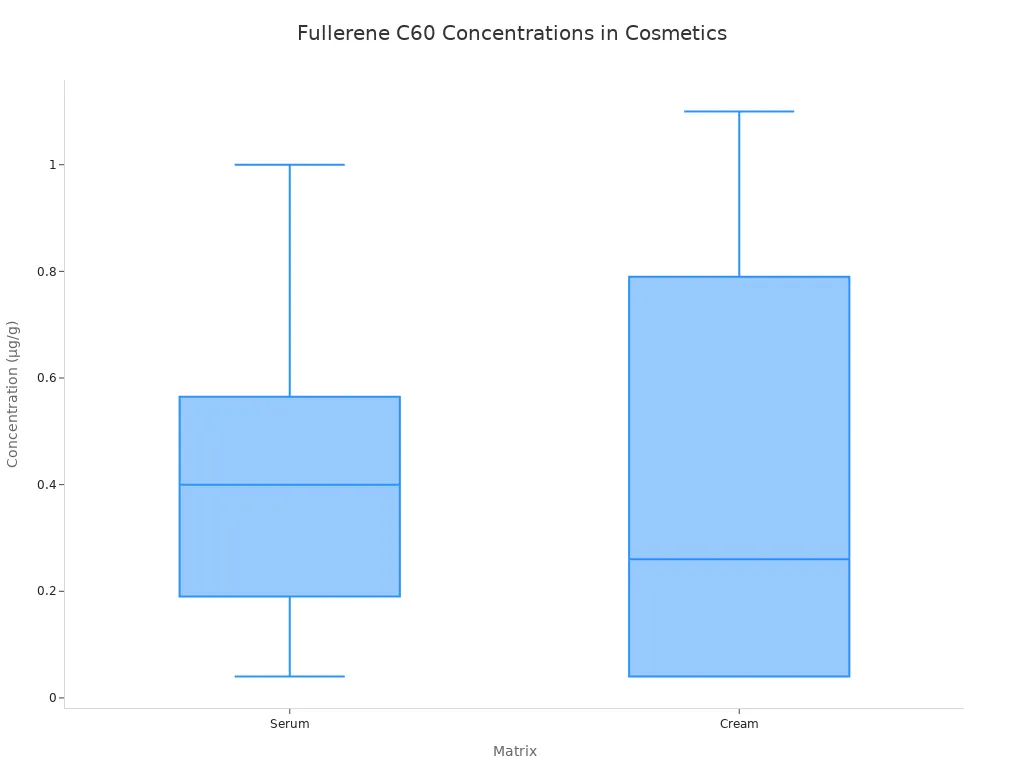
These measured values fall far below the concentrations claimed in some patent applications.
Although some patent applications for the use of fullerenes in cosmetic formulations report fullerene contents of up to 9% by weight, the fullerene contents of off-the-shelf products need to be quantified. Actual measured concentrations in commercial cosmetics were much lower, ranging from 0.04 to 1.1 μg/g.
This gap between patent claims and real-world products highlights the importance of verifying fullerene content. Conventional grade C60 provides sufficient purity for these cosmetic applications at a reasonable cost.
Role in Lubricants and Additives
Fullerene C60 functions as a molecular ball bearing in lubricant formulations. Its spherical geometry allows molecules to roll between sliding metal surfaces. This action converts sliding friction into rolling friction. Lubricant additives containing C60 reduce friction coefficients by 10–30% in metal-on-metal contacts. They remain effective in high-vacuum and extreme-pressure environments where conventional lubricants fail.
Research by Bhushan et al. (1993) in ASLE Transactions investigated sublimed C60 films for solid lubrication. The study noted that C60 molecules pack in a face-centered cubic lattice held by weak van der Waals attractions. These molecules possess low surface energy, high chemical stability, a spherical shape, and high load-bearing capacity. The authors proposed a mechanism for self-lubricating action and reported friction and wear performance across various operating environments. They concluded that C60 may be a promising solid lubricant owing to its unique crystal structure and bonding.
Three mechanisms explain how C60 reduces friction and wear:
- Nano-Ball Bearing Effect: C60's spherical geometry and high mechanical strength allow the molecules to act as molecular-scale ball bearings, converting sliding friction between surface asperities into rolling friction.
- Mending and Surface Smoothing: Under high pressure, the ultra-small (~0.7 nm) C60 spheres are forced into surface micro-cracks and valleys, smoothing surface roughness and distributing contact stresses more evenly.
- Tribofilm Formation: Under extreme pressures and flash temperatures, C60 molecules and hydrocarbon fragments react at the friction interface to form a highly elastic, protective carbonaceous tribofilm that prevents direct metal-to-metal contact.
Performance data across additive types show how C60 compares to other nanomaterials.
| Additive Type | Optimal Concentration | COF Reduction | Wear Rate Reduction | Dispersion Stability |
|---|---|---|---|---|
| Fullerene (C60) | 0.05% – 0.25 wt% | Up to 10% | 45% – 81% | Excellent |
| Carbon Nanotubes (MWCNTs) | 0.05% – 0.20 wt% | ~20% | Moderate | Poor |
| Graphene Sheets (rGO) | 0.05% – 0.075 wt% | 30% – 65% | 50% – 80% | Poor |
| Titanium Dioxide (TiO2) | 0.30 wt% | Up to 86% | High | Moderate |
Fullerene C60 offers excellent dispersion stability. This property makes it easier to blend into lubricant formulations. Conventional grade C60 provides adequate purity for these tribological applications. The cost savings compared to sublimed grade make it attractive for industrial lubricant production.
Applications in Basic Research and Education
Academic institutions and teaching laboratories use conventional fullerene C60 for foundational experiments. Students learn about carbon allotropes through hands-on activities. They explore the unique properties of buckminsterfullerene in chemistry and physics courses.
Undergraduate laboratories employ C60 in spectroscopy experiments. Students record UV-Vis absorption spectra and identify characteristic peaks. They also perform electrochemistry experiments to study electron transfer properties. These exercises teach fundamental concepts without requiring expensive ultra-high-purity materials.
Graduate research projects often begin with conventional grade C60. Researchers test hypotheses and develop methods before scaling up. If initial results show promise, they may switch to sublimed grade for final experiments. This staged approach saves money during the exploratory phase.
Materials science courses use C60 to demonstrate self-assembly principles. Students observe how molecules form ordered structures through weak interactions. They learn about van der Waals forces and crystal packing. These lessons connect theoretical concepts to real materials.
Educational institutions also use C60 in nanotechnology demonstrations. Students visualize molecular structures using 3D models and computer simulations. They compare C60 to other carbon forms like graphite and diamond. This comparison highlights how atomic arrangement determines material properties.
The choice between Fullerene C60 Conventional Grade and Sublimed Grade depends on the specific educational goal. Introductory courses benefit from the lower cost of conventional grade. Advanced research projects may require the higher purity of sublimed material. Educators should match the grade to the learning objectives and available budget.
Conventional fullerene C60 enables affordable exploration across cosmetics, lubricants, and education. Each application benefits from the material's unique properties without demanding extreme purity. The next section examines applications that require the higher purity of sublimed grade.
Applications of Sublimed Fullerene C60
Sublimed fullerene C60 serves fields that demand the highest purity levels. Organic electronics, biomedical research, and quantum technology all depend on material free from trace contaminants. Each field exploits a different property of the molecule. The sections below explore how sublimed grade C60 enables breakthroughs in these advanced areas.
Use in Organic Electronics and Photovoltaics
Organic electronics require materials with exceptional purity. Trace impurities create charge traps that degrade device performance. Sublimed fullerene C60 eliminates these traps through repeated sublimation cycles. This purification step removes solvent residues, oxygen complexes, and water molecules that standard synthesis leaves behind.
Organic field-effect transistors (OFETs) represent a primary application. C60 functions as the n-type semiconductor in these devices. Electrons travel through the fullerene lattice when the transistor operates. Impurities block this flow and reduce electron mobility. Researchers measure mobility in square centimeters per volt-second (cm²/V·s). Conventional grade C60 typically delivers mobility around 0.1 to 0.5 cm²/V·s. Sublimed grade pushes mobility above 1 cm²/V·s in optimized devices. Some research groups report values exceeding 5 cm²/V·s with careful device engineering.
The threshold voltage tells a similar story. Unpurified C60 shows a threshold voltage near 17.9 V. This high value indicates trapped charges that must be overcome before the device turns on. Adding a tiny amount of n-dopant fills these traps. The threshold voltage then drops to 4.7 V. Sublimed grade C60 achieves low threshold voltages without doping. This simplifies device fabrication and improves reproducibility.
Organic photovoltaics (OPVs) also benefit from sublimed C60. These solar cells use fullerene as an electron acceptor material. The fullerene accepts electrons from a donor polymer after light absorption. Electrons then travel through the fullerene phase to reach the electrode. Impurities in the fullerene phase create recombination centers. Electrons and holes meet at these centers and annihilate without producing current. Sublimed C60 reduces recombination and boosts power conversion efficiency.
| Parameter | Conventional C60 | Sublimed C60 |
|---|---|---|
| Electron mobility (cm²/V·s) | 0.1 – 0.5 | > 1 (up to 5+) |
| Threshold voltage (V) | ~17.9 (undoped) | < 5 |
| Trap density | High | Low |
| OPV efficiency contribution | Moderate | High |
| Reproducibility | Variable | Consistent |
Perovskite solar cells represent a newer frontier. These cells use a perovskite layer to absorb light. Fullerene C60 sits between the perovskite and the metal electrode. It extracts electrons and blocks holes from reaching the electrode. This selective contact reduces recombination losses. Sublimed C60 forms smoother films with fewer pinholes. Pinholes allow the perovskite to contact the metal directly. This contact degrades performance and stability. High-purity C60 prevents these defects and extends device lifetime.
Flexible electronics offer another growing market. These devices bend and fold without breaking. C60's molecular nature allows it to form thin, flexible films. Sublimed grade ensures these films conduct electrons reliably. Manufacturers use C60 in flexible displays, wearable sensors, and electronic skin. The purity requirement for these applications continues to rise as device dimensions shrink.
Application in Advanced Biomedical Research
Biomedical research demands materials with well-defined properties. Sublimed fullerene C60 provides the consistency that biological experiments require. Trace impurities can trigger unexpected biological responses. They can also interfere with sensitive assays. High-purity C60 eliminates these variables.
Drug delivery systems represent a major research area. C60's hollow cage structure can encapsulate therapeutic molecules. Researchers functionalize the cage surface with targeting groups. These groups direct the fullerene to specific cells or tissues. The cage then releases its payload at the target site. This approach reduces side effects and improves drug efficacy. Sublimed C60 ensures that the delivery vehicle itself does not cause toxicity. Impurities in conventional grade might introduce unknown biological effects.
Photodynamic therapy (PDT) uses light to activate drugs. C60 absorbs light and generates reactive oxygen species (ROS). These ROS destroy nearby cancer cells. The mechanism requires precise control over ROS generation. Impurities can quench ROS or generate them unpredictably. Sublimed C60 provides consistent ROS output for reproducible therapy. Researchers attach targeting molecules to C60 and test PDT efficacy in cell cultures and animal models.
Antioxidant research also employs sublimed C60. The molecule scavenges free radicals through its conjugated double bond system. This activity protects cells from oxidative stress. Neurodegenerative diseases like Alzheimer's and Parkinson's involve oxidative damage. Researchers study whether C60 can slow disease progression. The experiments require C60 free from pro-oxidant impurities. Some impurities actually promote oxidation rather than prevent it. Sublimed grade avoids this problem.
Bioimaging applications use C60 as a contrast agent. The molecule can be functionalized with fluorescent tags or magnetic particles. These modified fullerenes accumulate in specific tissues. Imaging techniques then detect the fullerene signal. This approach helps researchers visualize biological processes in real time. High-purity C60 ensures that the imaging signal comes from the fullerene itself. Impurities might create background noise or false signals.
| Biomedical Application | Role of Sublimed C60 | Purity Requirement |
|---|---|---|
| Drug delivery | Encapsulation vehicle | > 99.9% |
| Photodynamic therapy | ROS generator | > 99.9% |
| Antioxidant research | Free radical scavenger | > 99.9% |
| Bioimaging | Contrast agent | > 99.9% |
| Gene therapy | DNA delivery vector | > 99.9% |
Toxicology studies require the purest possible materials. Researchers test whether C60 causes harm to cells or organisms. Any toxicity observed must come from the fullerene itself. Impurities would confound the results. Sublimed C60 provides the clean baseline that toxicology demands. Studies using sublimed C60 generally show low toxicity in cell cultures. Animal studies confirm that high-purity C60 does not cause acute harm at tested doses.
Role in Quantum Computing and Nanotechnology
Quantum computing represents the cutting edge of technology. These computers use quantum bits (qubits) to process information. Qubits can exist in multiple states simultaneously. This property enables calculations that classical computers cannot perform. Fullerene C60 has emerged as a promising qubit platform.
The molecule's spherical shape and well-defined structure make it ideal for quantum applications. Researchers can embed a nitrogen atom inside the C60 cage. This creates an endohedral fullerene called N@C60. The nitrogen atom's electron spin serves as a qubit. The surrounding carbon cage protects the spin from environmental noise. This protection preserves quantum information for longer periods. Sublimed C60 provides the pristine cage structure that these experiments require.
Quantum sensing uses similar principles. A single N@C60 molecule can detect magnetic fields with extreme sensitivity. The electron spin responds to tiny magnetic field changes. Researchers read this response to measure the field. Applications include medical imaging and materials characterization. The sensitivity depends on the spin coherence time. Impurities in the C60 cage shorten this time. Sublimed grade C60 maximizes coherence and sensitivity.
Molecular electronics explores using single molecules as circuit components. C60 can function as a molecular transistor, diode, or switch. Researchers attach electrodes to a single C60 molecule. They then measure electron flow through the molecule. The molecule's discrete energy levels create unique electronic behavior. This behavior differs from bulk materials. Sublimed C60 ensures that measurements reflect the molecule's intrinsic properties. Impurities would introduce unpredictable effects.
Nanotechnology uses C60 as a building block for larger structures. The molecule can self-assemble into ordered arrays. These arrays serve as templates for nanoscale fabrication. Researchers grow metal nanoparticles on C60 templates. The template controls the nanoparticle size and spacing. This control enables precise tuning of optical and electronic properties. Sublimed C60 provides the uniform building blocks that self-assembly requires.
| Quantum Application | C60 Role | Key Property |
|---|---|---|
| Quantum computing | Qubit host (N@C60) | Long spin coherence |
| Quantum sensing | Magnetic field sensor | High sensitivity |
| Molecular electronics | Single-molecule device | Discrete energy levels |
| Nanofabrication | Self-assembly template | Uniform structure |
| Spintronics | Spin transport medium | Long spin diffusion length |
Spintronics uses electron spin rather than charge to carry information. C60 shows promise as a spin transport material. Electrons travel through C60 films while maintaining their spin orientation. This spin diffusion length determines how far information can travel. Sublimed C60 achieves spin diffusion lengths exceeding 100 nanometers at room temperature. Conventional grade falls short due to spin scattering at impurity sites.
The choice between Fullerene C60 Conventional Grade and Sublimed Grade becomes critical in these quantum applications. A single impurity can destroy a qubit's coherence. One trap site can block spin transport. The higher cost of sublimed grade pays for itself through reliable experimental results. Researchers cannot afford to repeat experiments because of material variability.
These three application areas share a common thread. Each demands purity levels that only sublimation can achieve. Organic electronics needs trap-free films. Biomedical research needs consistent biological responses. Quantum technology needs protected quantum states. Sublimed fullerene C60 delivers these requirements. The next section examines the cost and availability trade-offs that buyers must consider.
Cost and Availability Trade‑offs
Price Comparison: Conventional vs. Sublimed
Sublimed fullerene C60 costs significantly more than conventional grade. The extra purification steps drive up the price. Buyers pay for the repeated heating and condensation cycles that remove impurities.
| Grade | Typical Price Range (per gram) | Purity Level |
|---|---|---|
| Conventional C60 | $50 – $150 | 99% – 99.9% |
| Sublimed C60 | $200 – $500+ | 99.9% – 99.99% |
Prices vary by supplier, order quantity, and market conditions. Bulk orders reduce the per-gram cost for both grades.
Supply Chain and Sourcing Considerations
Sublimed C60 has fewer suppliers than conventional grade. Production requires specialized equipment and expertise. Lead times can stretch to several weeks for large orders. Conventional C60 ships faster because more manufacturers produce it.
Buyers should verify supplier reputation before purchasing. Established suppliers provide consistent quality and reliable delivery. New suppliers may offer lower prices but carry higher risk.
When the Higher Cost is Justified
The choice between Fullerene C60 Conventional Grade and Sublimed Grade depends on application needs. High-precision work justifies the premium for sublimed material. Organic electronics, quantum research, and biomedical studies require the purest form available.
Conventional grade works well for cosmetics, lubricants, and teaching labs. These applications tolerate trace impurities without performance loss. The cost savings allow larger-scale production and broader experimentation.
Buyers should calculate the total cost of ownership. Failed experiments from impure material waste time and money. In critical applications, the higher upfront cost of sublimed C60 pays for itself through reliable results.
How to Verify the Grade of Fullerene C60
Buyers must confirm the grade before they purchase. Verification protects experiments, products, and budgets. The steps below help buyers check Fullerene C60 Conventional Grade and Sublimed Grade with confidence.
Certificate of Analysis (COA) Requirements
Every reputable supplier provides a Certificate of Analysis. This document reports the measured purity of the batch. It lists test methods, batch numbers, and production dates. The COA should state a purity value of 99% or higher for conventional grade. Sublimed grade should show 99.9% or higher. Buyers should match the COA batch number to the product label. A missing or generic COA signals a problem.
Third‑Party Testing Methods (HPLC, TGA, Mass Spec)
Independent laboratories verify purity with several instruments. Each method reveals different information about the sample.
| Method | What It Measures | Typical Use |
|---|---|---|
| HPLC | Purity percentage and impurity peaks | Routine grade confirmation |
| TGA | Solvent and moisture content | Detecting residual contaminants |
| Mass Spec | Molecular weight and structure | Confirming C60 identity |
HPLC separates C60 from other fullerenes and impurities. TGA measures weight loss as the sample heats. Mass spectrometry confirms the molecular identity of the material.
Red Flags When Purchasing
Buyers should watch for warning signs during the buying process.
A price far below market rate, missing documentation, or vague purity claims often indicates low-quality or mislabeled material.
Other red flags include unclear supplier contact information, no return policy, and pressure to buy quickly. Buyers should request a sample before large orders.
Fullerene C60 Conventional Grade and Sublimed Grade serve different purposes. Conventional grade saves money for cosmetics, lubricants, and teaching labs. Sublimed grade delivers the purity that electronics, biomedical work, and quantum research demand. Buyers should always request a certificate of analysis and verify purity before purchasing. They must match the grade to their application's purity needs and budget. The final decision balances performance requirements against cost.
FAQ
What distinguishes conventional fullerene C60 from sublimed fullerene C60?
Conventional C60 contains trace impurities from standard synthesis. Sublimed C60 undergoes extra purification cycles. This process removes solvent residues, oxygen, and water molecules.
How does a buyer select the right grade of fullerene C60?
The buyer matches purity needs to the application. Cosmetics and lubricants work well with conventional grade. Electronics and quantum research require sublimed grade.
Why does sublimed fullerene C60 cost more than conventional grade?
Sublimation requires specialized equipment and multiple heating cycles. These steps consume more time and energy. Fewer suppliers produce sublimed grade material.
See Also
Evidence-Based Strategies For Enhancing 2 5-Furandicarboxylic Acid Sustainability
Novel Uses Of N,N-Dimethyl-N,N-Diphenylurea Across Diverse Industrial Sectors
Examining The Purpose And Construction Of Molybdenum High-Temperature Furnaces
Unexpected Methods For Resolving Sulfur Recovery Catalyst Issues
Grasping Molybdenum High-Temperature Furnace Technology In 2025