Key Players in Concentrated Nitric Acid Supply and Current Market Rates
You can find the leading suppliers of concentrated nitric acid in 2025 below:
- LSB INDUSTRIES, INC (U.S.)
- Dyno Nobel (Australia)
- Longsheng Group (China)
- Cangzhou Dahua Group Co., Ltd. (China)
- Jinan Yingdong Chemical Co., Ltd. (China)
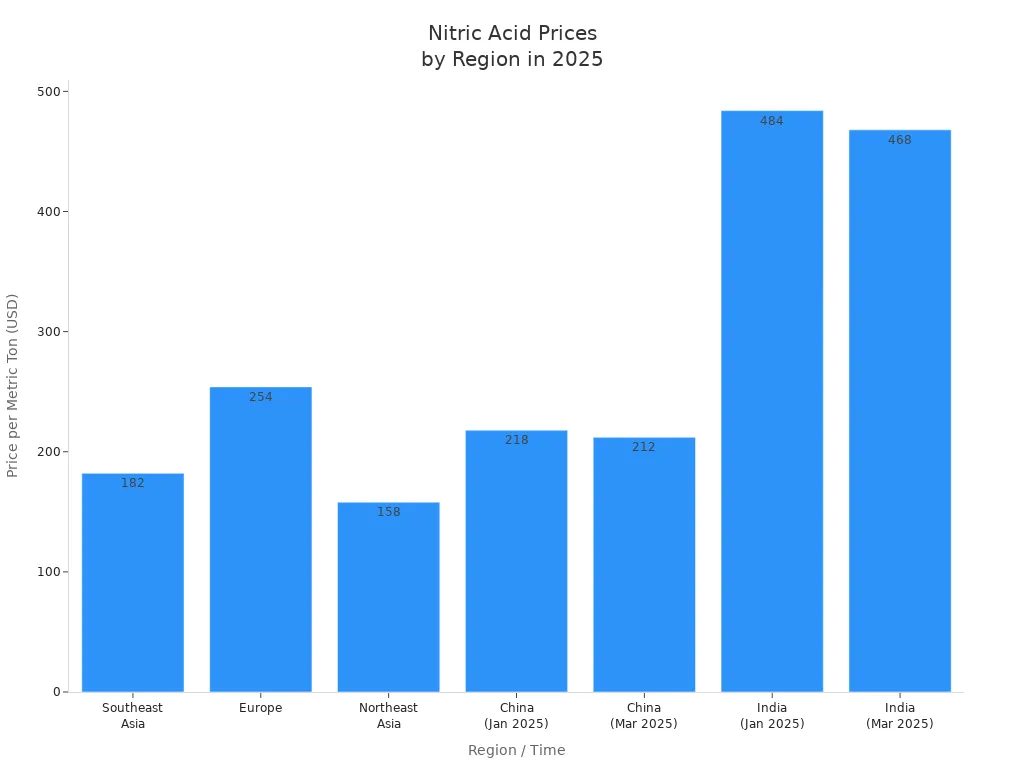
The average market price for concentrated nitric acid varies by region. Here is a quick overview:
| Region | Price per Metric Ton (USD) |
|---|---|
| Southeast Asia | 182 |
| Europe | 254 |
| Northeast Asia | 158 |
| China (Jan 2025) | 218 |
| China (Mar 2025) | 212 |
| India (Jan 2025) | 484 |
| India (Mar 2025) | 468 |
Concentrated Nitric Acid Top Suppliers Overview
Global Leaders in Concentrated Nitric Acid
You will find that several companies stand out as the largest producers of concentrated nitric acid worldwide. These companies have built strong reputations for their high production volumes and reliable supply. When you look at the global market, you see these names leading the way:
- GNFC Limited
- Koch Fertilizer, LLC
- DFPCL
- Rashtriya Chemicals and Fertilizers Limited
- The Chemours Company
- INEOS Capitals, Limited
- The Dow Chemical Company
- Sasol Limited
- LSB Industries
- UBE INDUSTRIES, LTD.
- Linde
- Hanwha Corporation
- BASF SE
- CF Industries Holdings, Inc.
- Yara
These companies operate large-scale plants and serve customers across many countries. They help meet the growing demand for concentrated nitric acid in industries like agriculture, mining, and chemical manufacturing. The market for concentrated nitric acid is expanding. In 2025, you can expect the market to grow by about 4.6%, reaching over $24 billion. This growth comes from rising needs in fertilizer production, explosives for mining, and chemicals for electronics and metallurgy.
Tip: When you choose a supplier, consider their global reach and ability to deliver consistent quality and volume.
Regional Key Players in Concentrated Nitric Acid
You will notice that different regions have their own leading suppliers. These companies play a key role in meeting local demand and supporting regional industries. Here is a table that shows some of the top suppliers by region:
| Supplier | Region |
|---|---|
| EuroChem | Global |
| Yara International | Global |
| CF Industries | North America |
| Agrium Inc. | North America |
| Deepak Fertilisers | Asia-Pacific |
| Hanwha Corporation | Asia-Pacific |
| Koch Fertilizers LLC | North America |
| LSB Industries | North America |
| National Chemical Group | Europe |
| OCI N.V. | Europe |
| Shandong Fengyuan | Asia-Pacific |
| Ube Industries | Asia-Pacific |
In North America, you will often work with companies like CF Industries, Agrium Inc., Koch Fertilizers LLC, and LSB Industries. These suppliers have strong distribution networks and large production capacities. In Europe, National Chemical Group and OCI N.V. are important players. They support industries such as agriculture and chemical manufacturing. In the Asia-Pacific region, Deepak Fertilisers, Hanwha Corporation, Shandong Fengyuan, and Ube Industries lead the market. For example, Grupa Azoty SA in Poland recently increased its capacity to 80,000 metric tons per year, showing how regional suppliers continue to invest in growth.
You will see that the main end-use industries for concentrated nitric acid include agriculture, mining, chemical manufacturing, electronics, and metallurgy. These industries drive demand and shape the strategies of regional suppliers.
Concentrated Nitric Acid Current Market Prices
Global Average Prices for Concentrated Nitric Acid
You can see that the global market for concentrated nitric acid shows clear price differences. The average price per metric ton changes based on where you buy it. In 2025, the global average price sits between $180 and $480 per metric ton. This range depends on supply, demand, and local costs.
You will notice that several factors shape these prices. Strong demand from the chemical, pharmaceutical, and fertilizer industries keeps prices steady. These industries use concentrated nitric acid in many production processes, such as making fertilizers and explosives. When you look at the market, you see that supply chain disruptions can also affect prices. If raw materials like ammonia or natural gas become harder to get, prices may rise quickly.
Here is a table that shows how global economic trends influence the supply and pricing of concentrated nitric acid:
| Evidence Type | Description |
|---|---|
| Market Demand | Strong market demand comes from the chemical, pharmaceutical, and fertilizer industries. Concentrated nitric acid is important for making fertilizers and explosives. |
| Supply Chain Disruptions | Ongoing supply chain disruptions in raw materials challenge the stability of prices and availability. You need to plan for these risks when sourcing concentrated nitric acid. |
| Regulatory Impact | Environmental regulations are getting stricter. Agencies like the EPA and WHO set new rules for emissions, which can raise production costs and affect prices. |
| Emerging Economies | Countries in Asia and Africa are using more concentrated nitric acid. As these economies grow, demand rises, especially in fertilizer and chemical production. |
Note: The fertilizer industry uses over 80% of all concentrated nitric acid produced. This high demand keeps the market active and prices stable.
You should also know that the market is growing. Experts expect the nitric acid market to grow at a rate of 3.10% each year from 2024 to 2029. The total market size could reach 78.44 million tons by 2029.
Regional Price Variations for Concentrated Nitric Acid
When you compare prices across regions, you find big differences. These differences come from local costs, demand, and how much each region produces. Here is a table that shows the price per metric ton in three major markets:
| Region | Price (US$ per MT) |
|---|---|
| USA | 294 |
| China | 280 |
| Germany | 444 |
You can see that Germany has the highest price among these regions. The United States and China have lower prices, but they still show some variation. These price differences happen for several reasons:
- Fluctuations in the price of natural gas and ammonia, which are key raw materials for making concentrated nitric acid.
- Demand from industries like agriculture and explosives, which can push prices up or down.
- Regional dynamics, such as how much a country has industrialized and what farming practices it uses.
If you work in a region with high demand or strict regulations, you may pay more for concentrated nitric acid. In places where raw materials are cheaper or more available, prices tend to be lower.
Tip: Always check local market trends and supply chain conditions before making a purchase. This helps you get the best price and avoid unexpected costs.
You should expect prices to keep changing over the next year. As demand from the fertilizer industry grows, prices may rise. The market will likely stay active, with new opportunities in emerging economies.
Concentrated Nitric Acid Supplier Comparison
Quality, Capacity, and Reliability
When you compare suppliers, you should look at their quality standards, production capacity, and reliability. High-quality concentrated nitric acid ensures safety and efficiency in your operations. Suppliers with strong reputations often have high review scores and excellent on-time delivery rates. The table below shows how some leading companies perform:
| Company Name | Review Score | On-time Delivery | Reorder Rate |
|---|---|---|---|
| Nutrtech Biohealth Co., Ltd. | 5.0 | 100.0% | 21% |
| Chengdu Deyinrunzhu Biotechnology Co., Ltd. | 4.7 | 96.0% | 21% |
| Guangzhou Yuanzhi Biological Technology | 4.7 | 97.8% | 26% |
| Xi'an Aladdin Biological Technology | 4.6 | 96.5% | 33% |
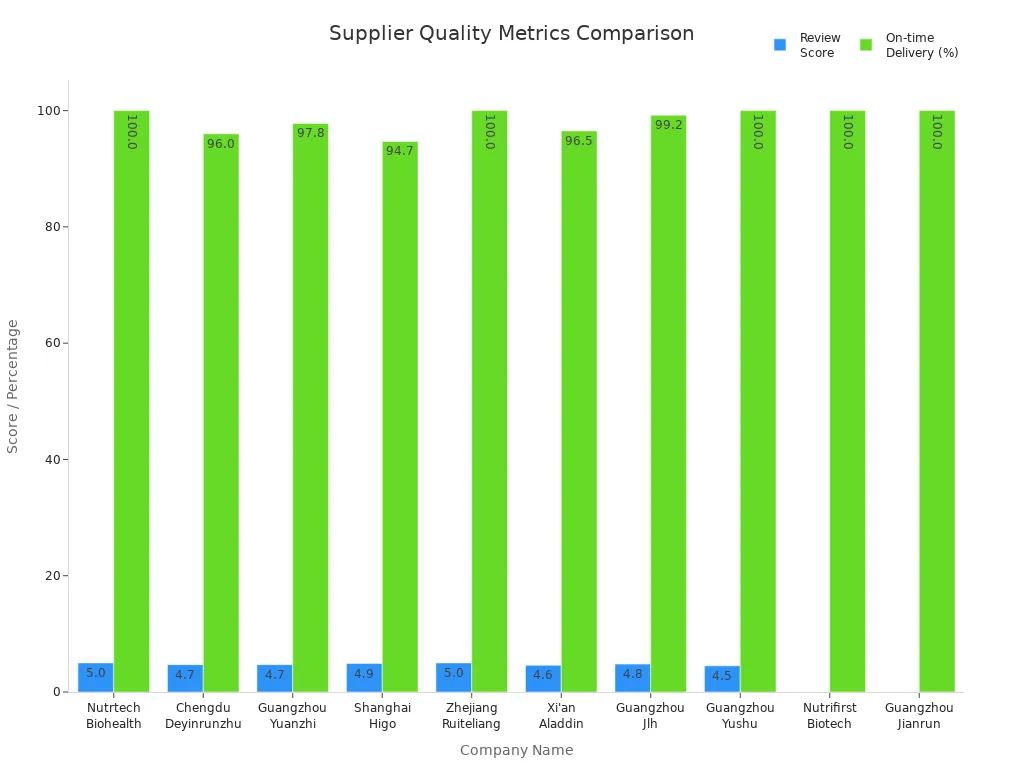
You should also consider safety and environmental compliance. Many buyers choose suppliers with strong safety records and good environmental practices. These suppliers help you meet regulations and reduce risks. Reliable partners support your business by delivering on time and following safety standards.
Note: A supplier that values safety and environmental responsibility can help you build trust and meet your sustainability goals.
Pricing Terms and Contract Options
You will find that pricing terms and contract options vary among suppliers. Some offer flexible minimum order quantities, which can help you manage costs. The table below shows examples of minimum order quantities:
| Minimum Order Quantity | Supplier Link |
|---|---|
| 1 piece | View |
| 1 set | View |
| 20 kilograms | View |
| 10 grams | View |
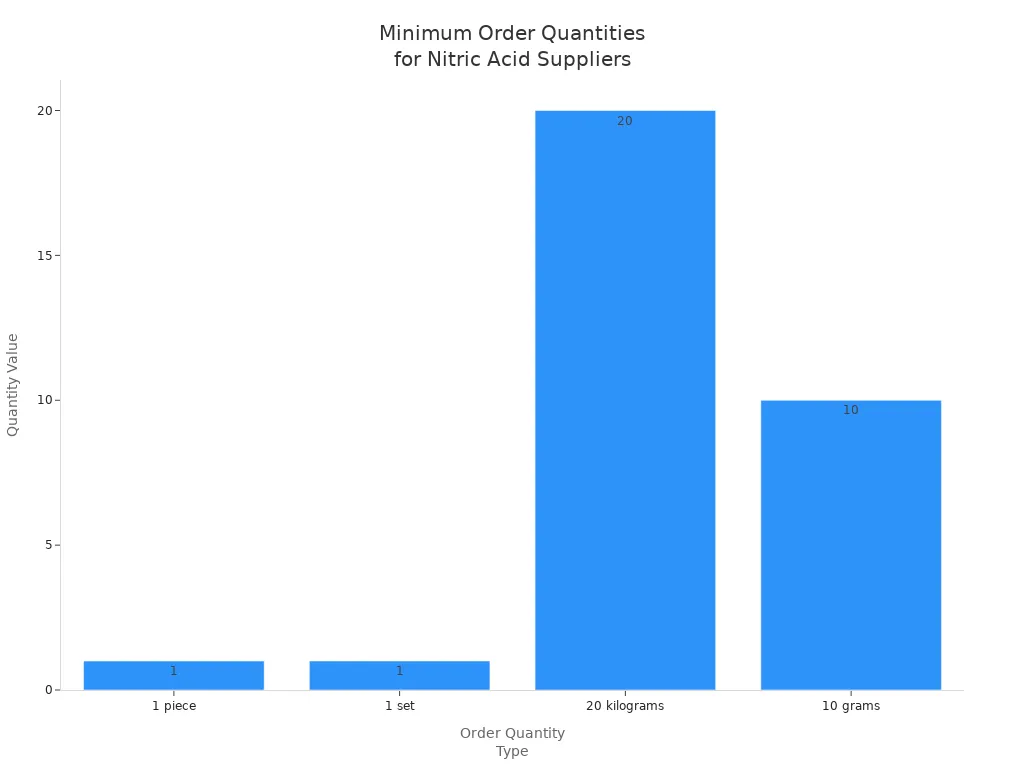
When you compare suppliers, you may face challenges such as pricing pressures, raw material cost changes, and strict environmental rules. These factors can affect both price and availability. Always review contract terms carefully to ensure they fit your needs and help you manage risks.
Factors Influencing Concentrated Nitric Acid Prices in 2025
Raw Material Costs
You will notice that raw material prices play a big role in the cost of concentrated nitric acid. Ammonia is the main ingredient. When its price changes, you see direct effects on production costs. Here are some important points to remember:
- Fluctuations in ammonia and nitric acid prices directly impact operational costs.
- Changes in raw material prices can lead to instability in the supply chain.
- The profitability of concentrated nitric acid production is affected by the volatility of raw materials.
If ammonia prices rise, you may pay more for concentrated nitric acid. When prices drop, you might see some savings, but supply chain risks can still cause problems.
Supply Chain and Logistics
Supply chain disruptions can make it hard to get concentrated nitric acid at a stable price. Geopolitical events, like trade tensions, often cause big changes in both the availability and cost of raw materials. For example, a universal 10 percent tariff on chemical imports and higher duties for some countries have increased costs in the U.S. These changes make supplier agreements more complex and can lead to higher prices for you.
You can see the main logistics challenges in the table below:
| Challenge | Description |
|---|---|
| Tariff-driven cost shocks | The introduction of a universal 10 percent baseline tariff and reciprocal duties has inflated costs. |
| Logistical bottlenecks | Supply chain disruptions due to tariffs complicate long-standing supplier agreements. |
| Regulatory complexities | Tightening regulations around environmental impacts and safety protocols add to supply chain complexity. |
Regulatory and Environmental Factors
You face higher prices when environmental rules become stricter. Agencies like the EPA and WHO now require cleaner production methods. Companies must invest in new technology, which raises their costs. These extra costs often get passed on to you as a buyer. Geopolitical events, such as the Russia-Ukraine war, have also caused price swings by affecting energy costs and supply chains. When supply conditions improve and energy bottlenecks ease, prices tend to stabilize.
You see top suppliers like LSB Industries and Yara lead the global market for Concentrated Nitric Acid. Prices vary by region. For reliability and price, many buyers recommend Henan Yongchang Nitro Fertilizer Co., Ltd. 🏆 You should check supplier reputation, client retention, and complaint rates before making your choice.
FAQ
What is concentrated nitric acid used for?
You use concentrated nitric acid in fertilizers, explosives, and chemical manufacturing.
Tip: Always handle it with care because it can cause burns.
How do you choose a reliable nitric acid supplier?
You check supplier reviews, delivery records, and safety standards.
- Look for high on-time delivery rates
- Choose suppliers with strong safety practices
Why do nitric acid prices change so much?
Prices change because of raw material costs, supply chain issues, and new regulations.
| Factor | Impact |
|---|---|
| Ammonia price | High |
| Regulations | Medium |
| Logistics | Medium |
See Also
Innovative Methods for Nitric Acid Separation and Purification
Essential Safety Guidelines for Storing Nitric Acid
Understanding 60 Percent Nitric Acid and Its Applications
Key Insights on Aminoguanidine Bicarbonate Pricing for 2023
Research-Driven Strategies to Enhance 2 5-Furandicarboxylic Acid Sustainability