How to Choose the Right Planetary Gearbox for Your Application
Selecting a Planetary Gearbox requires you to consider factors that impact performance and reliability. Review the table below for common operational requirements in manufacturing:
| Requirement | Description |
|---|---|
| Service Factor | Handles overloads and affects longevity. |
| Gearbox Ratio | Matches torque and motor power. |
| Material Quality | Improves performance and lifespan. |
| Environmental Conditions | Suits temperature and humidity needs. |
| Maintenance | Accessible parts reduce downtime. |
| Lifecycle Cost Analysis | Considers total ownership cost. |
Key Takeaways
- Identify your machine's torque and speed needs to select the right gearbox size and type. Accurate measurements prevent energy waste and equipment failure.
- Evaluate environmental conditions like temperature and humidity. Choose gearboxes with protective features to ensure durability in harsh settings.
- Consult manufacturer guidelines and use sizing tools to match gearbox specifications with your operational requirements. This step enhances performance and extends lifespan.
Planetary Gearbox Selection: Matching Requirements
Define Torque and Speed Needs
You must start by identifying the torque and speed requirements for your application. These two factors determine the size and type of Planetary Gearbox you need. Accurate torque measurement prevents wasted energy and safety hazards. If you apply too little or too much torque, you risk decreased efficiency and possible equipment failure.
- Use a torque wrench to ensure bolts and screws reach optimal tightness. This step is crucial for machinery safety and performance.
- Regularly calibrate your torque tools. Calibration involves comparing the tool’s readings to a known standard, which maintains accuracy and reliability.
When you select a Planetary Gearbox, consider how torque and speed vary across different applications. For example, packaging equipment may require precise torque for sealing, while material handling systems need consistent speed for moving products. The product’s material, environmental conditions, and even transportation can affect torque and speed demands.
| Factor | Description |
|---|---|
| Application Torque | The force applied affects the seal; higher torque does not always mean better sealing. |
| Dimensional Variation | Inconsistencies in dimensions can lead to binding and affect removal torque. |
| Time | Torque decay occurs quickly after application; tests should be done shortly after application. |
| Product | The product can alter torque based on its lubricating properties. |
| Material of Construction | Different materials can affect friction and sealing characteristics. |
| Transportation | Vibrations during transport can relieve torque stress. |
| Warehousing | Compression in storage can lower removal torque. |
| Environment | Temperature and humidity changes can affect torque due to material expansion and contraction. |
| Headspace Pressure | Changes in pressure can alter sealing force and removal torque. |
Tip: Use specialized software tools, such as Gam Sizing Tool or Wittenstein Sizing Assistant, to model torque and speed requirements. These tools help you match gearbox specifications to your operational needs quickly and accurately.
Assess Load and Duty Cycle
You need to evaluate the load profile and duty cycle before choosing a Planetary Gearbox. Understanding load inertia and non-dynamic load torque helps you estimate the required gearbox torque rating. This step ensures the gearbox can handle the specific demands of robotics, automation, or manufacturing.
- Torque loads influence motor performance.
- Radial loads affect operational stability.
- Axial loads impact gearbox durability.
Automation systems often experience repeated acceleration and deceleration cycles. These cycles create load peaks that vary in intensity and duration. Accurate measurement of these cycles is essential for proper gearbox selection.
- Automation applications often involve repeated acceleration and deceleration cycles.
- These cycles create load peaks of varying intensity and duration.
- Accurate load cycle measurement is essential for gearbox selection.
Duty cycle type also affects the lifespan and reliability of your Planetary Gearbox. Review the table below to understand how different duty cycles impact performance:
| Duty Cycle Type | Impact on Lifespan and Reliability |
|---|---|
| Continuous Use | Requires excellent heat dissipation and high-quality lubrication to manage sustained thermal stress. |
| Intermittent Use | Generates shock loads and fatigue due to frequent acceleration and deceleration, risking gear damage. |
Note: Use gearbox selection tools like MicronMOTIONEERING to input your load and duty cycle data. These tools help you find gearboxes that match your specific requirements.
Consider Environmental Conditions
Environmental factors play a major role in Planetary Gearbox performance. Extreme temperatures can break down lubricants, increase friction, and cause material expansion. Low temperatures thicken lubricants, raising energy consumption. High humidity leads to corrosion and lubricant degradation, which increases wear and damage risk.
- Extreme temperatures can lead to lubricant breakdown, increasing friction and wear.
- High temperatures may cause material expansion, affecting gear meshing and alignment.
- Low temperatures can thicken lubricants, increasing viscosity and energy consumption.
- High humidity can cause corrosion of metal components, weakening gears.
- Moisture can degrade lubricants, increasing wear and damage risk.
- Proper sealing and maintenance are essential to mitigate these effects.
In corrosive or high-dust environments, you must choose gearboxes with protective coatings and stronger parts. These features help the gearbox withstand shocks, vibrations, and chemical exposure.
| Environmental Factor | Impact on Gear Motor Performance |
|---|---|
| Corrosion and Chemical Exposure | Requires protective coatings for harsh environments. |
| Dust and Pollution | Needs stronger parts to handle shocks and vibrations. |
Tip: Always check the manufacturer’s recommendations for operating temperature and humidity ranges. Proper sealing and regular maintenance extend the lifespan of your Planetary Gearbox in challenging environments.
Comparing Planetary Gearbox Specifications and Types
Gear Ratios and Efficiency
When you compare gearboxes for your application, gear ratio stands out as a critical factor. The gear ratio determines how much torque and speed you can achieve. In industrial settings, planetary gearboxes offer a wide range of ratios. You can select from single-stage, double-stage, or triple-stage options depending on your needs.
| Gearbox Stage | Available Ratios |
|---|---|
| 1 Stage | 3, 4, 5, 6, 7, 8, 9, 10 |
| 2 Stages | Any multiple of 1 stage ratios |
| 3 Stages | Example: 300 (10x6x5 or 10103) |
Higher gear ratios increase torque but may reduce efficiency due to energy losses. Lower gear ratios improve efficiency but might not provide enough torque for heavy-duty tasks. You must balance your application's torque and efficiency requirements to avoid wasted energy and poor performance.
Note: Planetary gearboxes deliver higher efficiency and greater gear ratio flexibility compared to worm gearboxes. Worm gearboxes often operate at 30% to 60% efficiency and have limited ratio options, making them less suitable for heavy-duty operations.
| Gearbox Type | Efficiency | Gear Ratio Flexibility |
|---|---|---|
| Planetary Gearbox | Higher efficiency | Greater flexibility |
| Worm Gearbox | 30% to 60% | Limited to high reduction ratios |
Size, Mounting, and Configuration Options
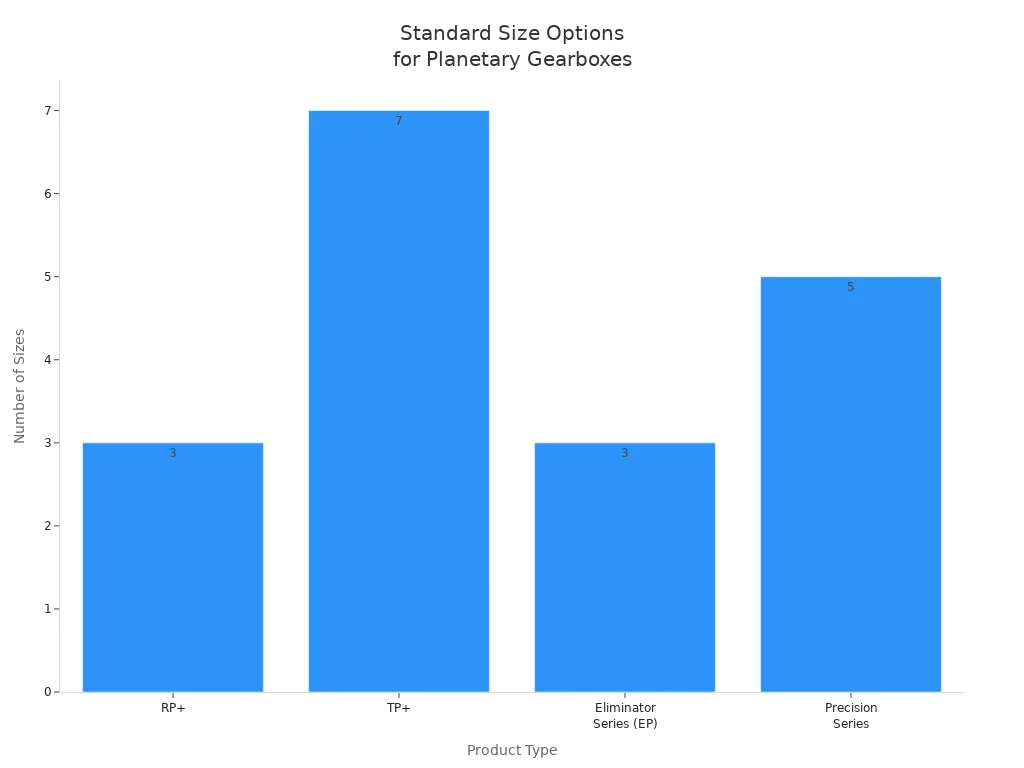
Selecting the right size and mounting configuration ensures compatibility with your machinery. Automotive manufacturing uses several standard size options for planetary gearboxes. You can choose from compact models for tight spaces or larger units for high-torque applications.
| Product Type | Number of Sizes |
|---|---|
| RP+ | 3 |
| TP+ | 7 |
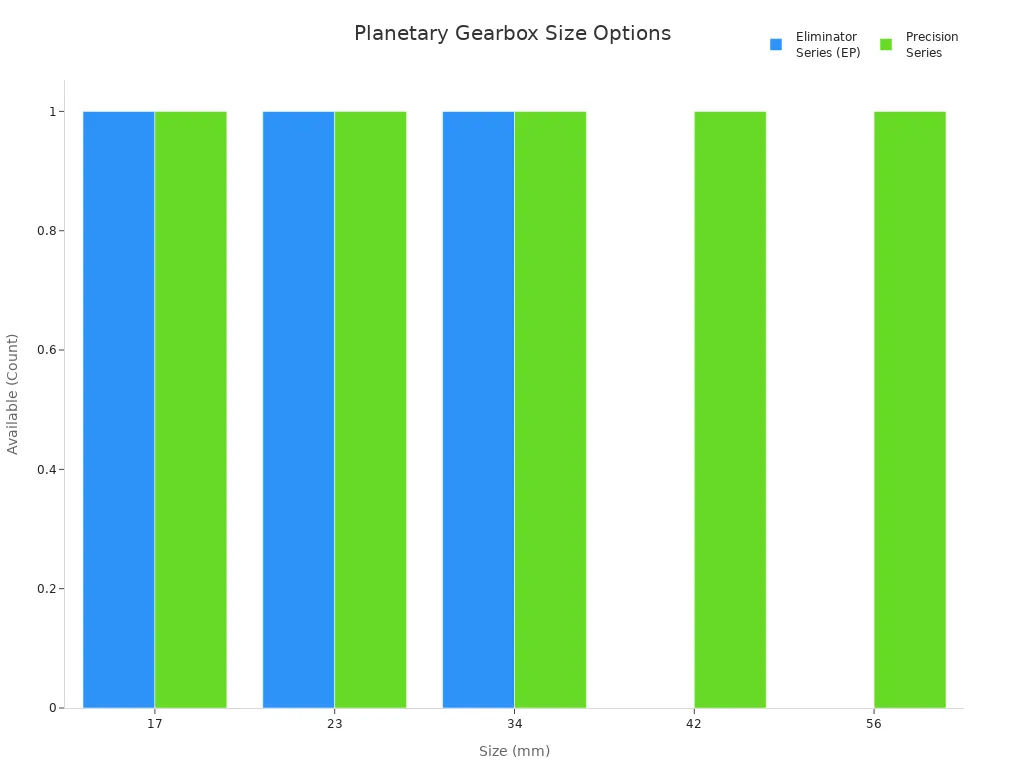
| Eliminator Series (EP) | 3 |
| Precision Series | 5 |
| Product Type | Sizes Available |
|---|---|
| Eliminator Series (EP) | 17, 23, 34 |
| Precision Series | 17, 23, 34, 42, 56 |
When you set up automated assembly lines, you must consider several configuration options:
- Models: Match specifications and precision levels to your machinery.
- Frame sizes: Ensure the mounting flange fits your application.
- Gear ratio: Select the speed reduction and output torque you need.
- Backlash: Evaluate this for precision tasks.
- Environmental factors: Account for temperature, humidity, and space limitations.
Tip: Always check the mounting type and size before installation. This step prevents misalignment and mechanical failures.
Manufacturer Quality and Support
Quality certifications help you identify reliable manufacturers. You should look for companies that meet international standards and provide strong technical support.
- ISO certifications show a commitment to quality.
- CE marking confirms compliance with safety standards.
- Industry standards and regulations ensure product reliability.
You can also check for specific certifications:
- ISO 9001: Quality management system.
- ISO 16949: Automotive quality management.
- CE marking: Safety and quality compliance.
Technical support from manufacturers influences the long-term reliability of your planetary gearbox installation. Leading companies offer:
- Selection assistance and setup advice.
- Service centers for quick repairs and spare parts.
- Ongoing support from selection to installation.
- Maintenance tips to extend product life.
Warranty terms vary among manufacturers. Some, like Cone Drive, offer a limited 3-year warranty on repairs. Others, such as Sumitomo Drive Technologies, provide detailed warranty information for their products.
Common Selection Mistakes and Tips
You can avoid costly errors by understanding frequent mistakes and following practical tips. Misalignment between the drive motor and gearbox often causes broken output shafts. When the assembly is not aligned, the output shaft faces extra radial forces and may fail. Proper alignment ensures the shaft only handles rotational torque.
| Consequence | Description |
|---|---|
| Early failure of the gearbox | Inadequate load capacity can lead to premature breakdowns of the gearbox. |
| Inefficient performance | Gearbox may not operate at optimal efficiency, leading to energy losses. |
| Potential damage to the system | Other components may suffer damage due to the stress from an overloaded gearbox. |
The most frequent mistake is improper gearbox selection. Choosing an undersized gearbox or the wrong type leads to overheating, gear stripping, and early wear.
- Improper Gearbox Selection (23%) - Selecting an undersized gearbox or the wrong type for the application.
To avoid these issues, follow these tips:
- Torque rating: Make sure the gearbox handles peak and continuous loads.
- Backlash: Critical for robotics and CNC machines.
- Efficiency: Affects energy use and system performance.
- Gear ratio: Impacts torque-speed balance.
- Size and mounting type: Guarantees compatibility with your setup.
⚡ Quick Tip: Always review your load requirements and alignment before finalizing your selection. This step prevents early failures and system damage.
To choose the right Planetary Gearbox, follow these steps:
- Define your machine’s torque, speed, and load needs.
- Check environmental conditions and maintenance requirements.
- Match specifications for accuracy, efficiency, and mounting.
- Consult manufacturers for expert advice.
You gain reliable performance and longer lifespan when you align gearbox features with your application.
FAQ
What is the main advantage of a planetary gearbox?
You gain higher torque density and compact size. Planetary gearboxes deliver efficient power transmission for demanding industrial applications.
How do you determine the correct gear ratio for your application?
You should match the gear ratio to your required output speed and torque. Use manufacturer sizing tools for precise calculations.
Can you use a planetary gearbox in harsh environments?
| Environment | Recommendation |
|---|---|
| High humidity | Choose corrosion-resistant models |
| Extreme temperature | Select gearboxes with proper seals |
You must always check manufacturer guidelines for suitability.