How to Make the Best Choice When Buying a Colour Sorting Machine
Selecting a colour sorting machine demands attention to sorting accuracy, capacity, and ease of use. Global demand continues to rise, with the market valued near USD 2.1 billion in 2023 and projected to reach USD 4.5 billion by 2032.
- Market growth rate stands at 8.5% CAGR.
Matching a Colour Sorting Machine to Your Business Needs
Identifying Sorting Requirements
Every business must first define its unique sorting requirements before investing in a colour sorting machine. The food processing industry, for example, relies on these machines to inspect and sort a wide range of products. Common applications include grains, cereals, nuts, fruits, vegetables, and seafood. Operators use these machines to detect discoloration, mold, defects, and foreign materials. They also help remove imperfections that can affect product quality.
Tip: Businesses should list all products that require sorting and specify the types of defects or contaminants they need to detect.
Sorting needs differ across industries. In agriculture, companies focus on achieving uniform color and texture for quality assurance. Industrial applications demand rapid inspection and removal of contaminants to maintain product integrity. For instance, agricultural producers use colour sorting machines to sort fruits, vegetables, and grains by color. Industrial processors rely on them for nuts, coffee beans, dried fruits, and seafood, where appearance directly impacts market value.
Assessing Production Volume and Product Types
Production volume and product type play a critical role in machine selection. High-capacity operations require machines that can handle large throughput without sacrificing accuracy. Small-scale businesses may prioritize flexibility and ease of changeover between product types.
A variety of technologies support different product types and operational needs. The table below summarizes the main technologies, their advantages, typical applications, and limitations:
| Technology | Main Advantage | Typical Applications | Limitations |
|---|---|---|---|
| CCD Camera | High-speed color sorting | Grains, seeds, plastics | Limited to color/shape |
| AI/Deep Learning | Learns complex defect patterns | Nuts, berries, specialty foods | Requires training data |
| X-ray | Detects internal defects | Nuts, minerals | Higher cost, safety protocols |
| Hyperspectral | Chemical composition detection | Plastics, recycling, pharma | Slower speeds, costlier |
| Sensor Fusion | Combines multiple technologies | Complex multi-material streams | Complexity, price |
Operators must match the technology to their product. For example, CCD cameras work well for grains and seeds, while AI-based systems excel with nuts and specialty foods. Some technologies, such as X-ray and hyperspectral, offer advanced detection but come with higher costs and operational complexity.
Considering Space and Workflow Integration
Space constraints and workflow integration often influence the final decision. Facilities must evaluate available floor space and consider how the new machine will fit into existing production lines. A colour sorting machine should not disrupt established processes. Instead, it should enhance efficiency and maintain smooth product flow.
Note: Companies benefit from mapping their workflow and identifying potential bottlenecks before installation.
Manufacturers offer machines in various sizes and configurations. Some models feature compact footprints for limited spaces, while others provide modular designs for easy expansion. Integration with upstream and downstream equipment, such as conveyors and packaging systems, ensures seamless operation and maximizes return on investment.
Evaluating and Comparing Colour Sorting Machine Features
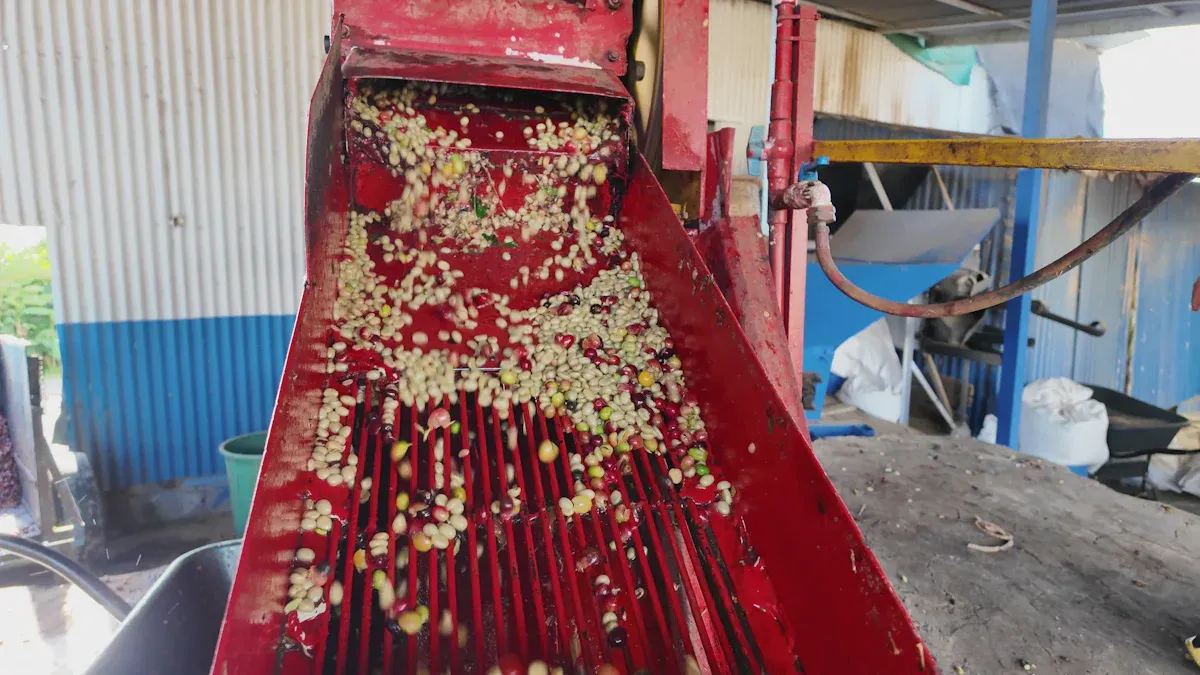
Sorting Accuracy and Detection Capabilities
Sorting accuracy stands as the most critical metric when evaluating a colour sorting machine. Top-rated machines consistently achieve accuracy rates between 99.95% and 99.9995%. Many optical sorters claim an accuracy of 99% or higher. High accuracy depends on precise calibration, which minimizes carryover rates and ensures only defective or off-color items are removed.
Modern machines use advanced detection technologies to reach these standards:
- High-resolution cameras capture detailed images of materials.
- Calibrated light sources provide consistent illumination for accurate analysis.
- Processors analyze reflected light patterns to determine color properties instantly.
- Machine vision systems use advanced color image processing to ensure accurate calibration and detect inconsistencies.
- Sophisticated optical sensors act as digital eyes, identifying and separating materials based on color characteristics.
These features allow businesses to maintain product quality and reduce waste.
Capacity and Throughput
Capacity and throughput determine how well a colour sorting machine fits into a production line. Large-scale operations require machines that can process several tons per hour. The following table shows typical throughput capacities for popular models:
| Model | Throughput Capacity (t/h) |
|---|---|
| BL300S | 2.5-5 |
| BL600S | 5-10 |
| BL1200S | 10-20 |
| TS7(R7-448) | 4.1 |
| TS8(R8-512) | 4.7 |
| TS10(R10-640) | 5.8 |
Selecting the right capacity ensures the machine keeps pace with production demands and prevents bottlenecks.
User Interface and Ease of Operation
A user-friendly interface reduces training time and operational errors. Operators value features that simplify adjustments and provide clear feedback. The table below highlights the most valued user interface features:
| Feature | Description |
|---|---|
| Custom Sorting Criteria | Operators define and name sorting criteria, enhancing control and confidence. |
| Combined Sorting | Combines size and color defect levels for more intelligent sorting. |
| Touchscreen Drag and Drop | Enables quick adjustments and visual clarity on sorting decisions. |
| At-a-Glance Dashboard | Provides real-time feedback on product and machine data for efficient sorting. |
| Unified User Experience | Consistent interface across machines builds operator confidence and ease of use. |
Training methods also impact ease of operation. Companies offer several options:
| Training Method | Description |
|---|---|
| On-site Training | Engineers visit customer sites to explain operation and maintenance. |
| Factory Visits | Customers learn directly at the factory about functionalities. |
| Online Training | Remote control training and video tutorials for convenience. |
A well-designed interface and flexible training options help new users become proficient quickly.
Maintenance, Reliability, and Support
Routine maintenance ensures reliable performance and extends the lifespan of a colour sorting machine. Common maintenance requirements include:
| Issue | Possible Cause | Solution |
|---|---|---|
| Color sorter fails to select colors | Low sensitivity or solenoid not powered | Adjust sensitivity, check solenoid power |
| Decreased sorting quality | Dust on sorting box glass | Clean sorting box glass regularly |
| Poor sorting effect on one side | Dirty rod less cylinder | Clean and inspect rod less cylinder |
| Color sorter often stops | High sensitivity or raw material impurities | Re-adjust sensitivity, check air pressure |
| Air compressor failure | Damaged motor windings or faulty AC contactors | Inspect and repair motor and contactors |
Manufacturers often provide technical support and spare parts to minimize downtime.
Cost-Effectiveness and Return on Investment
Cost plays a significant role in the decision-making process. The average price for a colour sorting machine ranges from $8,000 to $200,000. The cost depends on capacity and features. For example, a cereal chute color sorter typically costs between $12,000 and $30,000.
Businesses can expect a high return on investment from advanced machines. These machines offer low total prices and high economic efficiency. Upgrading to a modern system often results in improved product quality, reduced labor costs, and increased throughput.
Comparing Brands, Models, and Customer Reviews
Comparing different brands and models helps buyers identify the best fit for their needs. Customer reviews often highlight the following advantages:
| Advantage | Description |
|---|---|
| Sorting Capability | Sorts objects using a three-color approach. |
| Automation | Completes tasks quickly without human intervention. |
| Cost-Effectiveness | Uses powerful, low-cost color sensor ICs. |
| Flexibility | Allows easy modification of setups without reprogramming. |
| Advanced Technology | Stores color intensity data for color matching decisions. |
Buyers should consider both technical specifications and user experiences when making a selection.
Requesting Demos and Trials
Requesting a demo or trial provides valuable insight into real-world performance. Companies should observe the machine in action with their own products. This step helps verify sorting accuracy, ease of use, and integration with existing workflows. A hands-on trial also allows operators to assess training needs and maintenance requirements before making a final investment.
Selecting the right color sorting machine involves several key steps:
- Identify material type and sorting needs.
- Evaluate accuracy, capacity, and ease of use.
- Assess maintenance, durability, and ROI.
- Compare models and request demonstrations.
| Strategy | Benefit |
|---|---|
| High Accuracy | Ensures superior sorting quality |
| Supplier Credibility | Provides reliable support and service |
Thorough comparison and expert guidance help businesses achieve lasting value.
FAQ
What routine maintenance does a color sorting machine require?
Operators clean sensors, check air compressors, and inspect moving parts. Regular maintenance ensures consistent performance and extends machine lifespan.
How long does installation usually take?
Most installations finish within one to three days. The timeline depends on machine size, facility layout, and integration needs.
Can a color sorting machine handle multiple product types?
Many machines support quick changeovers. Operators can sort different products by adjusting settings or using pre-programmed recipes.
See Also
Top Locations for Purchasing X-Ray Inspection Equipment in China
Key Capsule Checkweighers to Consider for Purchase in 2025
Comprehensive Guide to Choosing Tablet Sampling Machines for Labs
Three Essential Industrial Checkweighers for Food Manufacturing Facilities
The Importance of Automatic UV Coating Machines in Fast Printing