Is Your Pool Safe? Use a Chloramines Test Kit for Swimming Pool Water
That sharp "pool" smell often signals high chloramines, which cause eye and throat irritation. They form when chlorine neutralizes contaminants from swimmers. You find the level with a good Chloramines Test Kit for Swimming Pool Water. This type of Water Test measures two values.
The Simple Formula: Total Chlorine (TC) – Free Chlorine (FC) = Combined Chlorine (CC)
A complete Chloramines Test Kit for Swimming Pool Water, Drinking Water Test will provide everything you need.
Key Takeaways
- Use a special test kit to find chloramines in your pool water. Chloramines cause that strong "pool" smell and can irritate your eyes.
- Measure Free Chlorine (FC) and Total Chlorine (TC) with your kit. Subtract FC from TC to get your chloramine level.
- If your chloramine level is 0.5 ppm or higher, shock your pool. This makes your pool safe and clean again.
What You Need for an Accurate Chloramine Test
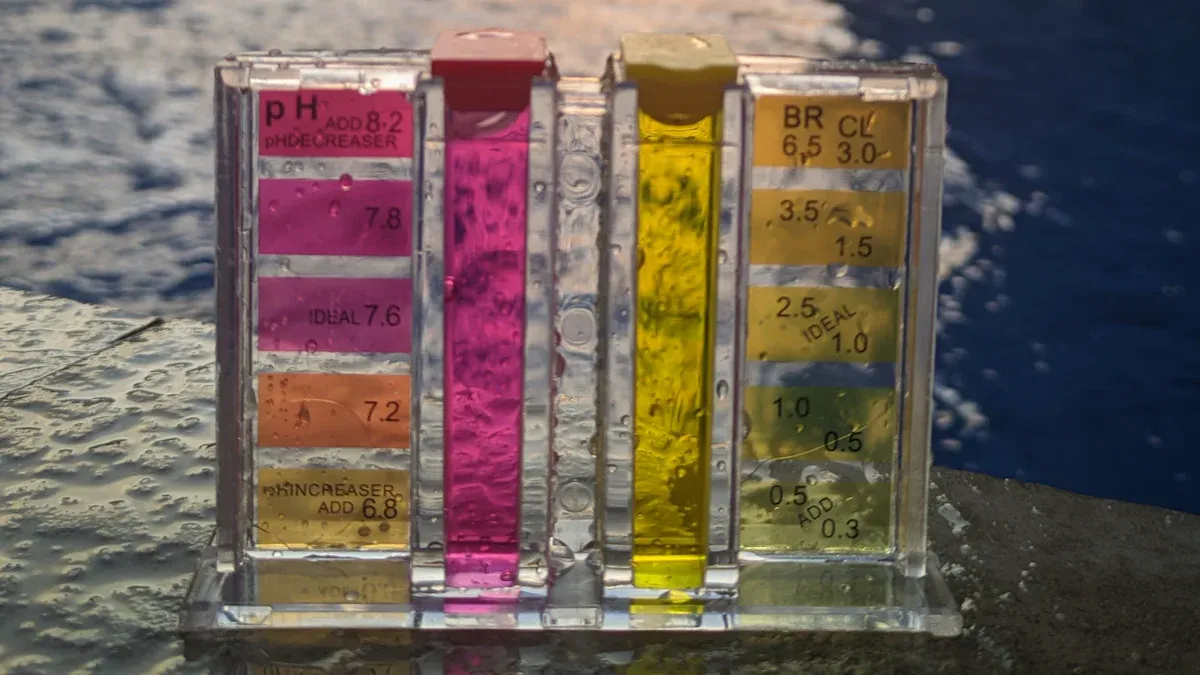
Getting an accurate chloramine reading starts with having the right tools. You need more than just a quick dip strip to understand your pool's health. A quality test kit provides the precision required for a safe swimming environment.
Choosing the Right DPD Test Kit
You have several options for testing your pool water. Each method offers a different balance of accuracy and ease of use. Liquid DPD kits provide a great middle ground for most pool owners.
| Method | Accuracy & Reliability |
|---|---|
| Test Strips | Less accurate. They give a quick, general idea but can be hard to read. |
| Liquid DPD Kits | More accurate than strips. They require you to follow steps carefully. |
| Digital Testers | Often the most accurate. They give a direct number, but cost more. |
For reliable results, you should choose a trusted brand. Pool professionals often recommend kits like the Taylor K-2005 for its accuracy or the LaMotte ColorQ 2X Pro 7 for its easy-to-read digital display. A good Chloramines Test Kit for Swimming Pool Water will give you confidence in your results.
Gathering Your Testing Supplies
Your Chloramines Test Kit for Swimming Pool Water is the main component, but you need a few other items. Check that your kit includes all the necessary reagents. These are the chemicals that react with the water to produce a color.
- DPD Reagents: You will need reagents for both Free Chlorine (like DPD #1) and Total Chlorine (like DPD #3).
- Fresh Reagents: Chemicals expire. Most reagents have a shelf life of one to two years. Always check the date and replace them at the start of a new pool season for best results.
- Clean Vials: Your kit’s plastic testing vials must be clean.
Pro Tip 📝 Always rinse your testing vials with fresh water before and after each test. This simple step prevents old chemicals from contaminating your new sample and giving you a false reading.
How to Test and Interpret Your Results
Testing your pool water is a simple process. You will get accurate results when you follow the steps carefully. This guide uses a liquid DPD test kit, the most common and reliable choice for home pool owners.
Step 1: Measure Free Chlorine (FC)
Free Chlorine is the active sanitizer in your pool. It is ready to fight germs and contaminants. Measuring it correctly is your first step.
First, you need a good water sample. The location matters for an accurate reading.
- Reach into the pool about elbow-deep (12-18 inches).
- Collect the sample away from skimmers or return jets. These areas can give you false readings.
- Turn the collection vial upside down as you lower it. Then, turn it right-side up to fill it.
Next, you will use your test kit. Fill the vial to the indicated line with your pool water. Add the DPD #1 reagent as directed by your kit, usually 5 drops. Swirl the vial gently to mix. A pink or red color will appear. Compare this color to the chart provided with your kit immediately. This number is your Free Chlorine (FC) level.
Avoid Common Testing Mistakes ⚠️ An inaccurate reading can mislead you. Watch out for these frequent errors:
- Waiting too long: You must read the FC result within 30 seconds. Waiting longer can allow chloramines to react, giving you a falsely high reading.
- High chlorine "bleach out": If your chlorine is very high, the sample might flash pink and then turn clear. This means the reagent was overwhelmed. You should dilute the sample with chlorine-free water and retest.
- Using old reagents: Chemicals expire. Replace your reagents at the start of each pool season for accuracy.
Step 2: Measure Total Chlorine (TC)
Total Chlorine includes both the active Free Chlorine and the used-up Combined Chlorine (chloramines). You will test the same water sample you just used for the FC reading.
Do not empty the vial. To the sample that already contains the DPD #1 reagent, you will now add the DPD #3 reagent. Most kits require 5 drops. The DPD #3 reagent contains potassium iodide. This chemical reacts with the chloramines in the water. The reaction creates a deeper magenta color.
Swirl the vial again to mix the new reagent. Wait for the time specified in your kit's instructions, usually a couple of minutes, for the color to fully develop. Then, compare the new, darker color to your kit's color chart. This second reading is your Total Chlorine (TC) level.
Step 3: Calculate Your Chloramine Level
Now you have the two numbers you need. Calculating your Combined Chlorine (CC), or chloramine level, is simple subtraction. You just need to apply the formula.
Total Chlorine (TC) – Free Chlorine (FC) = Combined Chlorine (CC)
For example, if your TC reading is 3.0 ppm and your FC reading is 2.5 ppm, the calculation is:
3.0 ppm (TC) - 2.5 ppm (FC) = 0.5 ppm (CC)
In this case, your chloramine level is 0.5 ppm. If your TC and FC readings are the same, your chloramine level is zero. This is the ideal situation for a clean pool. A proper Chloramines Test Kit for Swimming Pool Water makes finding these values easy.
Understanding Safe vs. Unsafe Levels
Knowing your chloramine level is important. It tells you about your pool's health and safety. Total Chlorine alone does not give you this picture. High chloramine levels mean your sanitizer is working hard, but the waste products are building up.
| Chloramine (CC) Level | What It Means | Action Needed |
|---|---|---|
| Below 0.5 ppm | ✅ Safe & Ideal. Your pool is clean and comfortable. | None. Continue regular testing. |
| 0.5 ppm or higher | ⚠️ Unsafe. This level causes eye irritation and that strong "pool smell." | Shock the pool. |
When your chloramine level reaches 0.5 ppm or higher, you must act. The solution is a process called breakpoint chlorination, also known as shocking the pool. You add a large dose of an oxidizer to the water. This powerful dose breaks down and destroys the chloramine molecules. Effective products for this include cal-hypo shock or a non-chlorine shock (MPS). This action frees up your chlorine to effectively sanitize the water again, making your pool safe and pleasant for everyone.
You can maintain a safe and comfortable pool with proactive care.
- Regularly use a DPD test kit to measure Free and Total Chlorine.
- Calculate your chloramine level using the formula:
TC - FC = CC. - Shock your pool when chloramines reach 0.5 ppm.
While shocking is the standard solution, some pools use advanced systems like UV or ozone to help destroy chloramines. A reliable Chloramines Test Kit for Swimming Pool Water is your first step to clean water.
FAQ
How often should I test for chloramines?
You should test your pool water weekly. Test more often after heavy use, such as a pool party. This helps you catch rising levels before they become a problem.
What causes high chloramines in my pool?
Sweat, oils, and urine from swimmers cause high chloramines. These contaminants react with your pool's free chlorine, creating the combined chlorine you measure with your test kit.
Does a strong "chlorine" smell mean my pool is clean?
No. That sharp chemical smell is from chloramines, not chlorine. It signals that your pool has too many contaminants and needs to be shocked to be safe and clean.
See Also
Selecting the Optimal A1 A2 Milk Test Kit for Dairy Operations
Benefits of Self-Priming Water Pumps for Efficient Water Systems Explained
Essential Safety Guidelines for Storing Nitric Acid Securely
Leading Precoating Materials for Advanced Filtration Systems in 2025
Boosting Metering System Accuracy with Manganin Copper Shunt Technology