How to Use PVA Powder in Mortar Adhesive Formulations
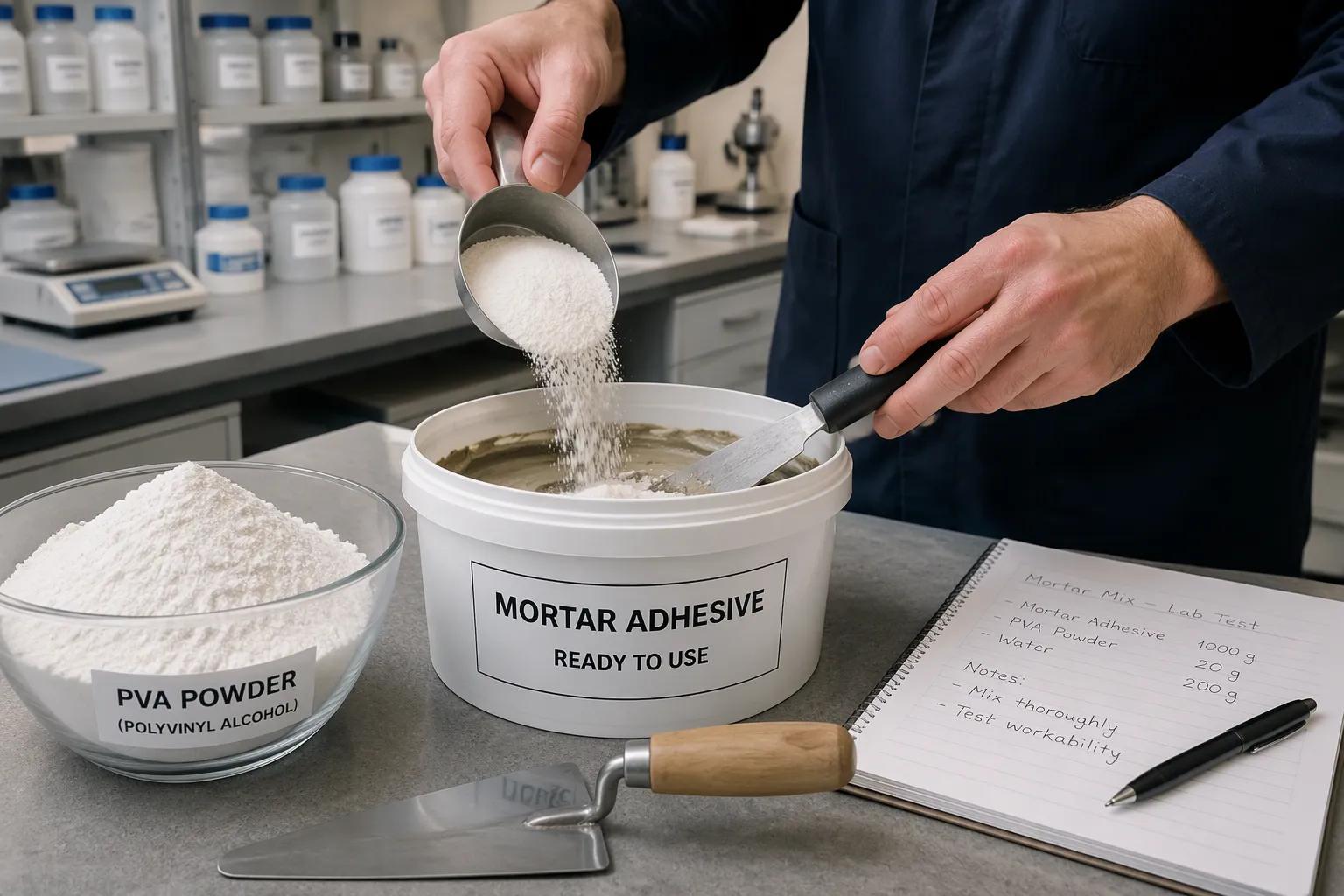
Add PVA powder at 0.3% to 0.5% by weight of the dry mix for most mortar adhesives. Blend the powder into the dry ingredients first, before you add any water. This range covers most tile adhesives and general-purpose mortars. Your exact dosage depends on the application and the PVA grade you select from a reliable China Supplier PVA powder polyvinyl alcohol for Adhesive / Mortar.
Key Takeaways
- Start with 0.3% to 0.5% PVA powder by weight of the dry mix for most mortar adhesives.
- Always dry-blend PVA powder into the dry ingredients before adding water to prevent lumps.
- Test small batches to find the best dosage for your specific application and materials.
How PVA Powder Works in Mortar
PVA powder improves mortar through three connected mechanisms. Each one supports the others, and together they turn a basic cement mix into a reliable adhesive.
Film Formation and Bond Strength
PVA particles dissolve in the mixing water and form a clear, stable colloid. As the mortar cures, this colloid creates a continuous polymer film throughout the cement matrix. The film bridges the cement particles and grips the substrate surface. This dual action delivers high adhesion and strong bond strength. You get a mortar that holds tiles and repair patches firmly in place.
Water Retention and Workability
Cement needs water to hydrate properly. PVA powder holds that water in the mix and releases it slowly. The mortar stays open and workable for longer, so you have more time to position tiles and finish surfaces. The mix also spreads more smoothly under the trowel. Better water retention means less water loss to porous substrates and a more consistent cure.
Flexibility and Crack Resistance
Plain cement mortar is rigid and brittle. The PVA film adds a flexible polymer network inside the hardened mortar. This network absorbs small movements and stresses that would otherwise open cracks. The result is a mortar with improved flexibility and reduced cracking over time. Your finished surface stays intact through normal building movement and seasonal temperature swings.
PVA Powder Dosage: China Supplier PVA Powder Polyvinyl Alcohol for Adhesive / Mortar
Dosage is where formulation decisions pay off. The right percentage of PVA powder gives you strong adhesion, good flexibility, and predictable setting behavior. The wrong percentage costs you time, money, or performance. Use the ranges below as your starting point, then fine-tune them through small-batch trials. A dependable China Supplier PVA powder polyvinyl alcohol for Adhesive / Mortar will give you consistent grades to test against.
The table below summarizes typical dosage ranges by application, based on guidance published by Zoran Chem.
| Application | PVA powder dosage (by weight of total dry mix) |
|---|---|
| Tile adhesives | 0.3% to 0.5% |
| Renders and plasters | 0.2% to 0.4% |
| Grouts and repair mortars | 0.5% to 1.0% |
Dosage for Tile Adhesives
For tile adhesives, 0.3% to 0.5% PVA powder by weight of the total dry mix gives the best balance of adhesion and flexibility, according to Zoran Chem. This range works for most cement-based tile adhesives on the market. Higher ratios improve water resistance and flexibility. Too much PVA, however, can slow down the setting time. Keep that trade-off in mind when you push toward the top of the range.
Many formulators pair PVA with cellulose ethers such as HPMC. Raw Chemical Mart notes that tile adhesives use PVA together with cellulose ethers to improve open time and slip resistance. The PVA handles bond strength and flexibility. The cellulose ether handles water retention and sag control. Together, they cover more of the performance map than either additive alone.
Start your trial at 0.3% and test adhesion after 28 days. Then step up to 0.4% and 0.5% and compare open time, slip, and tensile bond strength. This ladder approach shows you exactly where the performance gain flattens out. You avoid paying for polymer you do not need.
Dosage for Repair Mortars and Render
Repair mortars and render need more polymer than tile adhesives. Zoran Chem lists 0.5% to 1.0% PVA powder for grouts and repair mortars, and 0.2% to 0.4% for renders and plasters. The higher repair range reflects the job these materials do. Repair mortars bond to old concrete, fill deep sections, and resist shrinkage stress. A stronger polymer film helps them hold.
Render sits at the lower end because it goes on in thinner layers over large areas. You want flexibility and crack resistance without excess cost. A 0.2% to 0.4% addition supports workability and reduces surface cracking. It also keeps the mix economical for full-wall coverage.
Yaguan HPMC describes a common exterior render protocol: 8% PVA plus 0.5% hydroxypropyl methylcellulose for enhanced workability retention. That figure refers to a specific formulation basis, so treat it as a reference point rather than a universal rule. For structural repairs, the same source cites a sand-to-cement ratio of 2.5:1 with 10% PVA replacement of the mix water. These examples show how widely the basis of addition can vary. Always state your basis clearly, whether it is total dry mix, cement weight, or mix water.
For dry-mix putty and mortar applications, Raw Chemical Mart reports a recommended dosage of 0.3% to 3.0% of the total mass. The right level still depends on the grade and the recipe. Establish your addition basis first, then validate the result through formulation trials. This step protects you from scaling up a dosage that only worked on paper.
Dosage for Thin-Set and Large-Format Tile Bonds
Thin-set adhesives and large-format tile bonds push the formulation toward the top of the tile adhesive range. Large-format tiles are heavy, stiff, and unforgiving. They need a bond coat that resists shear stress and handles minor substrate movement. A 0.4% to 0.5% PVA addition supports that demand. The polymer film adds flexibility and improves grip across the full tile footprint.
Thin-set mortars go on in layers of a few millimeters. Water loss to the substrate and to the air happens fast in such thin sections. PVA water retention keeps the mortar open long enough for you to position and adjust each tile. This matters most on large-format installations, where one tile covers a big area and repositioning is difficult.
For bonding slurries, Raw Chemical Mart notes that higher concentrations are used, often mixed 1:1 with water before adding to the cement-sand mix. A slurry is a different animal from a thin-set mortar. Judge your dosage against the application, not against a single universal number. When you buy from a China Supplier PVA powder polyvinyl alcohol for Adhesive / Mortar, confirm the grade dissolves fully at your planned mixing temperature. Grades with alcoholysis degrees below 95% dissolve easily in room-temperature water. Higher alcoholysis grades need water above 95°C. Match the grade to your process before you lock in the dosage.
Run a small batch at 0.4% and a second at 0.5%. Test sag resistance on a vertical panel and tensile bond strength on your target substrate. Large-format work rewards the extra testing time. A China Supplier PVA powder polyvinyl alcohol for Adhesive / Mortar with consistent quality makes those comparisons meaningful, because each batch behaves the same way in your trials.
Mixing Steps and Mistakes to Avoid
Good formulation on paper means nothing without proper mixing on the floor. The steps below turn your dosage calculation into a consistent, lump-free mortar. Follow them in order, and you avoid the three most common failures: poor dispersion, weak bonds, and wasted material.
Dry-Blend PVA Before Adding Water
Dry-blending is the single most important step in the entire process. PVA powder must be fully dispersed in the dry ingredients before any water touches the mix. Skip this step, and the powder will clump into gel-coated lumps that never dissolve. Those lumps become weak spots in the cured mortar.
Follow this sequence for a clean blend:
- Load your sand, cement, and any other dry fillers into the mixer first.
- Add the PVA powder at your calculated dosage, measured by weight on a calibrated scale.
- Run the mixer dry for 2 to 3 minutes until the powder disappears into the blend.
- Check for streaks or visible white pockets before you proceed.
A ribbon blender or a planetary mixer handles this step well. For small batches, a forced-action drum mixer works too. The goal is uniform distribution, not speed. A 2-minute dry blend at low speed beats a 30-second blast at high speed, because high speed throws powder into the air and along the drum walls.
Weigh your PVA precisely. Volume scoops vary in density from batch to batch, and a 10% weighing error shifts your dosage outside the target range. A reliable China Supplier PVA powder polyvinyl alcohol for Adhesive / Mortar ships consistent grades, so your weighed dosage behaves the same way every time.
Add Water, Mix, Rest, and Remix
Water addition controls how the PVA dissolves and how the mortar develops its final properties. Add water gradually while the mixer runs. Stop when the mix reaches a smooth, workable consistency. The exact water volume depends on your filler moisture and the PVA grade, so judge by feel and by the manufacturer's water-to-binder guidance.
Run the wet mix for 3 to 5 minutes at moderate speed. This window gives the PVA particles time to swell and dissolve fully. Then stop the mixer and let the mortar rest for 5 to 10 minutes. This rest period, often called slaking or tempering, lets the polymer chains hydrate completely and lets the cement particles wet out.
Remix for 1 to 2 minutes after the rest. The mortar will stiffen during the rest as hydration begins. The remix breaks up any false set and restores the workable consistency. Now the mortar is ready to use. Respect the pot life stated for your formulation, and never add extra water to revive a mix that has started to set.
Avoid Overdosing, Underdosing, and Lumping
Three mistakes account for most PVA mortar failures. Each one has a clear warning sign and a clear fix.
Overdosing raises cost and slows the set. Underdosing weakens the bond. Lumping ruins both. Weigh every batch and dry-blend every time.
Overdosing shows up as a sticky, slow-setting mix that grabs the trowel. The mortar may also shrink more and lose open time. Push past 0.5% in a tile adhesive, and you pay for polymer that delivers no extra bond strength. Stay within the tested range, and step up only when your trial data supports it.
Underdosing shows up later, not during mixing. The mortar feels normal and spreads fine. Then the bond fails at 28 days, or the surface cracks within a season. The cause is usually a weighing error or powder lost to the drum walls during a careless dry blend. Calibrate your scale weekly and check the empty drum after each batch.
Lumping shows up immediately as gel-coated balls in the mix. The cause is almost always water contact before dispersion. Once a PVA particle forms a gel skin, water cannot reach the dry core, and the lump survives mixing. Screen your dry blend through a 1 mm sieve on the first few batches to confirm dispersion. If you find lumps, stop and fix the dry-blend step before you add water.
Keep your PVA storage dry and sealed. Moisture pickup in the bag causes premature clumping before the powder even reaches the mixer. Rotate stock on a first-in, first-out basis, and reseal opened bags after each use.
Start most mortar formulations at 0.3% to 0.5% PVA powder by weight of the dry mix. Dry-blend the powder first, before any water. Adjust the dosage to your application, and test small batches before you scale up. Correct use improves adhesion, flexibility, and workability without complicating your process.
FAQ
Does PVA powder dissolve in cold water?
It depends on the grade. Grades with alcoholysis degrees below 95%, such as PVA17-88 and PVA05-88, dissolve easily in room-temperature water. Higher alcoholysis grades need water above 95°C.
Can PVA powder replace cellulose ether in a tile adhesive?
No. PVA delivers bond strength and flexibility. Cellulose ether delivers water retention and sag control. Most formulations use both additives together to cover the full performance range.
How should you store PVA powder before use?
Keep bags sealed and dry. Moisture pickup causes clumping before the powder reaches your mixer. Rotate stock first-in, first-out, and reseal opened bags after each batch.
See Also
Ten Clever Methods for Incorporating Bovine Gelatin Powder into Recipes
Contemporary Synthesis Techniques for Aminoguanidine Bicarbonate and Industrial Uses
Novel Uses of N,N-Dimethyl-N,N-Diphenylurea Across Diverse Industrial Sectors
Selecting Materials for Pressure Vessels per ASME BPVC Section VIII
Five Optimal Applications for Single Stage Rotary Vane Vacuum Pump Sets