Sewage treatment plant for home never looked this cool
You can choose a sewage treatment plant for home with features that make daily life easier. Modern systems use energy-efficient motors and advanced filtration. Many units offer real-time monitoring and remote tracking. The table below shows some of the most impressive features you may find:
| Feature | Description |
|---|---|
| Real-time Monitoring | Live tracking of system parameters |
| Remote Performance | Monitor from anywhere |
| Maintenance Alerts | Automated fault and service notifications |
| Modular Designs | Easy to install, scalable |
| Energy Efficient Tech | Optimized aeration, low power use |
| Advanced Filtration | High-quality treated water |
Key Takeaways
- Choose a sewage treatment plant that fits your home size and water usage. This ensures efficient operation and compliance with local regulations.
- Look for systems with smart monitoring features. These allow you to track performance and receive maintenance alerts from anywhere.
- Consider eco-friendly options that reduce pollution and allow water reuse for gardening. This helps save money and protects the environment.
Sewage Treatment Plant for Home: Quick Comparison Table
Certifications
You want a system that meets strict standards. Most top suppliers offer certified products. These certifications show that the system meets safety and environmental rules. For example, Qingdao Yimei and Shandong Better provide units with international certifications. You can trust these brands for reliable performance.
| Supplier | Unit Price (FOB) | Warranty | Key Advantage |
|---|---|---|---|
| Qingdao Yimei | $28,500 | 2 years | Premium build + rapid support |
| Shandong Better | $25,800 | 2 years | Scalable for bulk orders |
| Qingdao Jinwantong | $23,200 | 1.5 years | Budget-friendly entry option |
| Sinooutput Plant | $31,000 | 3 years | Smart monitoring & predictive maintenance |
Capacity
You need to match the system to your home size. Most sewage treatment plant for home systems use local rules to set capacity. The number of bedrooms or people in your house helps decide the right size. Systems measure gallons per person each day. Pollution levels in your wastewater also affect the needed capacity.
| Factor | Description |
|---|---|
| Capacity Determination | Based on state and local design specifications. |
| Maximum Gallons per Person/Day | Calculated by bedrooms or people per day. |
| Wastewater Characteristics | Pollution level affects treatment capacity. |
Design Features
Modern systems offer features that make your life easier. You get compact sizes that save space. Energy-efficient motors use less than 40W and some units include solar options. Remote monitoring lets you check your system from anywhere. Quiet operation keeps your home peaceful.
| Design Feature | Description |
|---|---|
| Compact Size | Fits easily in most homes, saves outdoor space. |
| Energy Efficiency | Uses less power, solar integration available. |
| User Convenience | Remote monitoring and easy assistance. |
| Quiet Operation | Keeps noise below recommended limits. |
Key Technologies
You benefit from advanced technologies. Some systems use AI-driven optimization for smart monitoring. Others offer full automation with SCADA control. You can find manual override options and alarms for extra safety. These features help you manage your sewage treatment plant for home with confidence.
Tip: Choose a system with smart controls and energy-saving features for the best results.
Sewage Treatment Plant for Home: Detailed Reviews of Top Systems
BioMicrobics FAST System
You can rely on the BioMicrobics FAST System for strong performance and flexibility. This system uses advanced aerobic treatment to clean wastewater. You get several models to choose from, so you can match the right size to your home. The FAST System works well for small families and larger households. You also benefit from easy installation and low maintenance.
| Model | Treatment Capacity (GPD) | Recommended Users |
|---|---|---|
| MicroFAST 0.5 | 500 | 1 to 8 |
| MicroFAST 0.625 | 625 | 1 to 10 |
| MicroFAST 0.75 | 750 | 1 to 11 |
| MicroFAST 0.9 | 900 | 1 to 14 |
| MicroFAST 1.5 | 1,500 | 6 to 21 |
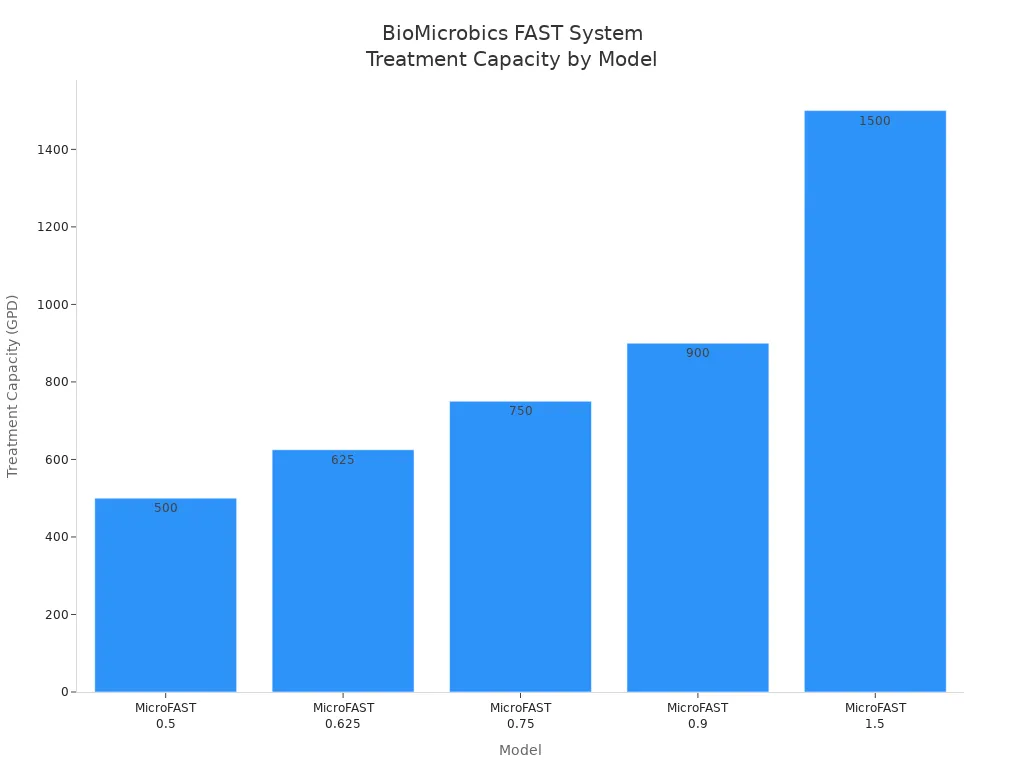
Tip: You can select a model based on the number of people in your home. This helps you avoid overloading your system.
Fuji Clean CE Series
You can choose the Fuji Clean CE Series if you want a compact and efficient solution. This system uses advanced filtration and aeration to treat wastewater. You get a unit that fits in tight spaces and works quietly. The CE Series offers easy access for maintenance. You also benefit from low energy use and reliable operation.
- Small footprint fits most yards.
- Quiet operation keeps your home peaceful.
- Simple controls make it easy to manage.
Norweco Singulair Green
You get a modern design with the Norweco Singulair Green. This system uses a three-stage process to treat wastewater. You can install it underground to save space. The Singulair Green uses energy-efficient motors and offers remote monitoring. You also receive alerts for maintenance needs.
| Feature | Benefit |
|---|---|
| Underground design | Saves outdoor space |
| Remote monitoring | Easy system checks |
| Energy efficient | Reduces power costs |
AquaKlear AK Series
You can trust the AquaKlear AK Series for advanced features and strong performance. This sewage treatment plant for home system meets strict standards and offers many benefits. You get models that handle 500 to 1500 gallons per day. The AK Series fits in small yards and can even go under a driveway. You also enjoy plug-and-play installation and two years of monitoring.
| Feature | Description |
|---|---|
| NSF Certified | Proven to reduce nutrients & solids by more than 98.8%, exceeding national & state standards. |
| Versatile Models & Sizes | Models range from 500 to 1500 gallons per day, available in fiberglass or concrete. |
| Compact Fit | Requires less yard space and can be placed under a driveway. |
| Plug & Play Installation | Preassembled and watertight tested for easy installation, saving time and money. |
| Worry-Free Monitoring & Maintenance | Includes TWO YEARS of monitoring and alerts for any issues. |
| Clarifying Trio | Innovative aerobic treatment with no internal moving parts. |
| Fine Air Bubble Diffuser | Injects oxygen continuously, resistant to clogging and mineral buildup. |
| AK Skimmer | Automatically skims and cleans the surface for high-quality effluent. |
| Dual Outlet Compressor | Quietly supplies oxygen to the Diffuser and Skimmer. |
| Use Your Water Twice™ | Treated water can be reused for landscape irrigation with a subsurface drip system. |
Note: You can reuse treated water for your garden, which helps you save money and protect the environment.
Delta ECOPOD Series
You can pick the Delta ECOPOD Series for reliable and eco-friendly treatment. This system uses a modular design, so you can expand it if your needs change. The ECOPOD Series uses advanced aeration to clean wastewater. You get low energy use and quiet operation. You also benefit from easy access for service.
- Modular design grows with your family.
- Quiet motors keep noise low.
- Simple maintenance saves you time.
Orenco AdvanTex AX Series
You can depend on the Orenco AdvanTex AX Series for strong cleaning and low upkeep. This system makes wastewater up to 98% cleaner, meeting tough rules. The compact design fits small lots. You get minimal maintenance and lower costs over time. Orenco offers support with trained installers and remote monitoring.
| Feature/Benefit | Description |
|---|---|
| Effective wastewater treatment | Can make raw wastewater up to 98% cleaner and meet stringent regulatory requirements. |
| Compact design | Small footprint suitable for residential sites. |
| Low maintenance | Requires minimal upkeep, leading to lower life-cycle costs. |
| Comprehensive support programs | Includes trained installers, remote monitoring, and ongoing maintenance commitments. |
Alert: You can get help from Orenco’s support team if you ever have questions or need service.
Ecoflo Biofilter by Premier Tech
You can choose the Ecoflo Biofilter if you want a natural and sustainable solution. This system uses coconut husk or peat to filter wastewater. You get a unit that works without electricity most of the time. The Ecoflo Biofilter fits in small spaces and needs little maintenance. You also help the environment by using renewable materials.
- Natural filtration with coconut husk or peat.
- Low energy use and minimal upkeep.
- Fits tight spaces and blends with landscaping.
Jet Wastewater Treatment System
You can select the Jet Wastewater Treatment System for fast and effective cleaning. This system uses a three-stage process to treat wastewater. You get a compact unit that works well for homes with limited space. The Jet system offers easy controls and quick installation. You also benefit from strong support and reliable operation.
| Feature | Benefit |
|---|---|
| Three-stage treatment | High-quality effluent |
| Compact design | Fits small yards |
| Easy controls | Simple to operate |
Tip: You can install the Jet system quickly and start using it right away.
What Makes These Sewage Treatment Plant for Home Systems “Cool”
Compact and Space-Saving Designs
You can enjoy more space in your yard when you choose a compact system. Many new systems use Membrane Bioreactor (MBR) technology. This technology combines biological treatment with special filters. It removes the need for large tanks and cuts the system size by up to 75% compared to older designs. You save money on digging and building. You also find it easier to manage and maintain your system. If your family grows, you can expand the system without needing more land.
Smart Monitoring and Controls
Modern systems give you smart features that make life easier. You can see some of these features in the table below:
| Feature | Description |
|---|---|
| Modes of Operation | Flushing, irrigation, and direct discharge with auto switching |
| Power Consumption | Uses less than 40W |
| Noise Level | Less than 45dB at night |
| Remote Control | 4G and WIFI for remote operation |
| Solar Energy | Solar energy management modules included |
| Remote Assistance | One-click help from engineers |
You can check your system from your phone or computer. If you need help, you can get support from experts with just one click.
Eco-Friendly and Energy Efficient
You help the planet when you pick an eco-friendly sewage treatment plant for home. These systems:
- Lower pollution in the environment
- Let you reuse treated water for your garden
- Meet strict environmental rules
- Improve health and sanitation
- Cut down on water and energy costs
Low-Noise Operation
You want a quiet home. Many new systems run at less than 45 decibels, even at night. You can relax without hearing loud motors or pumps. Your neighbors will appreciate the peace, too.
How to Choose the Right Sewage Treatment Plant for Home
Assessing Home Size and Water Usage
You need to think about your household size and how much water you use every day. Each system is custom designed for your home, considering collection type, design flow, and disposal method. Residential wastewater usually has a lower biological oxygen demand than commercial sites, so your system can be tailored for your needs. A site inspection helps check soil and groundwater conditions. Certified professionals often conduct soil evaluations to make sure your land is suitable.
| Criteria | Description |
|---|---|
| Site Inspection | Evaluates absorption rates, soil, and groundwater conditions. |
| Soil Evaluations | Conducted by certified professionals to assess soil suitability. |
| Installation Notice | Provides information on installation type and ongoing maintenance needs. |
Understanding Local Regulations
You must follow local rules before installing a system. The State Sanitary Code sets standards for household sewage treatment. Local health departments enforce these rules to protect public health and the environment.
| Regulation Aspect | Description |
|---|---|
| Permit Requirements | You need a permit before building or changing your system. |
| Design Standards | Your system must meet specifications for safe and effective treatment. |
| Operation and Maintenance | You must follow guidelines to keep your system working well. |
| Inspection Compliance | Regular inspections make sure your system meets health standards. |
| Certification of Professionals | Only certified installers and service providers can work on your system. |
- Siting and construction rules tell you where and how to build.
- Capacity and design standards make sure your system can handle your wastewater.
- Operation and maintenance guidelines help keep your system safe.
Matching Features to Your Needs
Homeowners can effectively match sewage treatment systems to their specific needs by focusing on site selection, understanding local regulations, and evaluating soil conditions. Consulting with local health departments and obtaining necessary permits is crucial before any construction.
You should look for features that fit your lifestyle. Smart monitoring, energy efficiency, and quiet operation may be important for you. Always check if the system matches your site and local rules.
Budget Considerations
Cost matters when you choose a system. Prices depend on the type and technology. Advanced systems may cost more at first but can save money over time. Here is a quick look at typical costs:
| System Type | Cost Range (CAD) | Description |
|---|---|---|
| Conventional septic system (gravity) on good soil | $10,000 – $20,000 | Best-case sites with decent percolation and easy access. |
| Average new system on many rural lots | $18,000 – $35,000 | Typical costs for sites with some constraints requiring more materials and labor. |
| Advanced treatment / raised bed / challenging site | $25,000 – $50,000+ | For sites needing special designs due to poor soil or other challenges. |
| Permit + testing + design (soft costs) | $1,000 – $3,000+ | Costs for soil evaluation, design, and permits. |
You can compare options and choose the sewage treatment plant for home that fits your budget and needs.
Sewage Treatment Plant for Home: Installation and Maintenance
What to Expect During Setup
You will follow a clear process when installing a sewage treatment plant for home. The steps help you get the best results and meet local rules. Here is a table that shows each step:
| Step Number | Installation Step |
|---|---|
| 1 | Site Evaluation: Assess soil conditions and proximity to infrastructure. |
| 2 | Selection of Design: Choose the appropriate STP type based on wastewater generation. |
| 3 | Permits and Legislation: Secure necessary permits and comply with environmental laws. |
| 4 | Excavation and Foundation: Prepare the site and foundation according to specifications. |
| 5 | Installation of Components: Assemble tanks, pumps, and systems per guidelines. |
| 6 | Electrical Connection: Ensure qualified personnel handle electrical setups. |
| 7 | Testing: Conduct thorough testing to confirm operational readiness. |
| 8 | Training: Train operators for effective monitoring and maintenance. |
| 9 | Maintenance: Establish a routine maintenance schedule for optimal performance. |
Tip: You can ask your installer to explain each step so you understand the process.
Routine Maintenance Requirements
You keep your system running smoothly by following a regular maintenance schedule. Modern systems are easy to manage and designed to be odor-free. Here are some tasks you should expect:
- Check filtration and treatment systems regularly.
- Monitor household size and tank capacity.
- Adjust maintenance schedules based on how much water you use.
- Watch waste disposal habits to avoid clogs.
| Maintenance Task | Frequency |
|---|---|
| Determine household size | As needed |
| Evaluate septic tank capacity | As needed |
| Adjust maintenance schedule | Based on usage |
| Monitor waste disposal habits | Regularly |
| Ensure adequate filtration and treatment | Regularly |
Note: Regular maintenance helps your system last longer and work efficiently.
Support and Warranty Options
You get peace of mind when you choose a system with strong support and warranty options. Most suppliers offer warranties from one to three years. You can contact support teams for help with troubleshooting or repairs. Many companies provide training for homeowners and offer remote monitoring services. If you have questions, you can reach out for quick assistance.
Alert: Always check the warranty details before you buy. Good support makes maintenance easier and protects your investment.
Real-Life Examples of Sewage Treatment Plant for Home Installations
Homeowner Testimonials
You can learn a lot from people who have installed these systems. Many homeowners say their new treatment plants make life easier. One family in Texas shared,
"We used to worry about odors and leaks. Now, our yard stays clean, and the system runs quietly. We even get alerts on our phones if something needs attention."
Another homeowner in Ontario said,
"The installation was quick. The support team answered all our questions. We feel good knowing our water is safe for the garden."
Before and After Installations
You see big changes when you install a modern system. Before, you might have noticed wet spots or bad smells in your yard. After installation, your yard looks better and smells fresh. Here is a simple comparison:
| Before Installation | After Installation |
|---|---|
| Wet, soggy patches | Dry, healthy lawn |
| Unpleasant odors | Clean, fresh air |
| Frequent repairs | Reliable performance |
Case Studies from Leading Brands
You can find many success stories from top brands. For example, a family in Florida chose a sewage treatment plant for home from the Orenco AdvanTex AX Series. Their system reduced water use and improved their landscape. Another case from California showed that the Ecoflo Biofilter helped a homeowner reuse water for plants, saving money each month. These real-life examples show how new systems can solve problems and improve your home.
You can choose a sewage treatment plant for home that gives you style, efficiency, and peace of mind. Homeowners report many benefits:
| Benefit | Description |
|---|---|
| Wastewater Treatment | Treats all household water, ensuring compliance. |
| Water Reuse | Purifies water for irrigation and toilets, saving fresh water. |
| Energy Efficiency | Uses minimal electricity, promoting sustainability. |
| User Convenience | Automatic operation and remote monitoring reduce work for owners. |
Upgrade to a modern system for better performance and a cleaner home.
FAQ
How often should you maintain your home sewage treatment plant?
You should check your system every 6 to 12 months. Regular inspections help you avoid problems and keep your system working well.
Can you reuse water from a home sewage treatment plant?
Yes! You can use treated water for your garden or lawn. This helps you save fresh water and protect the environment.
What happens if your system stops working?
| Step | What You Should Do |
|---|---|
| 1 | Call your service provider |
| 2 | Stop using excess water |
| 3 | Follow repair instructions |
See Also
Innovative Materials Transforming Heat Exchanger Distribution
Enhancing Industrial Energy Efficiency With Condensate Coolers
Industrial Use of Semi-welded Plate Heat Exchangers: 2025 Overview
Best Precoating Materials for Filtration Systems This Year
Comparing EHEDG Guidelines With 3A SSI Standards for Hygiene