Your first bottle inspection system step by step
A bottle inspection system helps manufacturers reach precise quality and efficiency targets. Common goals include:
| Goal | Description |
|---|---|
| Defect Detection Accuracy | Achieving up to 99.4% accuracy in identifying defects, ensuring high precision in quality control. |
| Consistency | Automated inspections eliminate human error, ensuring uniform quality across batches. |
| Productivity Improvements | Systems operate 24/7, increasing inspection speed and reducing downtime. |
| Compliance | Ensures products meet industry regulations and safety standards, supporting audits and checks. |
| Cost Savings | Reduces labor costs and scrap rates, leading to significant financial benefits for manufacturers. |
Manufacturers often notice early defect detection prevents costly rework and scrap. They also gain increased production efficiency and fewer returns, which protect brand reputation.
Planning and Preparing Your Bottle Inspection System
Define Inspection Requirements
A successful bottle inspection system begins with a clear understanding of what the inspection process must achieve. Companies must identify the types of bottles, their characteristics, and the specific defects that need detection. The most common defects in the food and beverage industry include:
- Surface scratches and marks
- Uneven wall thickness
- Deformation or ovality
- Foreign contaminants
- Discoloration
- Lip cut
- Flow lines
- Orange peel
- Cracks and splits
- Short shots
- Color variations
When defining inspection requirements, several key factors require attention:
- Product type and characteristics, such as fragility, perishability, chemical sensitivity, and dimensions
- Regulatory and safety requirements, including compliance with local and international standards for material safety and labeling
- Environmental conditions, such as temperature, humidity, and exposure to light
- Logistics, shipping, and handling, which involve testing packaging under simulated shipping conditions
- Functionality and usability, focusing on user experience, ease of opening, and resealability
Tip: A detailed requirements checklist ensures the bottle inspection system addresses all critical quality and compliance needs.
Select Equipment and Components
Selecting the right equipment forms the foundation of an effective bottle inspection system. Modern systems use a combination of technologies to maximize detection accuracy and operational efficiency. The following table summarizes the most common equipment types and their applications:
| Equipment Type | Application Description |
|---|---|
| Metal Detection | Removes contamination before the final product, including throat and gravity fall detectors. |
| Conveyorized Metal Detectors | Detects contamination in packaging and bottles from suppliers. |
| Pipeline Systems | Inspects the final product before the filling process. |
AI-based vision inspection systems have become increasingly popular. These systems use advanced algorithms for real-time defect detection and classification. X-ray inspection systems play a crucial role in identifying contaminants by using low-dose radiation to detect differences in material density. Optical inspection systems complement these technologies by providing real-time analysis with high-resolution cameras. Many modern bottle defect inspection systems analyze the entire container from multiple angles, identifying flaws in critical zones.
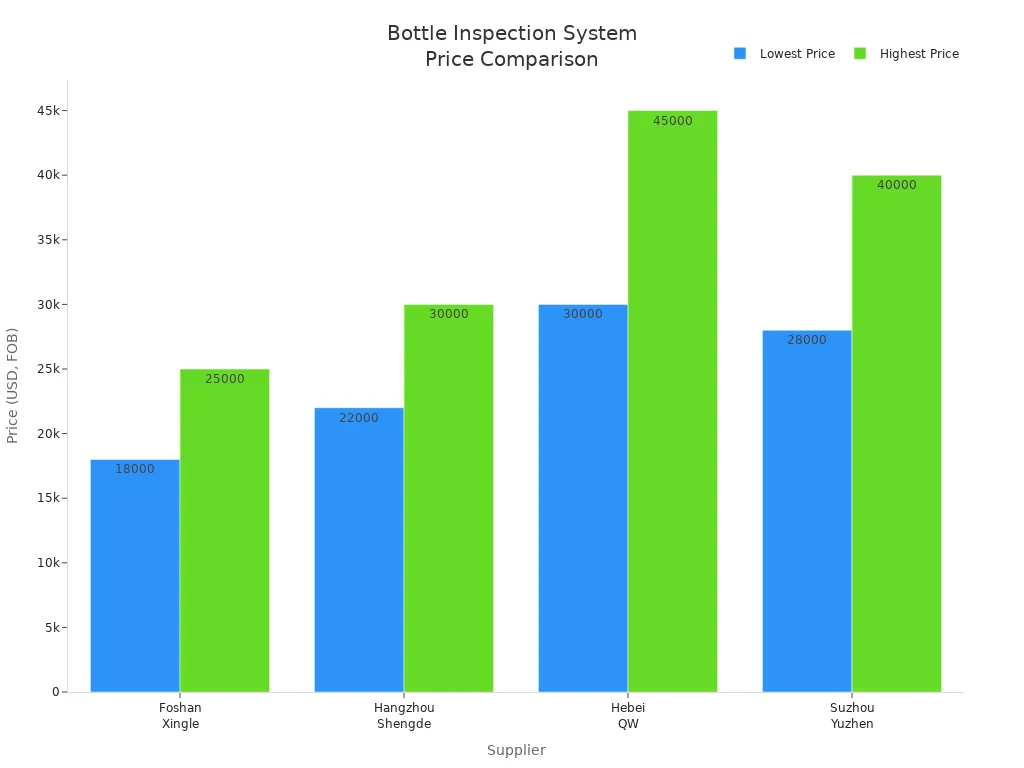
Cost remains a significant consideration when choosing components. The following table compares the costs and features of leading suppliers:
| Supplier | Price Range (FOB) | Included Services | Notable Advantages |
|---|---|---|---|
| Foshan Xingle Machinery Equipment Co., Ltd. | $18,000 – $25,000 | Basic installation guide, 1-year warranty | Lowest entry point; suitable for small bottling lines |
| Hangzhou Shengde Machinery Co., Ltd. | $22,000 – $30,000 | Remote setup support, spare parts kit | Mid-range option with enhanced diagnostics |
| Hebei QW Intelligent Equipment Co., Ltd. | $30,000 – $45,000 | On-site technician dispatch, full FAT report | Premium build quality; ideal for sterile environments |
| Suzhou Yuzhen Automation Technology Co., Ltd. | $28,000 – $40,000 | Custom UI, IoT connectivity, predictive maintenance module | Smart factory-ready with cloud monitoring |
Note: Companies should balance initial investment with long-term benefits such as reliability, support, and future scalability.
Prepare the Installation Area
Proper preparation of the installation area ensures smooth integration and optimal performance of the bottle inspection system. Environmental conditions must fall within the following ranges:
| Condition | Range |
|---|---|
| Temperature | 0°C to 35°C |
| Relative Humidity | 30% to 85% |
| Non-condensing | Yes |
Space requirements also play a crucial role. Most systems feature a compact design for space efficiency and can be installed over existing conveyors. Adjustable discharge height and high floor clearance provide flexibility for various production setups.
| Feature | Description |
|---|---|
| Compact Design | Designed to be space-efficient for installation. |
| Easy installation | Can be installed over existing conveyors. |
| Adjustable discharge height | Height can be adjusted to fit various setups. |
| High floor clearance | Allows for flexibility in installation space. |
Companies should verify that the installation area meets all environmental and space requirements before proceeding with hardware setup.
Installing and Launching Your Bottle Inspection System
Install Hardware Components
A successful installation begins with careful handling of each hardware component. Technicians position the main inspection unit over the conveyor, ensuring alignment with the bottle flow. They secure the mounting brackets and connect the power and data cables according to the manufacturer's guidelines. Many systems feature modular designs, which simplify integration with existing lines.
During installation, teams often encounter challenges related to bottle shape, curvature, or label artifacts. The following table outlines common issues and their solutions:
| Challenge | Solution |
|---|---|
| Shape and Curvature Distortion | Use high-resolution X-ray detectors and multi-angle scanning. |
| Liquid Interference | Select systems that detect contaminants based on density differences. |
| Label and Cap Artifacts | Apply intelligent image filtering and masking algorithms. |
| Dual-Energy X-Ray Inspection | Utilize two energy levels for improved accuracy in complex contents. |
| Single Beam Side Scan Inspection | Capture images from lateral angles for better visibility. |
| Advanced Image Processing | Implement AI-driven algorithms to adapt to product variations. |
| Customized Detection Zones | Configure zones to focus on critical areas and ignore non-critical components. |
Note: Proper alignment and calibration during installation reduce false positives and ensure reliable operation.
Configure Inspection Software
After hardware installation, engineers configure the inspection software to match the production line's requirements. They customize inspection parameters, such as defect thresholds and classification rules, to reflect the company's quality standards. Integration with enterprise resource planning (ERP) systems streamlines data flow and reporting.
Essential software features include advanced image processing, automated defect detection, real-time monitoring, and comprehensive reporting. The following table summarizes these features:
| Feature | Description |
|---|---|
| Advanced Image Processing | Captures and analyzes high-resolution images for precise defect detection. |
| Automated Defect Detection | Uses algorithms for automatic identification of defects, improving efficiency and accuracy. |
| Real-Time Monitoring | Provides live video feed for real-time insights into the inspection process. |
| Customizable Inspection Parameters | Allows users to adjust inspection thresholds and defect classification rules to meet quality criteria. |
| Comprehensive Reporting and Analytics | Generates detailed reports and statistical analysis for quality control insights. |
| Integration and Compatibility | Supports integration with existing production line components and systems. |
| User-Friendly Interface | Features intuitive controls and customizable layouts for easy operation. |
| Enhanced Quality Control | Improves product quality and regulatory compliance through accurate defect detection. |
Best practices for software configuration include:
- Customizing the software to match specific inspection needs and workflows.
- Integrating with other production tools for seamless operations.
- Providing comprehensive training for inspectors.
- Conducting short-scope testing before full rollout.
- Defining clear inspection processes to maintain consistency.
Tip: Configuring the software to align with operational needs ensures accurate defect detection and efficient reporting.
Test and Calibrate the System
Testing and calibration guarantee the accuracy and reliability of the bottle inspection system. Technicians run sample bottles through the system, observing detection rates and adjusting parameters as needed. They use image calibration tools, such as checkerboard patterns, to correct for optical imperfections. Transfer learning allows classification models to adapt across different devices, streamlining the setup of new systems.
Recommended calibration methods include:
| Calibration Method | Description |
|---|---|
| Image Calibration | Uses a checkerboard pattern with known geometry to adjust for optical system imperfections. |
| Transfer Learning | Enables classification models to work across devices without retraining. |
Regular calibration ensures accurate torque measurements for bottle caps and maintains compliance with industry standards. Most manufacturers recommend calibration every six to twelve months, with more frequent checks in high-usage environments.
The calibration and validation process involves a reference tool with a test certificate. Operators can use automatic software processes to align lens, illumination, camera, and mechanics for repeatable accuracy.
Train Operators and Set Up Maintenance
Operator training forms the backbone of a reliable bottle inspection system. On-site technician training provides hands-on experience, allowing staff to operate the system efficiently. Both new and experienced employees benefit from technical, practical learning sessions at the facility.
| Training Type | Description |
|---|---|
| On-Site Technician Training | Hands-on training for efficient operation of bottle filling and inspection machines. |
| On-Site Training for Bottle Filling | Technical, hands-on learning for both new and experienced employees. |
A preventative maintenance schedule minimizes downtime and extends equipment life. The following steps outline a robust maintenance plan:
- Set up a preventative maintenance schedule with regular checks.
- Inspect and replace worn parts periodically.
- Train operators for proper machine use to prevent errors.
- Maintain proper alignment and calibration.
- Keep the machine clean and free of debris.
Regular maintenance and operator training reduce unexpected stoppages and ensure consistent inspection quality.
Troubleshooting Common Issues
During the initial launch, teams may encounter several recurring issues. The table below lists frequent defect types and their causes:
| Defect Type | Causes |
|---|---|
| Holes | Contamination in resin, uneven heating, worn molds, or misadjusted deflashing setups. |
| Gate Cracks | Low temperatures in the gate, worn or misaligned blow pins. |
| Short Shots | Blocked channels or improper setup during injection molding. |
| Seal Surface Defects | Improper setup or worn components in a trimmer. |
| Random Defects | Insufficient sampling checks; 100% inline leak inspection recommended. |
Cost-effective solutions for technical issues include integrating AI and machine learning to enhance accuracy and adaptability. System consolidation through advanced I/O technology reduces the need for multiple components, saving space and costs. Localized supply chain management also improves efficiency and reduces operational expenses.
Teams should address root causes promptly and document solutions to build a knowledge base for future troubleshooting.
A bottle inspection system delivers measurable results, including rapid ROI and enhanced brand reputation. Companies achieve success by following clear steps, training operators, and embracing automation. Ongoing improvements, such as AI-driven inspection and adaptive algorithms, maximize efficiency and maintain high product quality.
| Metric | Value |
|---|---|
| Annual savings | $380,000 |
| ROI | 275% |
FAQ
What types of bottles can the inspection system handle?
The system inspects glass, plastic, and metal bottles. It adapts to various shapes and sizes with adjustable settings.
How often should operators calibrate the system?
Most manufacturers recommend calibration every six to twelve months. High-usage environments may require more frequent checks.
Can the system integrate with existing production lines?
| Integration Level | Description |
|---|---|
| Basic | Simple conveyor add-on |
| Advanced | Full ERP data connectivity |
The system supports both options.
See Also
A Comprehensive Guide to Choosing Tablet Sampling Machines
Three Essential Checkweighers for Every Food Processing Facility
Best Practices for Safely Storing Nitric Acid
Key Steps for Obtaining PED 2014/68/EU Certification
Understanding Plate Heat Exchangers: A Detailed Step-by-Step Guide