5 Optical Sorter Brands Perfect for Small Roasteries
Investing in quality control is a key step for small roasteries. Five top optical sorter brands offer an ideal balance of price, performance, and a smaller footprint. These brands include Satake, Bühler, Anysort, Meyer, and AMD. Their machines elevate green bean quality without the high cost of large industrial equipment. An instant coffee optical sorter serves a different, specialized function.
1. Satake: The Reliable Workhorse
Satake has earned its reputation as a dependable and efficient choice in the coffee industry. The brand is known for producing robust machines that deliver consistent performance. For small roasteries, this reliability translates into less downtime and a more predictable workflow. The financial benefits are also significant. Johanna Bot, a sales director at Satake, notes that a mere 2% or 3% increase in yield can quickly pay for the machine. This rapid return on investment makes Satake an accessible entry point into advanced quality control for growing businesses.
Why It's a Top Choice for Small Roasteries
Satake sorters are engineered for user-friendliness and stability. Once calibrated, the equipment runs for long periods without needing constant operator interaction. This frees up valuable staff time in a small roastery. The company provides comprehensive maintenance training during installation, empowering factory personnel to handle routine upkeep. This focus on operational independence makes Satake a practical and powerful asset for roasteries prioritizing efficiency and quality.
Key Features & Specifications
The Satake FMS 2000 (also known as PIKASEN FMS2000) is an excellent model for small-scale operations. Its compact design fits well in limited spaces while offering powerful sorting capabilities.
- Capacity: Processes up to 4,000 pounds (approx. 1,814 kg) per hour.
- Versatility: Sorts by color, shape, and size, removing defects like sour beans, insect damage, and foreign materials.
- Versions: Available in a Cascade version for gravity flow or a Feeder version for enhanced control.
Best For
Satake is best for roasteries seeking a high-performance, low-maintenance machine that delivers a swift return on investment. It is ideal for owners who need a "set it and forget it" solution.
Maintenance Note 📝 Satake sorters do not require a full-time operator. Operators simply need to perform periodic checks to ensure the machine is clean. A quick cleaning before each large batch run is a common practice that maintains peak sorting efficiency.
2. Bühler: The Premium Technology Leader
Bühler stands at the forefront of sorting technology, offering premium solutions for the coffee industry. The brand is synonymous with innovation and precision. It provides roasters with access to some of the most advanced defect detection capabilities on the market. This investment in technology translates directly into superior green bean quality and a stronger brand reputation.
Why It's a Top Choice for Small Roasteries
Bühler makes its industrial-grade technology accessible to smaller businesses through compact models like the SORTEX A. These machines empower roasters to achieve exceptional purity standards. The user-friendly SORTEX ProSortX operating software simplifies complex sorting tasks. Its machine-learning capabilities minimize setup time and reduce the need for constant operator input, a significant advantage for small teams.
Key Features & Specifications
The Bühler SORTEX A ColorVision is a powerful, compact machine packed with cutting-edge features. It brings a new level of precision to small-scale sorting.
- Advanced Detection: Utilizes InGaAs technology to identify foreign materials that share the same color as good coffee beans, such as stones or glass.
- Intelligent Software: Comes with pre-installed SORTEX ProSortX software, which features automatic calibration and can store up to 100 user-defined sorting modes.
- Remote Support: The SORTEX Anyware service allows Bühler engineers to access the machine remotely for real-time adjustments and support, minimizing downtime.
Best For
Bühler is the ideal choice for quality-focused roasteries with a flexible budget. It suits owners who want to leverage the best available technology to produce a truly premium product.
Tech Tip 💡 The machine-learning function simplifies sorting by automatically creating sorting parameters. This feature significantly reduces the need for manual calibration and monitoring.
3. Anysort: The High-Value Contender
Anysort enters the market as a powerful contender, offering intelligent sorting machines with an excellent price-to-performance ratio. The brand delivers high-tech innovation and competitive advantages for businesses on a budget. Anysort positions itself as a manufacturer of high-end sorters that substantially benefit the overall operating costs in the sorting business. This makes advanced technology accessible to a wider range of small roasteries.
Why It's a Top Choice for Small Roasteries
Anysort provides roasters with cost-minimizing solutions without compromising on quality. The company’s focus on delivering value allows smaller operations to invest in sorting technology that was previously out of reach. This strategic balance of price and performance helps roasteries improve their green bean quality, enhance their brand reputation, and achieve a faster return on investment. The machines are designed to be both powerful and economical.
Key Features & Specifications
Anysort integrates impressive technology and durable components into its machines. Its sorters are built for longevity and reliability.
- Cloud Connectivity: Many models feature cloud technology for remote control, monitoring, and diagnostics.
- AI-Powered Sorting: Utilizes deep-learning algorithms to identify and eject subtle defects with high accuracy.
- Durable Components: The intelligent high-frequency solenoid valve is a key component. It boasts a long lifetime exceeding 10 billion operations and includes a self-recovery system to ensure low maintenance costs.
- Comprehensive Support: Anysort provides a one-year guarantee for its machines. This includes professional training, technical guidance, and 24/7 consultation services.
Best For
Anysort is the perfect fit for budget-conscious roasteries that want to adopt modern sorting technology. It is ideal for owners seeking the best possible value and a quick path to profitability.
Value Proposition 💰 Anysort's core mission is to deliver competitive advantages through a combination of innovation, performance, and price. This makes it a smart choice for growing businesses.
4. Meyer: The Versatile Sorting Solution
Meyer offers highly adaptable sorting machines, making it a strong choice for dynamic roasteries. The brand is known for its technological flexibility. Its equipment can handle a wide range of products beyond coffee, including grains and nuts. This versatility provides small businesses with a long-term asset that can adapt to changing operational needs.
Why It's a Top Choice for Small Roasteries
Meyer sorters give roasters the power to customize their quality control processes. The machines are engineered to eliminate a broad spectrum of defects with high precision. This adaptability is perfect for roasteries that handle diverse coffee origins, each with unique defect profiles. Meyer provides a future-proof investment. A roastery can expand its product offerings without needing to purchase new sorting equipment.
Key Features & Specifications
Meyer equips its machines with optional AI deep learning and multi-spectrum recognition technology. This system efficiently removes moldy, discolored, insect-damaged, and broken beans. The advanced imaging technology includes:
- Advanced CMOS/CCD sensors with resolutions up to 4K for precise imaging.
- Multi-spectral cameras that use visible, near-infrared, and UV light to identify defects invisible to the naked eye.
- High frame rates that ensure accurate sorting even at high speeds.
The SMART series offers several models, allowing roasteries to choose a machine that fits their space.
| Model | Ejectors | Weight (kg) | Dimension (L×W×H) (mm) |
|---|---|---|---|
| 240SMART | 240 | 1110 | 1891×1564×2020 |
| 360SMART | 360 | 1380 | 2533×1564×2020 |
| 480SMART | 480 | 1730 | 2991×1564×2020 |
| 600SMART | 600 | 2070 | 3583×1564×2020 |
Best For
Meyer is best for roasteries that prioritize flexibility and plan for future growth. It is an excellent choice for owners who may want to sort other products in addition to coffee.
Pro Tip 💡 The ability to sort multiple types of agricultural products makes Meyer a uniquely versatile option for roasteries located in farming communities or those with diversified business models.
5. AMD: The Compact and Efficient Choice
AMD provides compact and efficient sorting solutions, making advanced technology accessible for roasteries with limited space. The brand focuses on creating powerful machines with a small footprint. This design philosophy allows smaller operations to integrate high-precision sorting without undertaking major facility renovations. AMD delivers a practical balance of size, performance, and user support.
Why It's a Top Choice for Small Roasteries
AMD sorters are ideal for small roasteries due to their efficiency and straightforward operation. The company emphasizes a supportive installation and training process. This approach empowers a roastery’s technical team to manage the equipment independently. AI-assisted training simplifies the initial setup. Users can quickly teach the system by tagging sample materials as 'good' or 'reject', minimizing downtime and accelerating the path to optimal performance.
Key Features & Specifications
AMD machines are engineered for reliability and ease of use, backed by robust support systems. The installation process is comprehensive and designed to ensure peak performance from day one.
- AI-Assisted Training: Simplifies machine setup by allowing operators to train the sorter with visual examples.
- Comprehensive Installation: The provider conducts a full inspection, recalibration, and optimization process with the client's team.
- Operator Training: The manufacturer trains the roastery’s staff on machine operation, settings adjustments, and basic maintenance.
- Remote Support: Many providers offer remote maintenance options, saving the roastery valuable time and money on service calls.
Best For
AMD is the best choice for roasteries that need a high-efficiency sorter with a minimal physical footprint. It is perfect for owners who value comprehensive training and reliable after-sales support to ensure a smooth integration.
Support Tip 🤝 Reliable after-sales service is a critical part of any optical sorter investment. AMD and its distributors often provide extensive support, including installation and calibration, to help you get the most out of your machine.
Is an Instant Coffee Optical Sorter Different?
Yes, an instant coffee optical sorter is fundamentally different from a machine designed for green beans. While both improve product quality, they target distinct materials with unique challenges. A standard sorter for green coffee may not perform effectively on soluble coffee granules. Understanding these differences is crucial for any business considering this technology. The right instant coffee optical sorter ensures the final product meets consumer expectations for appearance and quality.
Sorting Green vs. Soluble Coffee
Green coffee beans are dense, hard, and vary in size. Sorters for green beans identify defects like sour beans, insect damage, mold, and foreign materials such as stones or twigs. The goal is to purify the raw material before roasting.
In contrast, soluble coffee consists of brittle, porous granules created through a manufacturing process. An instant coffee optical sorter focuses on uniformity. It removes off-color particles, over-roasted specks, and lumps to create a visually consistent and appealing final product. The fragility of the granules also requires gentler handling.
Key Technology Differences
The technology inside an instant coffee optical sorter is specifically calibrated for its task. These machines often use high-resolution color cameras to detect subtle variations in shade, from light to dark brown. The material handling systems, such as chutes and belts, are designed to prevent breakage of the delicate granules.
A green bean sorter uses a wider range of technologies, including InGaAs for density and shape recognition, to find defects that are the same color as good beans. The robust nature of green beans allows for more aggressive handling and higher throughput speeds. Therefore, a dedicated instant coffee optical sorter is necessary for processing soluble products.
Brand Considerations
Major brands like Bühler and Satake manufacture equipment for various food products, including soluble coffee. When contacting a supplier, roasters must specify their exact application. A manufacturer will recommend a model tailored to the product's characteristics. Purchasing a standard machine for a specialized task will lead to poor results. Businesses need a purpose-built instant coffee optical sorter to achieve optimal quality control for soluble coffee.
Application Alert ⚠️ Always confirm with the manufacturer that the sorter model is designed for your specific product. A machine for green beans will not work effectively as an instant coffee optical sorter, and vice versa.
Comparison Table: Which Sorter Fits Your Roastery?
An optical sorter is a significant investment. This comparison helps roasteries match their specific needs with the right brand. The table below breaks down key factors like price, throughput, and footprint to guide your decision-making process.
Estimated Price Range
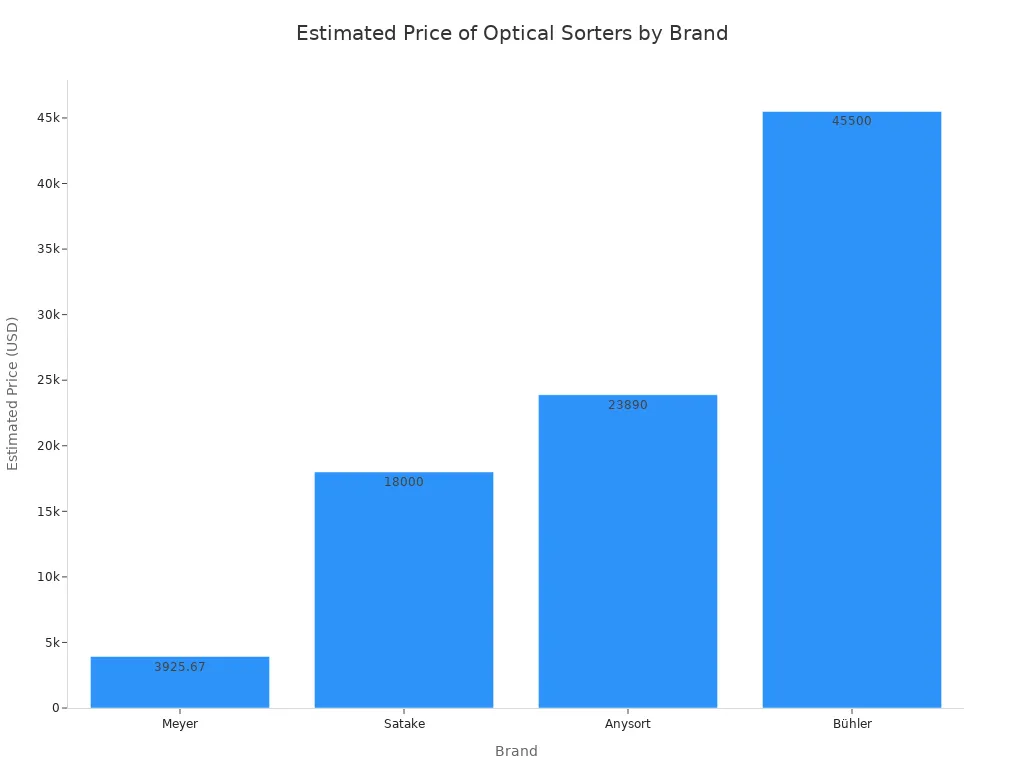
The cost of an optical sorter varies widely depending on the brand, model, and technology. Meyer offers some of the most accessible entry-level machines, with prices starting around $3,000 to $5,000. Satake provides a mid-range option, with some models estimated around $18,000. Anysort sits in a similar bracket, with certain machines priced near $24,000. Bühler represents the premium end of the market, with its advanced SORTEX A model costing approximately $45,500.
Budgeting Tip 💰 Prices can fluctuate based on features and import costs. Always request a direct quote from the manufacturer or a distributor for the most accurate pricing.
Throughput (kg/hr)
Throughput, or the amount of coffee a machine can process per hour, is a critical metric. Small, portable sorters may handle 50–150 kg/hr, suitable for micro-roasteries. Other compact models can process around 250 kg/hr of green coffee. Larger machines from brands like Satake can reach capacities of up to 1,800 kg/hr. Roasteries should choose a machine with a throughput that aligns with their current production volume and allows for future growth.
Footprint
Space is often a premium in small roasteries. AMD specializes in compact machines designed for tight spaces. Meyer also offers several models in its SMART series with varying dimensions, allowing roasteries to select a machine that fits their layout. Brands like Satake and Bühler provide compact versions of their industrial machines, such as the FMS 2000 and SORTEX A, which balance a smaller footprint with powerful performance.
Ideal Roastery Profile
Each brand caters to a different type of roastery:
- Bühler: Best for quality-obsessed roasteries with a flexible budget seeking top-tier technology.
- Satake: Ideal for roasteries needing a reliable, low-maintenance "workhorse" with a quick ROI.
- Anysort & Meyer: Perfect for budget-conscious roasteries that want modern features and versatility without a high initial investment.
- AMD: Suited for roasteries with limited space that value efficiency and strong after-sales support.
Selecting the right optical sorter depends on a roastery's budget, volume, and quality goals. The comparison table helps match specific needs with the best brand. An investment in sorting technology is a direct investment in coffee quality and brand reputation.
Removing a single "quaker" defect can prevent a one-point drop in a cup score, protecting the final product's integrity and elevating your brand's standing in a competitive market.
FAQ
Can an optical sorter be used for roasted coffee?
Most sorters are for green beans. Roasted beans are brittle and require specialized handling. A machine designed for green coffee may damage roasted beans during the sorting process.
How much maintenance does an optical sorter require?
Sorters need minimal daily maintenance. Operators should perform regular cleaning of cameras and chutes. Most brands also offer remote diagnostics and support to ensure consistent, reliable performance.
Quick Tip 💡 A clean machine is an effective machine. Schedule a quick wipe-down of the viewing area before each major sorting run to maintain accuracy.
See Also
Essential Industrial Checkweighers: Top 3 for Modern Food Processing Plants
Six Must-Have Industrial Vacuum Cleaners for Every Smart Business
Key Folder Gluer Innovations Shaping 2025 Carton Packaging Lines
Leading Capsule Checkweighers for Buyers to Evaluate in 2025
Five Optimal Applications for Single Stage Rotary Vane Vacuum Pump Sets