5 Hazelnut Sorters That Will Grow Your Small Business
An automated sorting machine is a crucial investment for small hazelnut businesses aiming for growth. The global hazelnut market is expanding rapidly, with projections showing it could reach over USD 15 billion by 2031. However, less than 5% of small to medium-sized hazelnut companies currently use automated sorting technology. This presents a significant opportunity for businesses to gain a competitive edge.
The right hazelnuts sorting machine boosts productivity and ensures product consistency. It reduces manual labor costs and improves quality to meet export standards. The TOMRA 5C, for example, offers an excellent balance of efficiency, size, and price, making it a top contender for small operations.
Key Features That Matter for Your Small Business
Selecting the right equipment requires a careful evaluation of several key features. These factors determine a machine's suitability for a specific operation and its potential to deliver a positive return. A thorough analysis ensures the investment aligns with both current needs and future growth objectives.
Sorting Accuracy and Defect Detection
High sorting accuracy is paramount for producing a premium product. Advanced sorters use cameras and sensors to identify and remove defective nuts with precision. This includes spotting issues like mold, insect damage, shriveling, and foreign materials. Superior defect detection protects brand reputation and enables businesses to meet stringent quality standards for lucrative export markets.
Throughput Capacity (kg/hour)
Throughput capacity measures the volume of hazelnuts a machine can process per hour. Small businesses should select a model that exceeds their current production needs. This foresight allows for operational scaling without requiring an immediate equipment upgrade as the business grows.
Footprint and Ease of Integration
A machine's physical footprint directly correlates with installation costs. Smaller, countertop-style units generally offer easier and lower-cost installation. In contrast, larger floor models require more facility space and professional setup. These larger systems may also necessitate complex utility modifications, such as electrical upgrades, which increases the final installation expense.
Cost vs. Return on Investment (ROI)
The initial price of a hazelnuts sorting machine is a significant investment, but its long-term value is crucial. Businesses can calculate ROI by projecting savings from reduced manual labor and increased revenue from higher-quality yields.
Note: Financial assistance is available. For example, the U.S. Farm Storage Facility Loan Program (FSFL) offers low-interest financing to producers for purchasing eligible equipment, including quality graders and sorters.
The Top 5 Hazelnuts Sorting Machine Models of 2025
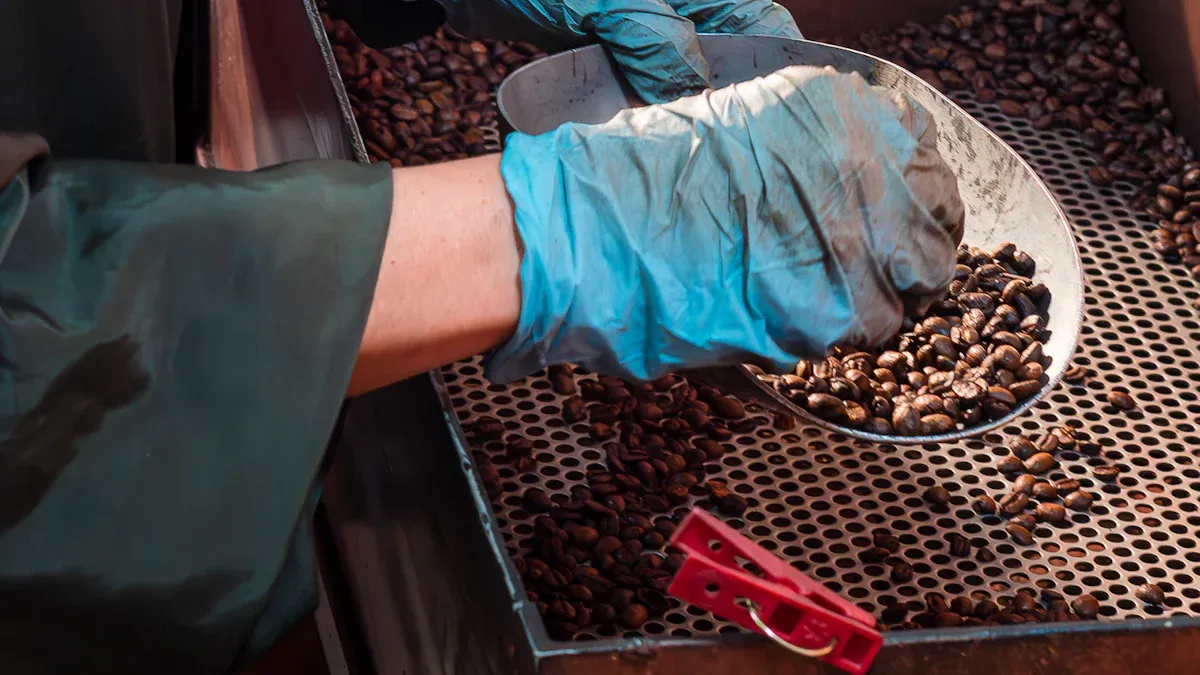
Choosing the right hazelnuts sorting machine is a strategic decision that impacts efficiency, quality, and profitability. Each model offers a unique combination of features tailored to different business needs. This section reviews the top five sorters for 2025, highlighting their strengths to help you find the perfect fit for your operation.
1. TOMRA 5C: Best Overall Value
The TOMRA 5C stands out as the premier choice for small businesses seeking the best balance of performance and price. It combines high-end sorting technology with a compact footprint, making it an accessible yet powerful investment. The machine uses advanced laser and camera sensors to detect a wide range of defects, from color imperfections to foreign materials.
Its design prioritizes efficiency, processing a significant volume of hazelnuts while minimizing good product rejection. This precision ensures a higher yield of premium-quality nuts, directly boosting revenue. For a growing business, the TOMRA 5C represents a smart investment that delivers a strong return by improving product quality and reducing labor costs simultaneously.
2. Key Technology VERYX B140: Most Compact Design
Space is a premium in many small processing facilities. The Key Technology VERYX B140 directly addresses this challenge with its exceptionally compact design. It delivers industrial-grade sorting performance without requiring a large operational area, making it ideal for businesses looking to upgrade their technology within an existing footprint.
Despite its size, the VERYX B140 does not compromise on sorting power. It features high-resolution cameras and laser sensors capable of identifying subtle defects in color, size, shape, and texture. Its thoughtful engineering allows for easy integration into existing production lines, minimizing installation downtime and costs. This model proves that powerful sorting capabilities can come in a small package.
3. Bühler Sortex FB2: Highest Sorting Accuracy
For businesses targeting premium or export markets, achieving near-perfect quality is non-negotiable. The Bühler Sortex FB2 excels in this area, offering the highest sorting accuracy available. It removes defective nuts and foreign materials with unmatched precision, protecting brand reputation and maximizing the value of each batch. This machine leverages a suite of proprietary technologies to achieve its superior performance.
- PROfile shape detection software uses advanced algorithms to identify and eject misshapen nuts, sticks, and other uniquely shaped foreign materials.
- Cutting-edge color, texture, and shape technologies work together to provide comprehensive defect and foreign material detection.
- BioVision technology specifically targets subtle biological defects, ensuring the final product meets the most stringent quality standards.
This level of accuracy minimizes waste and guarantees a consistently high-quality product stream.
4. Satake FMS2000: Easiest to Operate and Maintain
Technology is only effective if your team can use it confidently. The Satake FMS2000 is designed with the operator in mind, earning it the top spot for ease of use and maintenance. Its intuitive, full-color touchscreen interface simplifies setup and adjustments, reducing the need for extensive operator training.
The Satake FMS2000 series is widely recognized for its 'Excellent User-friendly Operation,' allowing staff to quickly become proficient and minimize operational errors. (gear icon)
Routine maintenance is straightforward, with easy access to key components for cleaning and inspection. This user-centric design ensures maximum uptime and consistent performance. For small businesses without a dedicated technical team, the Satake FMS2000 offers reliability and operational simplicity, allowing you to focus on production rather than complex machine management.
5. Longbow CT60: Most Scalable for Growth
Investing in equipment that can grow with your business is a wise long-term strategy. The Longbow CT60 is the most scalable sorter on our list, designed for businesses with ambitious growth plans. Its modular architecture allows you to start with a capacity that fits your current needs and budget, then add more sorting channels as your production volume increases. (chart increasing icon)
This "pay-as-you-grow" model prevents over-investment while ensuring your equipment never becomes a bottleneck. The Longbow CT60 also utilizes advanced AI and deep learning algorithms, which continuously improve sorting accuracy over time. This adaptability makes it a future-proof solution that evolves alongside your operational demands, providing a clear path for expansion.
How to Choose the Right Sorter for Your Operation
Selecting the ideal hazelnuts sorting machine requires a strategic approach. Business owners should evaluate their specific operational needs against the features of available models. This ensures the chosen equipment provides maximum value and supports long-term growth.
Assess Your Current Production Volume
First, analyze your current and projected production output. Document your peak processing volumes in kilograms per hour. A sorter should comfortably handle your current needs and offer capacity for future expansion. This prevents the machine from becoming a production bottleneck as your business grows.
Measure Your Available Facility Space
Next, measure the physical area available for the new equipment. Consider not only the machine's footprint but also the surrounding space required for operation, maintenance, and workflow. A detailed floor plan helps visualize how the sorter will integrate into your existing production line.
Define Your Quality Standards
Your target market dictates your quality requirements.
- Export Markets: These often demand the highest purity levels, requiring a sorter with advanced defect detection for issues like mold and insect damage.
- Domestic Markets: Standards may be more lenient, but high quality still commands premium prices. Clearly defining your quality goals helps you choose a machine with the necessary sorting accuracy.
Calculate Your Budget and Potential ROI
Finally, evaluate the financial impact. An ROI calculation projects the sorter's long-term value. You must first identify all initial costs, including the equipment purchase and implementation fees. Then, estimate annual benefits like labor savings and increased revenue from higher throughput. The net gain shows the investment's profitability over time.
Tip: The ROI percentage is a powerful metric. Calculate it by dividing the net gain from the investment by the initial costs.
| ROI Component | Calculation |
|---|---|
| Initial Costs | Equipment hardware, software, and installation fees |
| Labor Savings | Reduced wages, benefits, and overhead |
| Efficiency Gains | Additional revenue from increased throughput |
| Net Gain | (Annual Benefits – Annual Costs) x Years |
| ROI Percentage | (Net Gain / Initial Investment) x 100 |
At-a-Glance: Comparing the Top 5 Sorters
This section provides a direct comparison of the top models across essential metrics. Use these tables and lists to quickly evaluate which machine aligns with your operational priorities and budget.
Price Range Comparison
The initial investment varies significantly based on technology and capacity.
- Entry-Level ($): Satake FMS2000, Longbow CT60 (base model)
- Mid-Range ($): TOMRA 5C, Key Technology VERYX B140
- Premium Investment ($$): Bühler Sortex FB2
Capacity (kg/hr) Comparison
Throughput determines how much product you can process. High-capacity models can sort up to 2000 kg/h, while others are tailored for smaller batches.
| Model | Typical Capacity (kg/hr) |
|---|---|
| TOMRA 5C | 500 - 1500 |
| Key Technology VERYX B140 | 400 - 1200 |
| Bühler Sortex FB2 | 800 - 2000 |
| Satake FMS2000 | 300 - 1000 |
| Longbow CT60 | 500 - 1800+ (Scalable) |
Footprint (sq. meters) Comparison
Facility space is a key constraint for small businesses. The VERYX B140 offers the most compact design, while models like the Bühler Sortex FB2 require a larger operational area. Always confirm exact dimensions before purchasing.
Key Feature Comparison
Each hazelnuts sorting machine offers unique technological advantages.
- Bühler Sortex FB2: Utilizes PROfile shape detection and BioVision technology for unmatched accuracy.
- Longbow CT60: Features AI deep learning for unique shape selection and classification, improving over time.
- TOMRA 5C: Employs advanced laser and camera sensors for comprehensive defect detection.
- Key Technology VERYX B140: Offers high-resolution recognition with a large viewing angle for easy separation.
- Satake FMS2000: Prioritizes a user-friendly interface with customized light assets for simple operation.
Tech Tip: Some premium sorters now use exclusive four-view imaging and multi-spectral confocal technology, which can identify challenging impurities like glass and transparent plastic. (microscope icon)
Ideal Business Size Comparison
Matching the machine to your business scale ensures a strong ROI.
| Model | Ideal Business Size |
|---|---|
| TOMRA 5C | Small to Medium, Growth-Focused |
| Key Technology VERYX B140 | Small, Space-Constrained Facilities |
| Bühler Sortex FB2 | Medium to Large, Export-Focused |
| Satake FMS2000 | Start-up or Small Operation |
| Longbow CT60 | Businesses Planning Rapid Scaling |
The TOMRA 5C is our top recommendation. It provides a powerful mix of technology, a manageable size, and strong ROI for small businesses. This guide's comparison charts help you evaluate your specific needs. Investing in the right sorter is a crucial step toward reducing costs and ensuring sustainable growth. (rocket icon)
FAQ
What is the typical lifespan of a hazelnut sorter?
Industrial sorters typically last 10 to 15 years. Consistent, proper maintenance extends the machine's operational life and protects the owner's initial investment.
How much training is required to operate these machines?
Training requirements vary by model. User-friendly machines like the Satake FMS2000 require only a few hours of training for operators to achieve proficiency.
See Also
Essential Industrial Vacuum Cleaners: Top 6 Picks for Every Business
Crucial Industrial Checkweighers: The Top 3 for Food Plants
Ampoule Filling Production Lines: A Comprehensive Manufacturer Comparison
Identifying the Foremost Nameplate Suppliers: Key Qualities for 2025
Top Capsule Checkweighers: Essential Considerations for Buyers in 2025