Understanding the Benefits of 3D Skin Analyzers for Personalized Skincare
A 3D skin analyzer delivers highly accurate, multi-dimensional data. This information offers a complete roadmap of a person's skin health. This precision enables the diagnosis of specific issues. It supports the creation of a truly personalized and effective skincare routine, moving beyond guesswork to achieve tangible results.
What a 3D Skin Analyzer Reveals About Your Skin
A professional skin analysis moves beyond a simple look in the mirror. It delves deep into the skin's layers to provide a comprehensive diagnostic report. A 3d skin analyzer uses advanced imaging to uncover a wealth of information that is impossible to see with the naked eye. This data empowers individuals and skincare professionals to understand skin health on a microscopic level.
See Beyond the Surface to Hidden Damage
The most immediate benefit of 3D skin analysis is its ability to see what lies beneath the epidermis. The skin you see is not the full story. Years of sun exposure and environmental factors can cause damage that has not yet surfaced. These analyzers utilize specialized cross-polarized and UV lighting to reveal a host of underlying issues.
This technology can effectively identify and map:
- UV Spots: Damage from sun exposure that exists below the skin's surface. These spots are often precursors to future age spots and pigmentation.
- Brown Spots: Areas of hyperpigmentation and discoloration that may not be fully visible yet.
- Red Areas: Concentrated redness that can indicate inflammation, sensitivity, spider veins, or conditions like rosacea.
- Porphyrins: Bacterial excretions lodged in pores. High levels of porphyrins can lead to acne breakouts and inflammation.
Replace Guesswork with Objective Data
Effective skincare relies on accurate information, not assumptions. A 3d skin analyzer replaces subjective visual assessments with objective, measurable data. This technology quantifies a wide range of skin characteristics, providing a precise baseline for any treatment plan.
Key metrics that can be measured include:
- Wrinkles and fine lines
- Pore size and count
- Skin texture and smoothness
- Pigmentation irregularities
- Oil secretion levels
- Hydration levels
For example, some systems use a technique called fringe projection. They project light patterns onto the face to create a precise 3D model. This model allows for the exact measurement of a wrinkle's volume, depth, and surface area in millimeters. This turns a vague concern like "deepening wrinkles" into a quantifiable metric that can be tracked over time.
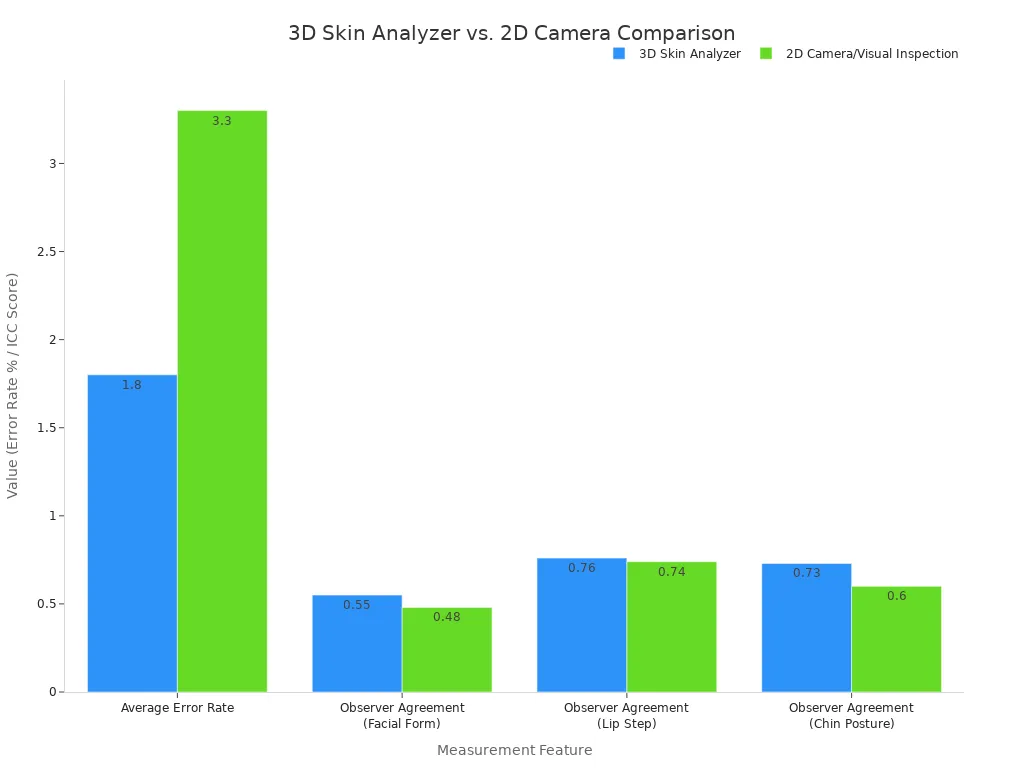
The difference in data quality compared to a standard 2D camera or visual check is significant. 3D scanners are less affected by lighting and shadows, leading to more accurate and repeatable results.
| Feature | 3D Skin Analyzer | 2D Camera/Visual Inspection |
|---|---|---|
| Measurement Accuracy | Provides data closer to clinical standards. | Less accurate due to shadows and projection errors. |
| Average Error Rate | Approximately 1.8% | Approximately 3.3% |
| Observer Agreement | Higher agreement among professionals on facial form. | Lower agreement on qualitative assessments. |
| Impact of External Factors | Less affected by lighting and patient pose. | Highly affected by lighting and pose variations. |
Identify Future Problems Before They Appear
Perhaps the most revolutionary aspect of a modern 3d skin analyzer is its predictive capability. By integrating artificial intelligence (AI) and deep learning algorithms, these systems can forecast a person's potential aging trajectory.
These AI models are trained on vast datasets of skin images. They learn to identify subtle changes in skin microstructures, like the collagen network in the dermis, to predict chronological age with remarkable accuracy. Some analyzers use this data to power AIGC (AI-Generated Content) aging simulations. These simulations create predictive images showing how a person's skin may appear from ages 20 to 80, offering a powerful visual tool for understanding the importance of preventative care.
This early detection is not just for cosmetic concerns. It plays a critical role in medical dermatology by identifying suspicious changes in skin lesions that may require intervention.
A clinical case study highlights this power. A 50-year-old patient's baseline 3D body scan detected numerous nevi (moles). Over nine months of monitoring, the system flagged a significant increase in pigment and an asymmetrical shape in one nevus. This early alert prompted a biopsy, which revealed a melanoma in situ, demonstrating the system's life-saving role in early cancer detection.
This proactive approach transforms skincare from a reactive process into a forward-thinking, evidence-based science.
How Analysis Translates to Better Skincare
Gathering detailed skin data is only the first step. The true power of this technology lies in its ability to translate complex analytics into a clear, actionable, and effective skincare strategy. The insights gained from a comprehensive scan empower both individuals and professionals to move beyond generic solutions and embrace a truly scientific approach to skin health.
Receive Truly Personalized Recommendations
A detailed analysis provides the foundation for a hyper-personalized treatment plan. Professionals use the specific data on wrinkles, spots, pores, texture, and subsurface conditions to recommend the most effective treatments and products. This eliminates the trial-and-error process that often comes with choosing skincare.
For example, the analysis might reveal significant underlying UV damage and a high concentration of porphyrins. A skincare professional would use this information to recommend a routine with targeted antioxidants, a high-SPF sunscreen, and specific antibacterial ingredients. This data also guides professional procedures. An in-depth evaluation helps determine if a person is a better candidate for microneedling, a specific type of chemical peel, or a targeted laser therapy to address their unique combination of concerns like acne scars or uneven pigmentation.
Visually Track Your Skincare Progress
One of the most motivating aspects of using advanced skin analysis is the ability to visually and quantitatively track progress. The technology creates a precise baseline measurement of the skin. Subsequent scans can be compared against this baseline to provide objective proof of a treatment's effectiveness. This dynamic tracking is crucial for monitoring both short-term improvements and the long-term management of chronic skin conditions.
Dermatologists and estheticians use these tools to provide data-driven outcomes that go beyond subjective opinion.
- Objective Measurement: The system provides quantitative data on wrinkle depth, scar volume, and pigmentation density.
- Anti-aging Treatments: Professionals can track visible reductions in wrinkle depth and measurable improvements in skin texture.
- Acne Scars: Changes in scar depth and volume are measured to confirm the effectiveness of therapies like fractional laser.
- Pigmentation Issues: The technology visualizes melanin distribution, helping to optimize laser protocols and assess post-treatment changes for conditions like melasma.
This visual evidence enhances communication between a client and their provider, offering tangible proof of progress and increasing satisfaction with the treatment plan. A study on a radiofrequency treatment provides a clear example of this detailed tracking.
| Metric | Baseline (Mean ± SD) | Week 4 (Mean ± SD) | Week 8 (Mean ± SD) | Week 24 (Mean ± SD) | p (95% CI) |
|---|---|---|---|---|---|
| Fine wrinkle score | 24.90 ± 11.29 | 27.40 ± 11.14 | 28.90 ± 11.73 | 24.70 ± 10.85 | 0.306 |
| Skin pore score | 43.15 ± 12.47 | 43.40 ± 12.45 | 46.10 ± 13.11 | 41.00 ± 14.83 | 0.308 |
| Skin tone score | 52.70 ± 3.95 | 51.35 ± 5.38 | 51.30 ± 4.93 | 51.55 ± 4.52 | 0.186 |
| Radiance score | 42.65 ± 17.48 | 52.20 ± 16.94 | 59.35 ± 18.60 | 48.90 ± 19.32 | < 0.001 |
| Sebum score | 29.05 ± 11.24 | 23.20 ± 13.24 | 20.45 ± 10.86 | 17.75 ± 11.68 | < 0.001 |
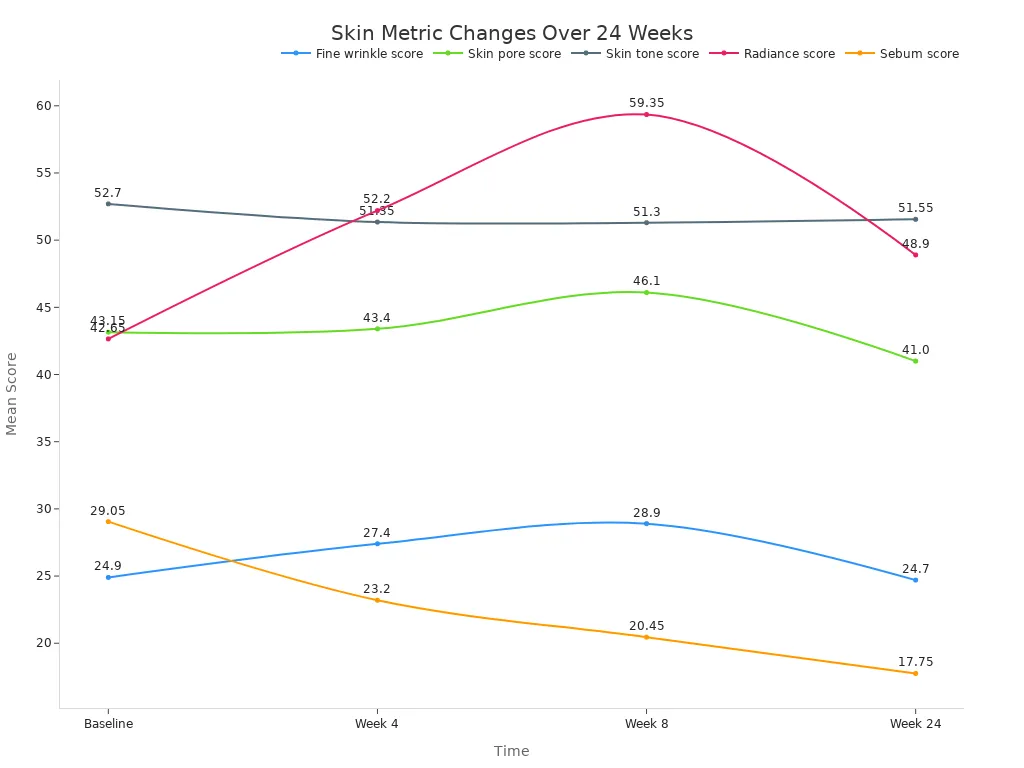
As the data shows, the treatment produced statistically significant improvements in skin radiance and sebum levels. Interestingly, the 3d skin analyzer did not record significant changes in fine wrinkles or pores for this specific treatment. This highlights how the technology provides a nuanced, multi-faceted view of progress. While some metrics improve dramatically, others may remain stable, guiding future treatment decisions.
Make Data-Driven Adjustments to Your Routine
Skincare is not a static process. A person's skin changes due to age, environment, and lifestyle. The ability to track these changes over time allows for intelligent, data-driven adjustments to any skincare routine or treatment plan. A regimen that worked perfectly six months ago may need modification to remain effective.
Regular follow-up scans provide the necessary feedback to make these adjustments with confidence. This ensures that the treatment plan evolves alongside the skin's needs for optimal long-term results.
Note: If a follow-up scan shows that redness has decreased but pore-clogging porphyrins have increased, a professional can adjust the plan. They might recommend swapping a calming serum for a product with salicylic acid, all based on objective data rather than guesswork. This feedback loop is essential for achieving and maintaining peak skin health.
A 3d skin analyzer delivers unmatched benefits through precision diagnostics and hyper-personalized routines. This technology enables measurable progress tracking and proactive care. It represents a powerful, scientific, and data-driven approach for anyone serious about achieving optimal skin health. This method transforms skincare from guesswork into an evidence-based science.
FAQ
How long does a 3D skin analysis take?
The imaging process is quick. A complete session, including the scan and a professional review of the data, typically lasts between 15 and 20 minutes.
Is the 3D skin analysis process safe?
Yes, the analysis is non-invasive and safe. It uses standard visible and UV light for imaging. The process does not involve any harmful radiation.
How often should a person get a follow-up scan?
Professionals often recommend follow-up scans every 3 to 6 months. This frequency allows for effective progress tracking and timely adjustments to a person's skincare regimen.