The Ultimate Guide to Lip Gloss Filling Machines for 2026
You need the right equipment to grow your cosmetics brand. This guide presents the top five machines for small businesses in 2026. The list covers everything from manual starters to choices in the Automatic vs. Semi-Automatic Lip Gloss Filling Machines debate.
- TECHTONGDA A03 Manual Filler
- VEVOR G1WYJ50 Semi-Automatic Piston Filler
- Accutek Mini-Pinch Filler
- E-PAK E-Filler Piston Filler
- Oden GEN3 Peristaltic Filler
Key Takeaways
- Choose a lip gloss filling machine based on your budget, how much you need to make, and how fast you want to grow.
- Piston fillers are good for thick lip gloss, while peristaltic fillers are easy to clean and good for sensitive formulas.
- Manual machines are cheap for starting out, semi-automatic machines help you make more, and automatic machines are for very large businesses.
Key Factors for Choosing Your Machine
Choosing the right machine can feel overwhelming. You need to balance your budget, production needs, and future growth. This section breaks down the most important factors to help you make a smart investment.
Piston vs. Peristaltic Fillers
You will first encounter two main filler types: piston and peristaltic. Piston fillers work like a syringe, pushing out a precise amount of product. This makes them perfect for thick lip gloss. Peristaltic fillers use rollers to squeeze a tube, moving the liquid without any machine parts touching it.
Pro Tip: Piston fillers offer excellent accuracy for viscous products, while peristaltic fillers provide a sterile path ideal for sensitive formulas.
Production Volume and Speed (BPM)
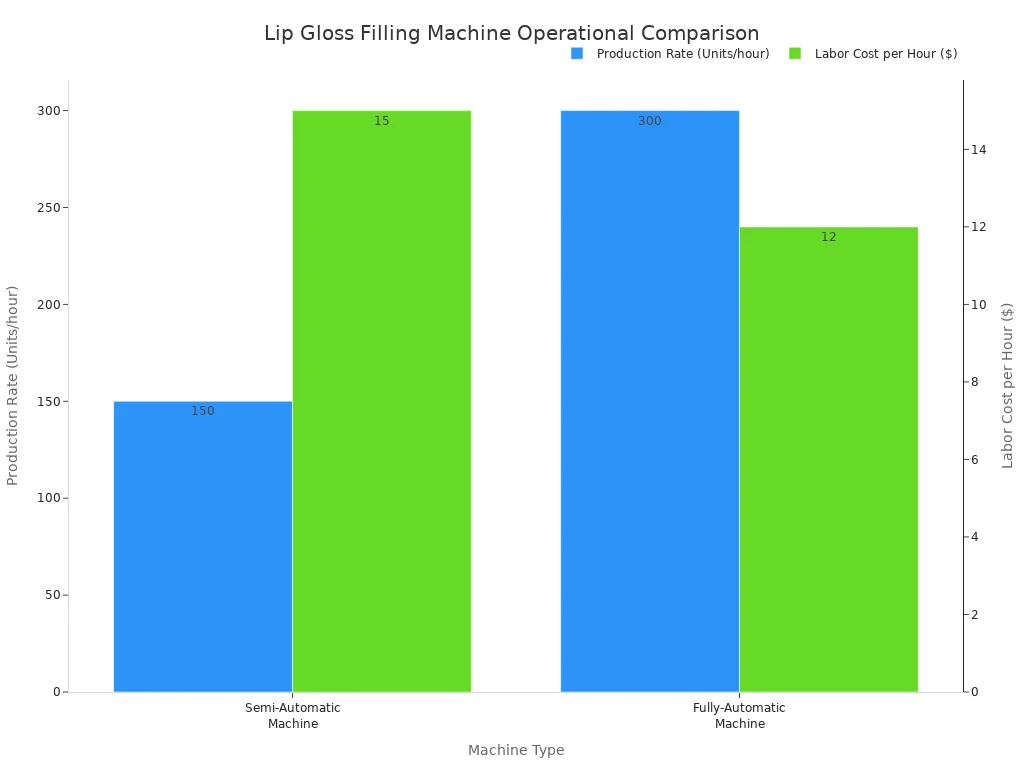
Consider how many units you need to produce. Speed is measured in bottles per minute (BPM). A semi-automatic machine typically fills 10-30 BPM. An automatic machine can reach over 60 BPM. Remember, the viscosity of your lip gloss will affect the final speed.
Automatic vs. Semi-Automatic Lip Gloss Filling Machines
Your choice between Automatic vs. Semi-Automatic Lip Gloss Filling Machines depends on labor. A semi-automatic machine requires an operator to place and remove tubes. A fully automatic machine does everything on its own, saving labor costs for large-scale production. The debate over Automatic vs. Semi-Automatic Lip Gloss Filling Machines often comes down to your production scale.
Filling Accuracy and Consistency
Accuracy prevents product waste. High-quality piston fillers deliver outstanding consistency, often with a fill accuracy of ±0.5%. This precision ensures every tube has the right amount of gloss, protecting your profits and brand reputation.
Ease of Use and Cleaning
Think about your daily operations. Peristaltic fillers are simple to clean because you can just replace the disposable tube. Piston fillers require more effort, as you must disassemble parts for a thorough cleaning.
Budget and Return on Investment
Finally, look at your budget. To calculate your return on investment (ROI), compare the machine's cost to your savings. Consider factors like reduced labor costs, faster packing speed, and lower product waste. A higher initial cost may offer a faster payback period.
In-Depth Reviews: The Top 5 Machines for 2026
Now you know the key factors. Let's look at the top machines. Each review will help you find the perfect match for your brand's needs and budget.
TECHTONGDA A03: Best for Startups
If you are just starting your lip gloss business, the TECHTONGDA A03 is your best friend. This is a fully manual machine. It works like a large, precise syringe. You fill its hopper with your gloss, set the fill volume, and pull a lever for each tube.
Pros:
- Extremely Affordable: It has the lowest entry cost, perfect for tight budgets.
- Simple to Use: You can learn to operate it in minutes.
- No Power Needed: You can use it anywhere without needing an electrical outlet.
Cons:
- Slow: Production is entirely dependent on your own speed.
- Labor-Intensive: Filling hundreds of tubes can be tiring.
Bottom Line: Choose the TECHTONGDA A03 if you are hand-filling right now and want to improve your consistency without a big investment. It is the first step away from spoons and syringes.
VEVOR G1WYJ50: Best for Scaling Up
Your brand is growing. You need to fill orders faster. The VEVOR G1WYJ50 Semi-Automatic Piston Filler is the ideal upgrade. This machine uses a pneumatic piston to deliver a consistent fill with the press of a foot pedal. It frees up your hands to manage tubes, boosting your output significantly.
This machine offers a great balance of speed and control for a small business ready to scale.
| Specification | Value |
|---|---|
| Filling Speed | Max. 20 Bottles/min |
| Filling Volume | 50-500 ml |
| Filling Head | Single Head |
| Type | Semi-automatic Piston Filler |
Pros:
- Excellent Value: It provides a major speed increase for a modest price.
- Consistent Fills: The piston ensures high accuracy, reducing product waste.
- Adjustable: You can easily change the fill volume and speed for different products.
Cons:
- Requires Air Compressor: You will need to purchase a separate air compressor to run it.
- Piston Cleaning: Cleanup is more involved than with a manual filler.
Oden GEN3: Best for High Viscosity
Does your brand specialize in thick, glittery, or high-viscosity glosses? The Oden GEN3 Peristaltic Filler is built for the challenge. This machine uses rollers that squeeze a tube to move your product. Your lip gloss never touches the machine's internal parts. This makes it incredibly easy to clean and perfect for sterile applications.
Pros:
- Handles Thick Products: It excels at moving viscous liquids that can jam piston fillers.
- Easy Cleanup: You can swap out the tubing in minutes for a fast and sanitary changeover between colors.
- Incredibly Accurate: It delivers precise fills even with difficult formulas.
Cons:
- Higher Cost: This technology comes with a higher price tag.
- Tubing is a Consumable: You will need to replace the filling tubes regularly.
Accutek Mini-Pinch: The All-Around Workhorse
The Accutek Mini-Pinch is a versatile and reliable machine that can grow with your business. It uses a "pinch" mechanism on a hose to start and stop the product flow. This simple design makes it a true workhorse for a variety of cosmetic products, not just lip gloss.
One of its biggest strengths is its flexibility. It works well with many container types, including:
- Chubby Gorilla containers
- Larger unicorn containers
- Various plastic or glass bottles
This filler is known for its user-friendly design and precision. It offers several key advantages for a growing cosmetics line.
- It handles a wide range of viscosities, from thin liquids to light creams.
- The minimal contact parts (only the hose) ensure a sanitary filling process.
- Its compact size is perfect for businesses with limited space.
Pros:
- Versatile: It can fill a wide range of products and containers.
- Sanitary: The product path is easy to clean or replace.
- Fast: It can achieve high speeds, making it suitable for larger batches.
Cons:
- Less Ideal for Very Thick Pastes: Extremely thick products may flow too slowly.
E-PAK E-Filler: The Premium Compact Option
When you need top-tier construction and performance in a small footprint, the E-PAK E-Filler is an excellent choice. This machine is built with high-quality materials, making it a long-term investment. The debate over Automatic vs. Semi-Automatic Lip Gloss Filling Machines often overlooks premium semi-automatic options like this one, which offer professional-grade results without the full automation footprint.
Its construction shows a commitment to quality and safety.
- All parts that touch your product are made of SS 316 stainless steel or other food-grade materials.
- The machine is built to GMP (Good Manufacturing Practice) standards.
- Key components are "CE" certified, meeting high safety and operational standards.
Pros:
- Superior Build Quality: Made with durable, corrosion-resistant stainless steel for a long life.
- GMP Compliant: Ideal for brands that need to meet strict manufacturing regulations.
- Highly Accurate and Reliable: Delivers precise performance you can count on.
Cons:
- Premium Price: It is one of the more expensive semi-automatic options.
Comparison at a Glance: Which Machine is Right for You?
Making the final decision can be tough. This section breaks down the key differences between our top 5 machines. You can use this quick guide to see how they compare on price, speed, and other important features.
Price Comparison
Your budget is a major factor. We use a simple dollar-sign rating to show the relative cost of each machine. This helps you quickly see which options fit your financial plan.
- $: Under $500
- $: $500 - $2,000
- $$: $2,000 - $5,000
- $$: Over $5,000
Speed (BPM) Comparison
Production speed is measured in bottles per minute (BPM). Your actual speed will depend on your lip gloss thickness and your own working pace. The numbers below show the machine's potential.
Best Use Case
Each machine shines in a specific environment. For a home-based business with limited space, a manual lip gloss filling machine like the TECHTONGDA is a perfect fit. It is compact and very affordable. Other machines are better for scaling up. The choice often comes down to the Automatic vs. Semi-Automatic Lip Gloss Filling Machines debate and your production goals.
Ease of Cleaning Rating
Cleaning is a daily task. A machine that is easy to clean saves you valuable time. Peristaltic fillers like the Oden GEN3 are the easiest because the product only touches disposable tubing.
Quick Tip: The table below summarizes everything to help you choose the best machine for your brand's journey.
| Machine | Price | Speed (BPM) | Best Use Case | Cleaning Ease |
|---|---|---|---|---|
| TECHTONGDA A03 | $ | 1-10 | Startups, home businesses | ★★★☆☆ |
| VEVOR G1WYJ50 | $ | 5-20 | Scaling up from manual | ★★☆☆☆ |
| Oden GEN3 | $$ | 5-25 | High viscosity, sterile fills | ★★★★★ |
| Accutek Mini-Pinch | $$ | 10-30 | All-around versatility | ★★★★☆ |
| E-PAK E-Filler | $$ | 5-20 | Premium, GMP-compliant labs | ★★☆☆☆ |
For ultimate budget-friendliness, the TECHTONGDA A03 is your best starting point. Businesses ready to scale production find the VEVOR G1WYJ50 offers excellent value and speed.
Final Tip: Always request a demo or send your product for a sample run. This step ensures the machine is compatible with your formula before you buy.
FAQ
What is the main difference between piston and peristaltic fillers?
Piston fillers use a cylinder to push out thick products. Peristaltic fillers use rollers to squeeze a tube. This method is great for easy, sterile cleaning.
Do all semi-automatic machines need an air compressor?
No, they do not. Pneumatic piston fillers require an air compressor to operate. However, many electric peristaltic or pinch fillers plug directly into a standard wall outlet.
Can I fill both lip gloss and lip oil with one machine?
Yes, you can. A versatile machine like the Accutek Mini-Pinch handles many product thicknesses. You can easily adjust settings for both thin oils and thicker glosses.