Scaling Your Beauty Brand With the Right Filling Machine
An indie beauty brand's journey from a kitchen-table startup to a retail powerhouse is a story of strategic scaling. A pivotal decision in this journey is choosing the right production equipment. This choice directly impacts a brand's ability to grow, maintain profitability, and secure large retail contracts. The decision rests on the brand's current production needs and its five-year growth strategy.
Semi-automatic machines serve as the ideal entry point for brands with low-to-medium production volumes, typically under 5,000 units per day. They are perfect for businesses with limited initial capital. Conversely, an automatic lip gloss filling machine is the necessary upgrade for high-volume production exceeding 5,000 units daily. This investment is crucial for reducing long-term labor costs and meeting escalating demand.
Market Growth Outlook: The global cosmetics market shows strong and consistent growth projections.
- Fortune Business Insights forecasts a CAGR of 6.64% from 2025 to 2032.
- Grand View Research anticipates a CAGR of 6.1% between 2024 and 2030.
- Transparency Market Research projects a CAGR of 4.5% from 2025 to 2035.
This expanding market presents a significant opportunity for brands equipped to scale their operations efficiently. Selecting the right filling machine is not just an operational choice; it is a strategic investment in the brand's future success. It determines whether a company can capitalize on market growth or be limited by its production capacity. The correct equipment empowers a brand to fulfill large orders, ensuring it can compete on a larger stage.
The Starting Point: Semi-Automatic Fillers
Ideal for Startups and Boutique Brands
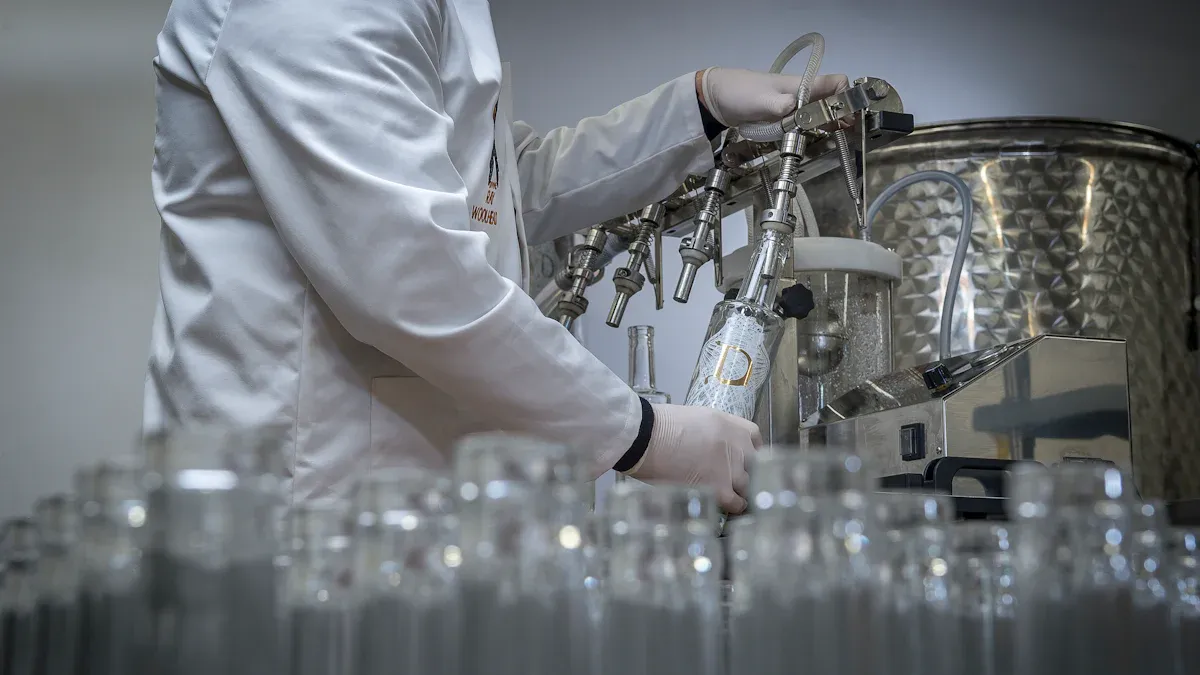
Semi-automatic fillers are the quintessential starting point for emerging beauty brands. Most modestly funded startups can realistically target first-year revenues between $100,000 and $1 million. This sales volume aligns perfectly with the production capacity of a semi-automatic machine. It provides a professional manufacturing solution without the significant capital outlay required for full automation. These machines empower boutique brands to move production from the kitchen to a dedicated workspace, establishing a foundation for scalable operations and consistent product quality from the very beginning.
Key Benefits for Early Growth
Early-stage brands gain several crucial advantages by investing in semi-automatic equipment. The initial investment is manageable, with semi-automatic fillers typically costing between $10,000 and $50,000. This affordability allows founders to allocate capital to other critical areas like marketing and product development. The efficiency gains are also substantial.
| Machine Type | Output (Units/Hour) |
|---|---|
| Manual Filling | 100–2,000 |
| Semi-Automatic Filling | 10,000-40,000 |
Furthermore, a quality semi-automatic lip gloss filling machine achieves up to 90% fill accuracy. This precision drastically minimizes the product waste common with manual filling, protecting profit margins on expensive formulations.
Signs You Need a Semi-Automatic Filler
A brand knows it needs an upgrade when manual filling becomes a clear bottleneck. When staff cannot produce more than 100 units per hour, order fulfillment slows, and the brand risks losing sales opportunities. This limitation directly impacts profitability as demand outpaces production capacity.
A semi-automatic machine is the ideal solution for growing brands producing 500-2,000 units per day. It serves as a critical middle ground when manual processes are insufficient but full automation is not yet required.
Investing in a semi-automatic filler resolves these bottlenecks, enabling the brand to meet growing demand efficiently and prepare for the next stage of expansion.
The Growth Engine: Automatic Lip Gloss Filling Machine
Built for Mass Production
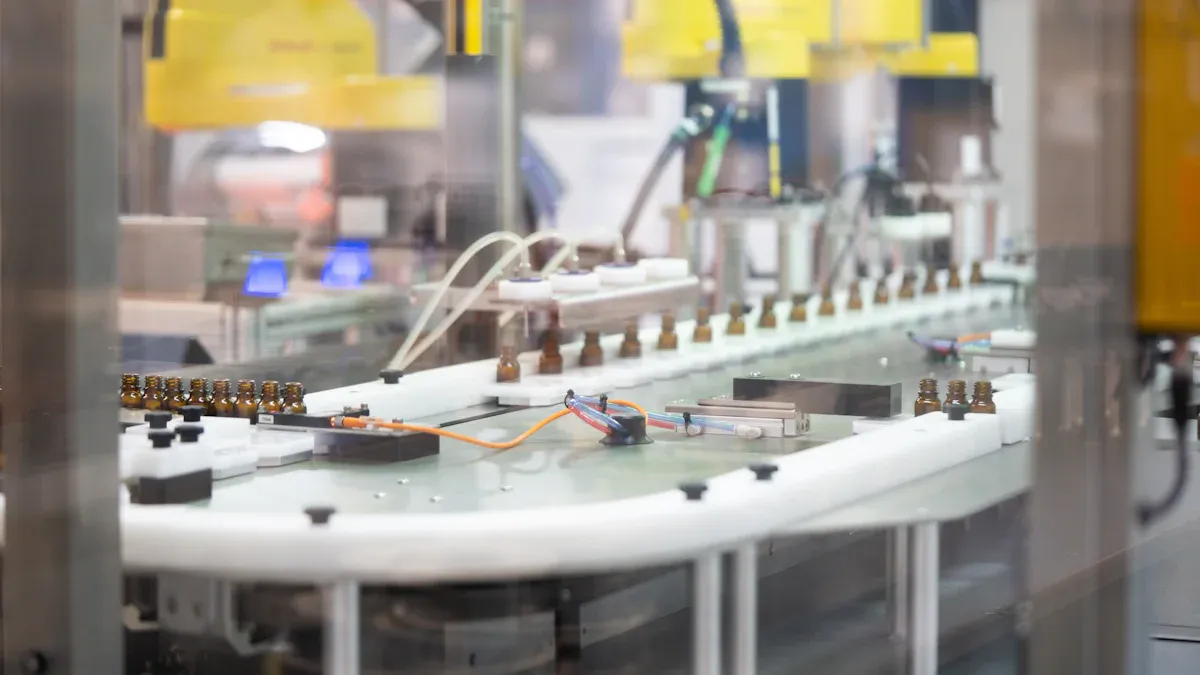
An automatic filling machine is the engine of high-volume cosmetic production. Brands aiming for mass-market penetration require equipment that can handle immense output without sacrificing quality. These systems are engineered for daily production volumes that consistently exceed 10,000 units. This level of productivity is non-negotiable for brands seeking to secure and fulfill large purchase orders from national or international retailers. An automatic lip gloss filling machine transforms a brand from a boutique operation into a manufacturing powerhouse, ready for exponential growth. It provides the speed and reliability necessary to compete on a larger stage.
Key Benefits for Scaling Operations
Investing in automation delivers transformative benefits for a growing brand. The most immediate impact is a significant reduction in per-unit labor costs, as fewer operators are needed to manage the production line. Furthermore, automated systems offer unparalleled precision. Some companies report a 30% improvement in filling accuracy, which drastically cuts down on expensive product waste. This leads to enhanced profitability and consistency.
Success in Scaling: A Korean beauty brand provides a powerful case study. After a successful trial with an automatic filler, the company invested in a full high-speed packaging line. The results were dramatic:
- A 100% increase in total output.
- A 60% reduction in labor costs.
- End-to-end traceability for superior quality control.
This example demonstrates how the right equipment directly fuels expansion and operational excellence.
Signs You're Ready to Upgrade
A brand is ready for full automation when its current production methods become a barrier to growth. If daily demand consistently surpasses 5,000 units and a semi-automatic system cannot keep pace, it is time to upgrade. This production ceiling limits revenue and prevents the brand from pursuing larger opportunities. Investing in an automatic lip gloss filling machine is the clear next step when the primary goal shifts from establishing a process to maximizing output. It is a strategic decision that unlocks the brand’s full potential for market leadership.
Key Differences: A Head-to-Head Comparison
Choosing between a semi-automatic and an automatic filler requires a clear understanding of their core differences. This comparison breaks down five critical factors: production speed, investment, labor, flexibility, and physical space. Analyzing these areas helps a brand align its equipment choice with its operational needs and growth ambitions.
Production Speed and Volume
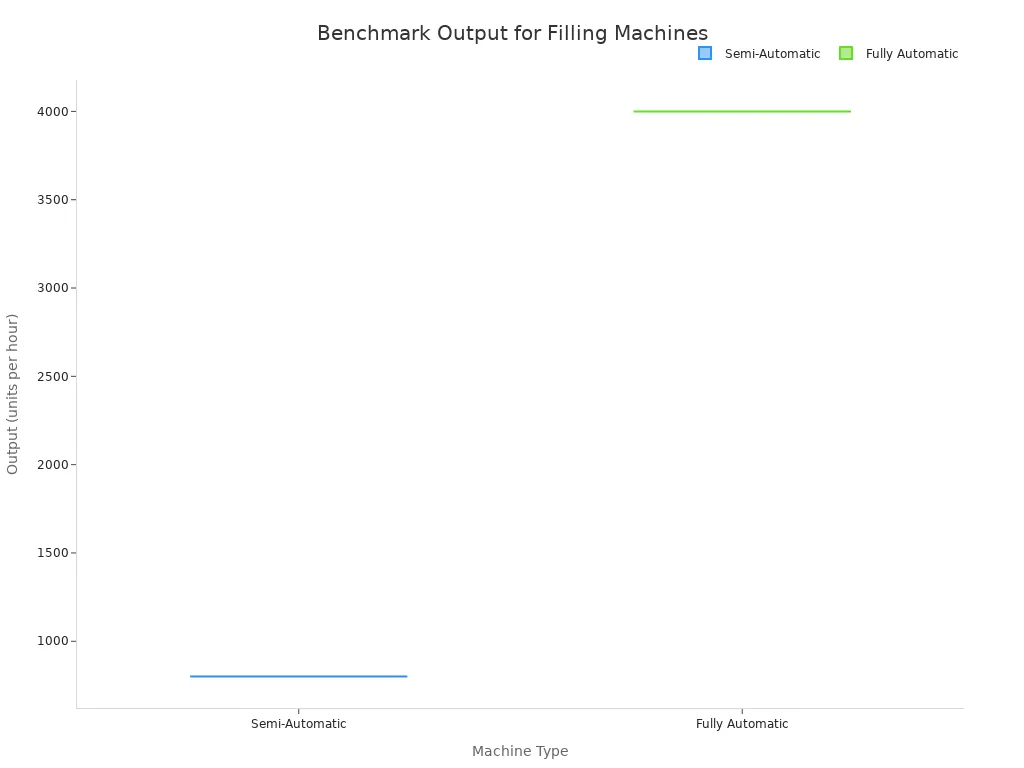
Production output is the most significant differentiator between semi-automatic and automatic systems. Semi-automatic machines are faster than manual methods, but their speed is limited because an operator must handle each container. Automatic filling machines, in contrast, are engineered for high-volume, continuous production, filling thousands of containers per hour without interruption.
The practical impact on a production schedule is substantial. For example, a semi-automatic machine managing 500 bottles per hour would need 16 hours to complete an 8,000-unit order. An automatic system rated at 1,200 bottles per hour finishes the same job in just over six and a half hours. This efficiency gap widens as production demands increase.
Upfront Investment and ROI
The initial cost of equipment is a primary consideration for any brand. Semi-automatic fillers offer an accessible entry point, with prices for entry-level cosmetic fillers typically ranging from $5,000 to $20,000. This affordability makes them ideal for startups and brands with limited capital.
Automatic machines represent a much larger capital expenditure, but this investment drives down per-unit costs in mass production. By minimizing manual intervention and maximizing output, an automatic lip gloss filling machine delivers significant long-term savings.
| Filler Type | Initial Cost Range | Per-Unit Cost for Mass Production |
|---|---|---|
| Semi-Automatic | $3,000 - $15,000 | Higher |
| Fully Automatic | $50,000 - $300,000 | Lower |
The return on investment (ROI) for automation is compelling for high-volume businesses.
- Most manufacturers achieve payback on automatic filling machines within 18 months.
- Automated systems can yield a 214% return on investment over a three-year period.
This demonstrates that while the upfront cost is high, the long-term financial benefits are substantial.
Labor Requirements
Labor needs differ fundamentally between the two systems. A semi-automatic machine requires an operator's direct involvement in every cycle. The operator manually places each container, starts the fill with a button or foot pedal, and then removes the filled product. This process demands a dedicated, full-time operator to run the machine.
An automatic machine needs someone to ensure it continues to work. A semi-automatic machine needs someone to make it work.
In contrast, an automatic line operates with minimal human intervention. An operator's role shifts from active participation to oversight. Their primary tasks include preparing the machine for production runs, monitoring performance, performing occasional quality control checks, and replenishing bulk materials like caps and labels.
Product and Container Flexibility
Flexibility is crucial for brands offering a diverse product portfolio. Semi-automatic fillers excel in this area, especially for short production runs. A changeover for a new product or container can take five minutes or less, often requiring just one person to swap out the contact parts. This makes them perfect for brands that frequently switch between different SKUs.
Modern automatic machines, however, are also designed with efficiency in mind. The changeover process is streamlined to minimize downtime. Features like a power height switch on the control panel allow operators to easily adjust fill heads for different container heights. Fingertip knobs simplify width adjustments, making the transition between bottle sizes quick and tool-free.
Operational Footprint
The physical space a machine occupies is a practical constraint for many facilities. Semi-automatic fillers are known for their small footprint. Many are tabletop models that can fit into limited production areas without requiring significant facility modifications. For example, a typical tabletop filler might only occupy a space of 30 inches by 22 inches.
Automatic filling lines require a much larger operational footprint. These systems are not standalone units; they include integrated conveyors, capping stations, and other components that form a complete packaging line. A brand must have adequate, dedicated floor space to accommodate the entire system, which is a key consideration during facility planning.
Planning Your Investment for Future Growth
A strategic equipment purchase looks beyond immediate needs and considers long-term scalability. Brands must evaluate the financial viability, integration potential, and overall value of their investment to ensure it supports future expansion. This forward-thinking approach transforms a machine from a simple expense into a powerful growth asset.
Calculating Your Break-Even Point
Understanding the financial return is a critical first step. A brand can determine when its investment will pay for itself by calculating the break-even point. The formula is straightforward: Fixed Costs / (Price – Variable Costs). Here, fixed costs represent the machine's purchase price. The price is the selling price of one unit, and variable costs are the per-unit expenses like labor and materials. This calculation reveals the number of units a brand must sell to recoup its initial investment, providing a clear timeline for profitability.
Integrating with a Full Packaging Line
An automatic filler rarely operates in isolation. It serves as the core of a comprehensive packaging line. A growing brand must plan for integration with other essential equipment to create a seamless workflow. This complete system can include:
- Conveyors and Turntables
- Sleeving Machines and Shrink Tunnels
- Marking and Coding Systems
- Inspection-Rejection Stations
Proper planning ensures all components work together efficiently, maximizing throughput and minimizing bottlenecks from filling to final packaging.
Factoring in Long-Term Value
The true value of an automatic lip gloss filling machine emerges over its entire lifecycle. While maintenance is a recurring expense, the savings from reduced labor and material waste far outweigh these costs. Modern machines also feature predictive maintenance technologies that monitor component wear, reducing unexpected downtime by nearly 50%. This reliability ensures consistent production and protects revenue. The investment delivers substantial net savings, proving its long-term financial benefit.
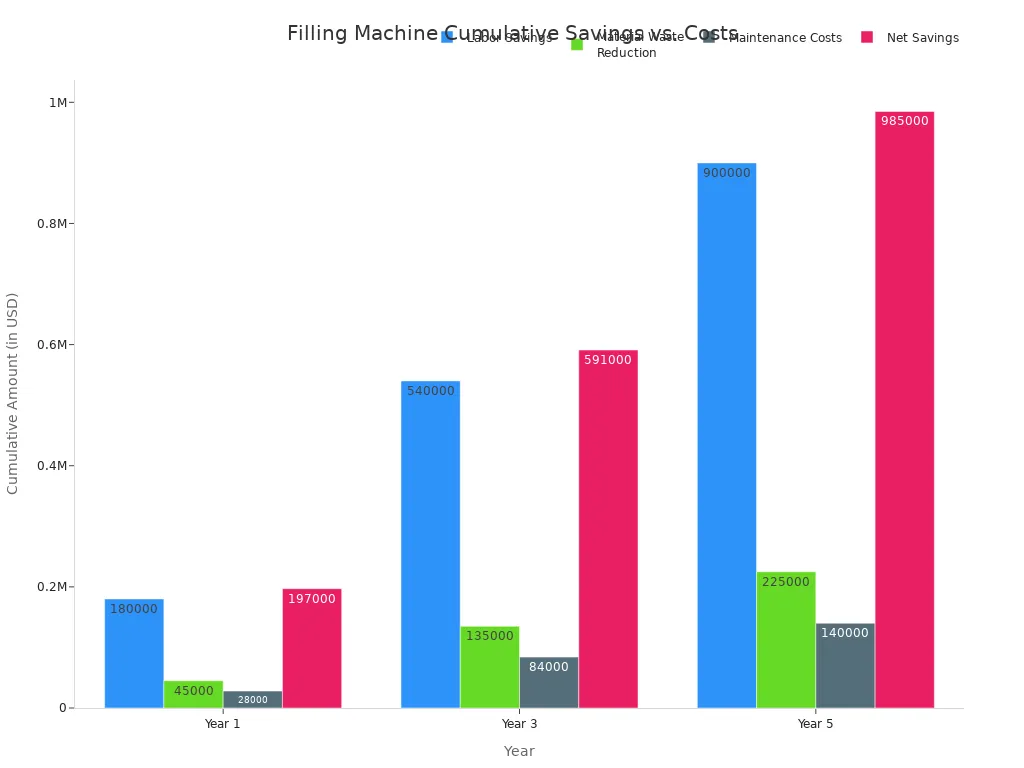
A brand chooses a semi-automatic filler to master its process with a lower initial investment and high flexibility. It invests in an automatic filler to maximize output and lower labor costs.
The right machine becomes a valuable asset. Aligning the purchase with strategic goals ensures a strong return on investment.
FAQ
What products can an automatic filler handle?
Automatic machines offer great versatility. They can fill various cosmetic products, including lip gloss, mascara, concealer, liquid foundation, serum, and nail polish, accommodating a brand's diverse product line.
How does automation improve product quality?
Automation ensures superior quality control. Machines provide precise, consistent fills and capping, which reduces product waste. This process guarantees every unit meets the brand's high standards for excellence.
Can one person operate an automatic machine?
Yes, modern automatic filling machines are designed for single-person operation. An operator oversees the process, manages material replenishment, and performs quality checks, significantly reducing a brand's labor requirements.
See Also
Top Ampoule Filling Line Manufacturers: A Comprehensive Industry Comparison
Innovative Folder Gluer Technologies Revolutionizing Carton Production in 2025
Boosting Pharmaceutical Efficiency: Modern Capsule Decapsulation Machine Advancements Explained
Automatic UV Coaters: Indispensable for Achieving High-Speed Printing Excellence