2026 Update on TMXDI CAS No. 2778-42-9 in Automotive Coatings

In 2026, TMXDI (CAS No. 2778-42-9) retains its niche as a high-value aliphatic isocyanate for automotive coatings. Regulatory clearances remain favorable, and steady demand in premium clear coats drives interest in low-VOC systems. The Application Prospect of TMXDI (Tetramethylxylylene Diisocyanate) CAS No. 2778-42-9 focuses on superior UV stability and adhesion for performance-critical formulations.
Key Takeaways
- TMXDI makes car coatings last longer and resist yellowing from sunlight.
- TMXDI helps coatings stick well to plastics and metals, even in tough conditions.
- TMXDI supports eco-friendly coatings with low VOC emissions.
Overview of TMXDI
Chemical Identity and CAS No. 2778-42-9
TMXDI stands for tetramethylxylylene diisocyanate. This specialty aliphatic diisocyanate carries CAS No. 2778-42-9. The molecule contains two isocyanate groups attached to tertiary carbons. This structure differs from conventional primary and secondary carbon isocyanates. The Application Prospect of TMXDI (Tetramethylxylylene Diisocyanate) CAS No. 2778-42-9 depends on this unique chemistry. Formulators value the molecule for its balance of reactivity and stability.
Key Physical and Reactivity Properties
TMXDI appears as a colorless liquid at room temperature. Its molecular weight is 244.3. The NCO content reaches at least 33.7%. Density measures 1.07 g/cm³ at 20°C. Viscosity is remarkably low at 9 mPa·s at 20°C. The freezing point sits at -10°C. These properties allow easy handling and formulation.
| Property | Value |
|---|---|
| Appearance | Colorless liquid |
| Molecular Weight | 244.3 |
| NCO Content | ≥ 33.7% |
| Density (20°C) | 1.07 g/cm³ |
| Viscosity (20°C) | 9 mPa·s |
| Freezing Point | -10°C |
The tertiary-carbon NCO groups react more slowly than traditional isocyanates. This slower reactivity extends the processing window. TMXDI also shows low tendency to crosslink between 100 and 120°C.
Why the Aliphatic Structure Matters
The aliphatic structure gives TMXDI its standout performance. The NCO groups do not conjugate with benzene rings. This separation prevents yellowing under light exposure. Four methyl groups create substantial steric hindrance. This hindrance controls reactivity and improves stability. The structure also yields low-viscosity prepolymers. Manufacturers can produce solvent-free waterborne polyurethane dispersions. These traits make TMXDI ideal for automotive clear coats and primers.
Performance Advantages in Automotive Coatings
Durability and Hydrolytic Stability
TMXDI delivers exceptional durability in automotive coating systems. The tertiary-carbon isocyanate groups resist hydrolysis far better than conventional primary-carbon isocyanates. Water molecules struggle to attack the sterically hindered NCO groups. This resistance translates directly into longer coating service life.
Automotive coatings face constant exposure to moisture, humidity, and temperature swings. A coating must maintain its integrity through years of rain, car washes, and environmental cycling. TMXDI-based polyurethane networks handle these conditions with remarkable resilience. The crosslinked structure remains intact even after prolonged water immersion.
The steric hindrance from four methyl groups plays a critical role here. These methyl groups shield the NCO groups from nucleophilic attack by water. Formulators gain a wider processing window during application. The finished coating also resists degradation during its service life.
Hydrolytic stability matters most in primer layers and adhesion promoters. These layers sit closest to the metal substrate. Any breakdown at this interface leads to catastrophic coating failure. TMXDI-based primers maintain strong bonds even in high-humidity environments. This reliability explains why automotive manufacturers specify TMXDI for demanding applications.
The low tendency to crosslink between 100 and 120°C adds another durability advantage. Coatings can undergo baking cycles without premature curing. The final network achieves optimal crosslink density. This density directly correlates with mechanical strength and chemical resistance.
Weatherability and UV Resistance
Sunlight destroys most organic coatings over time. UV radiation breaks chemical bonds and triggers yellowing. Automotive clear coats must resist this degradation for a decade or more. TMXDI excels in this critical performance area.
The aliphatic structure of TMXDI provides its key advantage. The NCO groups do not conjugate with benzene rings. This separation prevents the formation of chromophores that absorb UV light. Coatings based on TMXDI show minimal yellowing after extensive UV exposure.
Automotive OEMs test clear coats under accelerated weathering conditions. These tests simulate years of sun exposure in weeks. TMXDI-based coatings consistently outperform aromatic isocyanate systems. They also match or exceed the performance of other aliphatic isocyanates like HDI and IPDI.
Gloss retention is another critical measure of weatherability. A clear coat must maintain its shine through years of exposure. TMXDI-based coatings retain gloss exceptionally well. The surface does not develop the dull, chalky appearance common in inferior systems.
The molecular structure also resists chain scission from UV radiation. The bonds holding the polymer network together remain stable. This stability prevents the surface from becoming brittle or developing cracks. Automotive refinish shops value this longevity because their customers expect durable repairs.
Premium vehicle manufacturers use TMXDI in their topcoat formulations. These coatings must look flawless after five, ten, or even fifteen years. The UV resistance of TMXDI makes this longevity possible. No other isocyanate offers the same combination of clarity and stability.
Adhesion to Challenging Substrates
Modern vehicles use a complex mix of materials. Steel, aluminum, plastics, and composites all require coating. Each substrate presents unique adhesion challenges. TMXDI-based coatings bond effectively to all of them.
Plastic substrates are particularly difficult to coat. Their low surface energy resists wetting by conventional coatings. Poor wetting leads to adhesion failure and coating delamination. TMXDI-based polyisocyanate coatings solve this problem through superior surface interaction.
Adhesion testing confirms these performance claims. A TMXDI-based polyisocyanate coating achieved a 5B rating on the cross-hatch test (ASTM D3359). This rating represents the highest possible score. The test showed no delamination at all. The coating remained firmly bonded to the plastic substrate.
- Cross-hatch test (ASTM D3359): 5B rating (no delamination) for a TMXDI-based polyisocyanate coating
This result demonstrates the practical value of TMXDI in automotive applications. Plastic components are increasingly common in vehicle assembly. Bumpers, trim pieces, and interior panels all require durable coatings. TMXDI provides the adhesion needed for these challenging substrates.
The low viscosity of TMXDI contributes to its adhesion performance. Formulators can create coatings with high solids content. These coatings wet substrates more effectively. Better wetting leads to stronger mechanical interlocking at the interface.
TMXDI also works well in adhesion promoter layers. These thin coatings bridge the gap between substrate and topcoat. The tertiary-carbon structure provides stable bonding to both polar and non-polar surfaces. Automotive manufacturers rely on this versatility for multi-substrate assemblies.
The combination of durability, weatherability, and adhesion makes TMXDI a premium choice. Formulators accept the higher cost because the performance justifies it. Automotive coatings represent the most demanding application for any isocyanate. TMXDI meets those demands consistently.
Regulatory and Environmental Status in 2026
Global Compliance Overview
TMXDI maintains a clear regulatory standing across all major automotive manufacturing regions in 2026. The chemical holds active registrations under key frameworks that govern industrial chemical use. These registrations allow unrestricted import, sale, and formulation in the European Union, North America, and Asia-Pacific markets.
The United Nations Globally Harmonized System classifies TMXDI as a diisocyanate compound. This classification requires standard hazard communication through safety data sheets and product labels. Automotive coating formulators must follow these labeling requirements during raw material procurement and finished product distribution.
China, Japan, and South Korea each maintain their own chemical inventory systems. TMXDI appears on all three inventories without restrictions specific to automotive coatings. This status enables global supply chains to move the material freely between manufacturing sites.
The World Health Organization and the International Agency for Research on Cancer have not classified TMXDI as a carcinogen. This non-classification supports its continued use in coatings that contact workers and consumers. Automotive OEMs accept TMXDI as a safe component in their approved raw material lists.
REACH, TSCA, and Workplace Exposure Limits
The European Union's REACH regulation covers TMXDI under its comprehensive chemical management system. Manufacturers and importers hold full REACH registrations for TMXDI. These registrations include all required toxicological and ecotoxicological data packages. No substance-of-very-high-concern (SVHC) status applies to TMXDI. This clearance means no special authorization requirements burden downstream users.
The United States Environmental Protection Agency (EPA) manages TMXDI under the Toxic Substances Control Act (TSCA). TMXDI appears on the TSCA Inventory of Chemical Substances. No significant new use rule (SNUR) applies to the compound. The EPA considers existing uses, including coatings applications, as acceptable.
Workplace exposure limits for TMXDI follow the general diisocyanate standards established by regulatory agencies. The American Conference of Governmental Industrial Hygienists (ACGIH) provides threshold limit values that apply to all isocyanates. These limits typically range between 0.005 ppm and 0.02 ppm as ceiling limits. Automotive coating facilities implement engineering controls and personal protective equipment to meet these standards.
The Occupational Safety and Health Administration (OSHA) in the United States enforces permissible exposure limits for isocyanates. TMXDI falls under these general standards. Spray booth ventilation, air monitoring programs, and respiratory protection protect workers during application.
Low-Monomer and VOC Considerations
TMXDI supports low-monomer and low-VOC formulation strategies that align with 2026 environmental regulations. The tertiary isocyanate groups provide moderated reactivity that eliminates the need for toxic metal catalysts during synthesis. This controlled reaction facilitates high-yield prepolymer synthesis with narrow molecular weight distribution and low viscosity. The manufacturing process reduces the likelihood of residual monomer formation.
The following comparison highlights TMXDI's advantages in low-VOC and low-monomer vapor strategies:
- TMXDI achieves an ultra-low VOC profile meeting VDA 278 standards. Other isocyanates, such as HDI, exhibit only low VOC profiles with higher monomer vapor risk. Some alternatives carry high residual odor and hazardous classification.
Automotive coating regulations increasingly target volatile organic compound emissions. The European Union's Directive 2004/42/EC limits VOC content in vehicle refinishing products. The United States EPA's Control Techniques Guidelines limit VOC emissions from automotive coatings. TMXDI-based formulations comply with these limits without sacrificing performance.
The low viscosity of TMXDI allows high-solids formulations. High-solids coatings contain less solvent and emit fewer VOCs during application. Formulators achieve target film thickness with fewer coating layers. This efficiency reduces total VOC emissions per vehicle.
Waterborne coating systems also benefit from TMXDI's properties. The moderated reactivity prevents premature reaction with water during storage and application. Waterborne polyurethane dispersions based on TMXDI maintain stability while delivering low-VOC performance.
This regulatory and environmental profile reinforces the Application Prospect of TMXDI (Tetramethylxylylene Diisocyanate) CAS No. 2778-42-9 for sustainable automotive coatings.
Comparative Analysis: TMXDI vs. HDI and IPDI
Reactivity and Pot Life Comparison
TMXDI reacts more slowly than HDI and IPDI. The tertiary-carbon NCO groups create steric hindrance. This hindrance blocks nucleophiles from reaching the isocyanate groups. Formulators gain a longer pot life with TMXDI-based systems. HDI reacts quickly and demands tight process control. IPDI sits between the two in reactivity. A longer pot life helps applicators who need extended working windows.
Hardness, Flexibility, and Optical Properties
Each isocyanate delivers a different balance of film properties. TMXDI produces softer, more flexible films with excellent elongation. HDI yields harder films with high crosslink density. IPDI offers moderate hardness and good flexibility. Optical clarity favors TMXDI because its aliphatic structure resists yellowing. HDI and IPDI also resist yellowing, but TMXDI maintains superior gloss retention over time.
| Property | TMXDI | HDI | IPDI |
|---|---|---|---|
| Reactivity | Slow | Fast | Moderate |
| Film Hardness | Lower | Higher | Moderate |
| Flexibility | High | Lower | Moderate |
| Yellowing Resistance | Excellent | Good | Good |
Cost and Availability Trade-Offs
TMXDI costs more than HDI and IPDI. Higher production complexity drives this price gap. HDI offers the lowest cost and the widest supply base. IPDI sits in the middle for both price and availability. Formulators choose TMXDI only when performance justifies the premium. Premium clear coats and specialty primers absorb the higher cost. Commodity coatings rarely use TMXDI for this reason.
Applications in Automotive Coatings
Clear Coats and Topcoats
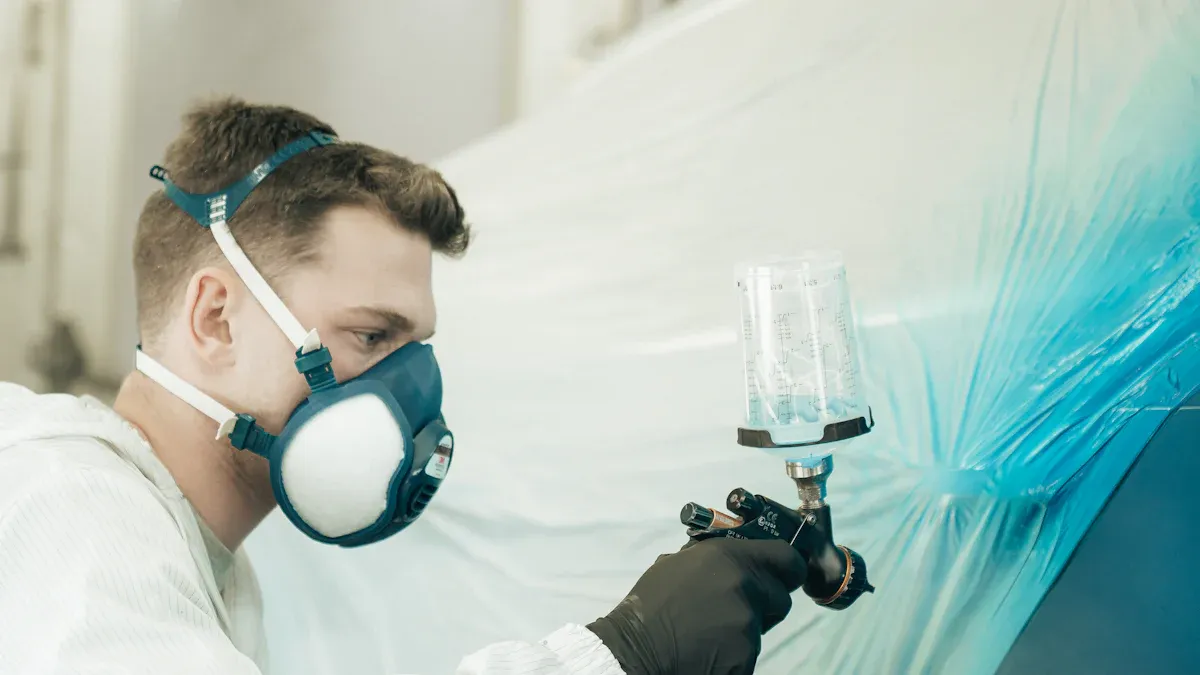
Clear coats protect a vehicle's aesthetic appearance. TMXDI forms the backbone of premium clear coat formulations in 2026. The aliphatic structure prevents yellowing under prolonged sunlight exposure. Automotive OEMs demand this level of UV stability for their top-tier models. TMXDI-based clear coats maintain gloss and clarity for years. Refinish shops also choose TMXDI for high-end repair work. The slow reactivity allows a longer working window during application. This property helps technicians achieve flawless finishes without rushing. The low viscosity supports high-solids formulations that meet strict VOC limits. Formulators achieve the perfect balance of durability and appearance with TMXDI.
Primers and Adhesion Promoters
Primers require strong adhesion to difficult substrates. TMXDI excels in this demanding role. The molecule bonds effectively to steel, aluminum, plastics, and composites. Modern vehicles contain an increasing variety of materials. TMXDI-based primers handle this diversity with consistency. The hydrolytic stability protects the primer-substrate interface from moisture attack. This protection prevents delamination and corrosion over the vehicle's lifetime. Adhesion promoters based on TMXDI create a reliable bridge between substrate and topcoat. The coating achieves a 5B rating on the cross-hatch adhesion test. No peeling or flaking occurs after testing. Automotive manufacturers trust TMXDI for these critical performance layers.
Specialty and Low-VOC Systems
Regulatory pressures drive demand for low-VOC coating systems. TMXDI enables formulators to meet these requirements without sacrificing performance. The low viscosity of TMXDI allows high-solids formulations with minimal solvent content. Waterborne polyurethane dispersions also benefit from TMXDI's moderated reactivity. The molecule reacts slowly with water during storage and application. This stability ensures consistent performance in waterborne systems. UV-curable coatings represent another specialty application. TMXDI provides the reactivity needed for fast curing while maintaining film flexibility. Optical coatings with high refractive index also use TMXDI. These specialty systems demand the unique combination of clarity, durability, and low environmental impact that TMXDI delivers.
Application Prospect of TMXDI (Tetramethylxylylene Diisocyanate) CAS No. 2778-42-9
Demand Drivers Through 2026 and Beyond
Several factors drive demand for TMXDI in automotive coatings. Electric vehicle manufacturing expands rapidly in the Middle East. Saudi Arabia's automotive hub at King Abdullah Economic City houses Ceer Motors and Lucid Motors. These manufacturers use TMXDI in waterborne polyurethane clearcoats. Regional sustainability initiatives push for ultra-low VOC coatings. The Saudi Green Building Council sets strict emission standards. Mega-projects like NEOM and the Red Sea Project require green building certified coatings. Compliance with SABER/SASO regulatory standards ensures TMXDI supplies meet local requirements. The Application Prospect of TMXDI (Tetramethylxylylene Diisocyanate) CAS No. 2778-42-9 remains strong in these emerging markets.
Innovation in Waterborne and High-Solids Systems
TMXDI supports innovation in environmentally friendly coating systems. The low viscosity allows formulators to create high-solids coatings with minimal solvent content. Waterborne polyurethane dispersions benefit from TMXDI's moderated reactivity. The molecule reacts slowly with water during storage and application. This stability ensures consistent performance in waterborne systems. Formulators achieve excellent durability, adhesion, and weatherability without VOC compromises. Automotive manufacturers adopt these systems to meet tightening environmental regulations.
Sustainability and Regulatory Pressures
Global regulatory pressure shapes the coatings industry. The European Union, United States, and China enforce stricter VOC limits each year. TMXDI-based coatings comply with these evolving standards. The Application Prospect of TMXDI (Tetramethylxylylene Diisocyanate) CAS No. 2778-42-9 expands as sustainability requirements grow. Automotive manufacturers seek materials that reduce environmental impact without sacrificing performance. TMXDI provides this balance between ecological responsibility and coating excellence. The compound's favorable regulatory profile supports its continued adoption across regions.
TMXDI (CAS No. 2778-42-9) holds a stable, specialized position in automotive coatings in 2026. Formulators value its weatherability, adhesion, and formulation flexibility. Its higher cost keeps it focused on premium clear coats, primers, and specialty low-VOC systems. Regulatory compliance remains favorable. The Application Prospect of TMXDI (Tetramethylxylylene Diisocyanate) CAS No. 2778-42-9 will likely expand through sustainability-driven innovation in high-performance automotive finishes.
FAQ
What makes TMXDI different from other isocyanates?
TMXDI features tertiary-carbon NCO groups. This structure provides slower reactivity, better UV stability, and superior adhesion. Formulators gain longer processing windows and excellent yellowing resistance.
Can TMXDI work in waterborne coating systems?
Yes. TMXDI reacts slowly with water during storage. This stability allows waterborne polyurethane dispersions. Automotive manufacturers use these systems for low-VOC primers and clear coats.
Why does TMXDI cost more than HDI or IPDI?
TMXDI requires complex production processes. This complexity raises manufacturing costs. However, premium automotive applications justify the price through superior weatherability, adhesion, and formulation flexibility.
See Also
Proven Data Strategies For Enhancing Furandicarboxylic Acid Sustainability
Key Facts About WT20 Thoriated Tungsten For Improved TIG Welding
Novel Industrial Uses Of N,N-Dimethyl-N,N-Diphenylurea Across Sectors
A Guide To Molybdenum High Temp Furnaces For 2025 Applications
Industrial Usage And Dissolution Methods Of Furandicarboxylic Acid