AI and Machine Learning Power Mushroom Detection with X-ray Imaging
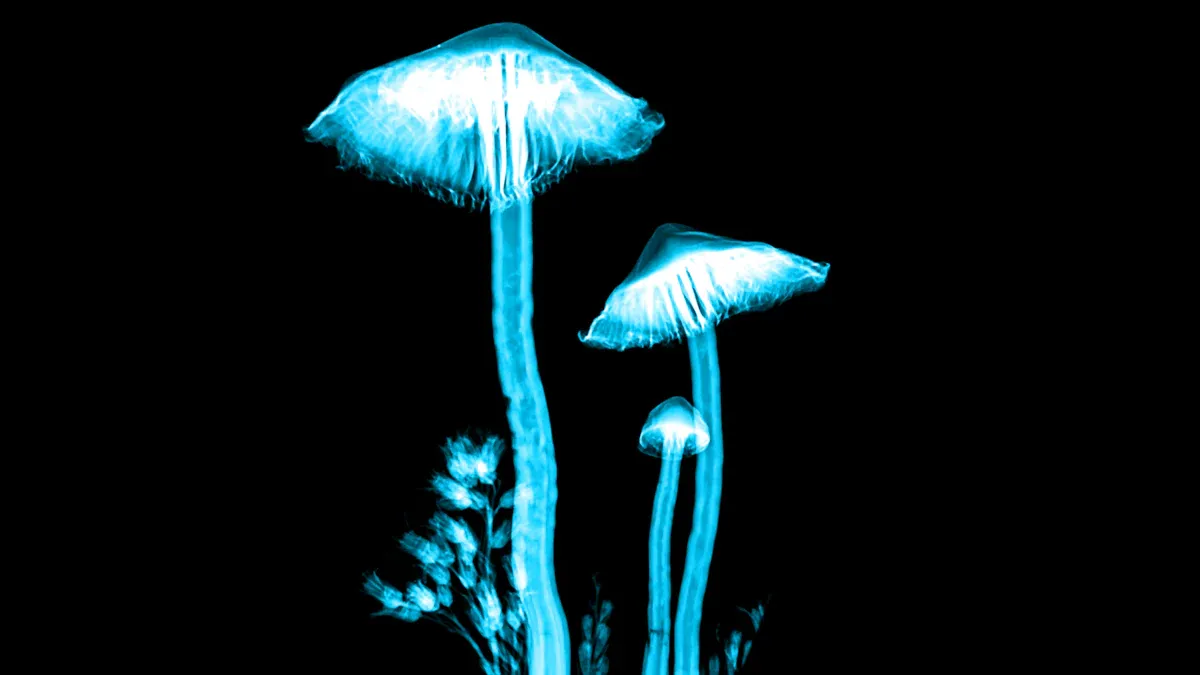
Recent advances in ai allow mushroom x ray machine technology to detect mushrooms with remarkable precision. X-ray irradiation stops microbial growth and prevents nutrient loss, which helps keep mushrooms safe for consumers. This method preserves flavor and sensory quality, so growers see fewer cases of decay and spoilage. Farmers and food producers benefit from better food safety and longer shelf life.
AI and Mushroom X Ray Machine Detection
How AI Integrates with X Ray Imaging
The mushroom x ray machine combines advanced imaging with powerful algorithms to improve detection of mushrooms. Engineers design these machines to scan mushrooms using x-rays, which reveal internal structures invisible to the human eye. AI models analyze these images and identify features that signal freshness, quality, or contamination.
Convolutional neural networks (CNNs) play a key role in this process. These algorithms learn to recognize patterns in x-ray images, making detection more accurate. The Xception model, which uses depthwise separable convolutions, processes mushroom images efficiently. The Convolutional Block Attention Module (CBAM) helps the algorithm focus on important features and ignore background noise. This combination allows the mushroom x ray machine to handle complex visual details found in mushrooms.
The synergy between mushroom x ray machine technology and AI algorithms leads to impressive results. Validation accuracy reaches 96%, meaning the system correctly identifies mushrooms almost every time. Precision and recall both stand at 0.96, showing that the algorithm rarely misses or misclassifies mushrooms during detection.
Automated Detection of Mushrooms
Automated detection changes how growers and food producers inspect mushrooms. The mushroom x ray machine uses computer vision systems and machine learning algorithms to scan large batches quickly. These systems classify mushrooms based on size, shape, and internal quality without human intervention.
Researchers have tested different algorithms to improve detection. CNNs and EfficientNet models have achieved classification accuracies of 65% and 83.55%, respectively, when identifying fungal spores. These results highlight the importance of building strong image classifiers and collecting valid datasets for mushroom detection.
Automated mushroom detection offers several benefits:
Faster inspection of mushrooms in processing plants.
Consistent quality control using the mushroom x ray machine.
Reduced risk of contaminated mushrooms reaching consumers.
Improved shelf life predictions with advanced algorithm analysis.
Lower labor costs due to machine learning algorithms handling routine detection tasks.
Machine learning algorithms also face challenges. Feature selection remains a critical step, as the algorithm must choose the right details to analyze. Accurate detection depends on the quality of the images and the training data used by the mushroom x ray machine.
The combination of AI, mushroom x ray machine technology, and robust algorithms continues to transform mushroom detection. Producers rely on these systems to deliver safe, high-quality mushrooms to the market.
Importance of Mushroom Detection
Food Safety and Agriculture
Mushroom detection plays a vital role in protecting food safety and supporting agriculture. Farmers and producers rely on accurate identification to ensure only edible mushrooms reach consumers. Advanced detection systems help prevent contaminated mushrooms from entering the supply chain. These systems use rapid identification methods to spot foodborne pathogens, which reduces the risk of illness outbreaks. Biosensors and CRISPR-based diagnostics improve detection sensitivity and speed, allowing real-time safety monitoring.
Undetected contamination in mushrooms can cause serious health problems. Listeriosis, a foodborne illness, poses a severe threat, especially to vulnerable groups like the elderly, pregnant women, and those with weakened immune systems. The FDA has developed strategies to prevent contamination and keep imported mushrooms safe. Producers use mushroom identification to separate edible mushrooms from harmful ones, which protects public health.
AI-powered mushroom detection brings economic benefits to commercial agriculture. Automated identification optimizes environmental conditions and streamlines processes such as quality grading and harvesting. These improvements reduce labor costs and make it easier to manage large operations. Predictive capabilities in yield forecasting and disease management help farmers use resources wisely and increase profitability.
Mushroom identification technology supports food safety and boosts agricultural productivity. Accurate detection ensures that edible mushrooms meet quality standards and reach consumers safely.
Challenges in Traditional Methods
Traditional mushroom detection methods face several limitations. These approaches depend on basic features like color, shape, and texture for identification. They often struggle to recognize mushrooms in different lighting conditions or complex backgrounds. This makes wild mushroom detection and mushroom species identification difficult and less reliable.
Manual identification requires expert knowledge and can be time-consuming. Workers may misidentify edible mushrooms, which increases the risk of contamination. Inconsistent results from traditional detection methods highlight the need for advanced technologies. Automated systems improve accuracy and efficiency, making mushroom identification more dependable.
Key challenges in traditional mushroom detection:
Difficulty in identifying mushrooms in varied environments
Limited accuracy in wild mushroom detection
High risk of misidentifying edible mushrooms
Slow and labor-intensive identification process
Modern detection technologies address these challenges by providing faster and more reliable mushroom identification. Producers can now ensure that only safe, high-quality edible mushrooms reach the market.
Technologies for Mushroom Detection
Multispectral Imaging and Yolov5
Multispectral images provide valuable data for mushroom identification. These images capture information across different wavelengths, revealing details that standard photographs cannot show. Farmers and researchers use multispectral images to analyze mushrooms for freshness, disease, and quality. The yolov5 algorithm plays a crucial role in real-time detection and identification. This object recognition algorithm processes multispectral images from drone footage, allowing rapid identification of mushrooms in the field.
The yolov5 algorithm begins detection when the drone flies below 20 meters. It identifies mushrooms and saves regions of interest as jpg files for further analysis. This process highlights specific characteristics in multispectral images, making identification more accurate. The yolov5 algorithm supports live stream recognition, which helps producers monitor large areas efficiently.
Evidence Description | Details |
|---|---|
Application of Yolov5 | The algorithm is used for object identification in live stream recognition of wild mushrooms from drone footage. |
Detection Process | The detection begins when the drone is below 20 meters in altitude, allowing for real-time identification. |
Image Processing | Regions of interest (ROIs) are saved as jpg files for further analysis, highlighting specific mushroom characteristics. |
Deep Learning and CNNs
Deep learning models have transformed mushroom detection. These models analyze multispectral images and learn to identify mushrooms with high accuracy. Convolutional neural networks (CNNs) extract features from multispectral images, improving identification and classification. Researchers use deep learning to build robust detection systems that handle complex visual data.
The following table shows the performance metrics of several deep learning models in mushroom detection tasks:
Model | Accuracy | Precision | Recall | F1-score | AUC | Specificity | Log Loss | MCC |
|---|---|---|---|---|---|---|---|---|
GhostNet | 87.78% | 87.92% | 87.78% | 87.78% | 97.19% | 97.56% | 87.39% | 85.36% |
RegNetX-400MF | 79.44% | 79.51% | 79.44% | 79.15% | 96.36% | 95.89% | 88.86% | 75.46% |
RegNetX-800MF | 85.56% | 85.72% | 85.56% | 85.43% | 97.64% | 97.11% | 72.78% | 82.74% |
RepVGG | 93.89% | 94.04% | 93.89% | 93.92% | 99.15% | 98.78% | 30.81% | 92.68% |
ResNeXt | 95.00% | 95.08% | 95.00% | 95.00% | 99.90% | 99.00% | 9.37% | 94.02% |
ShuffleNetV2 | 87.22% | 88.02% | 87.22% | 87.21% | 96.63% | 97.44% | N/A | N/A |
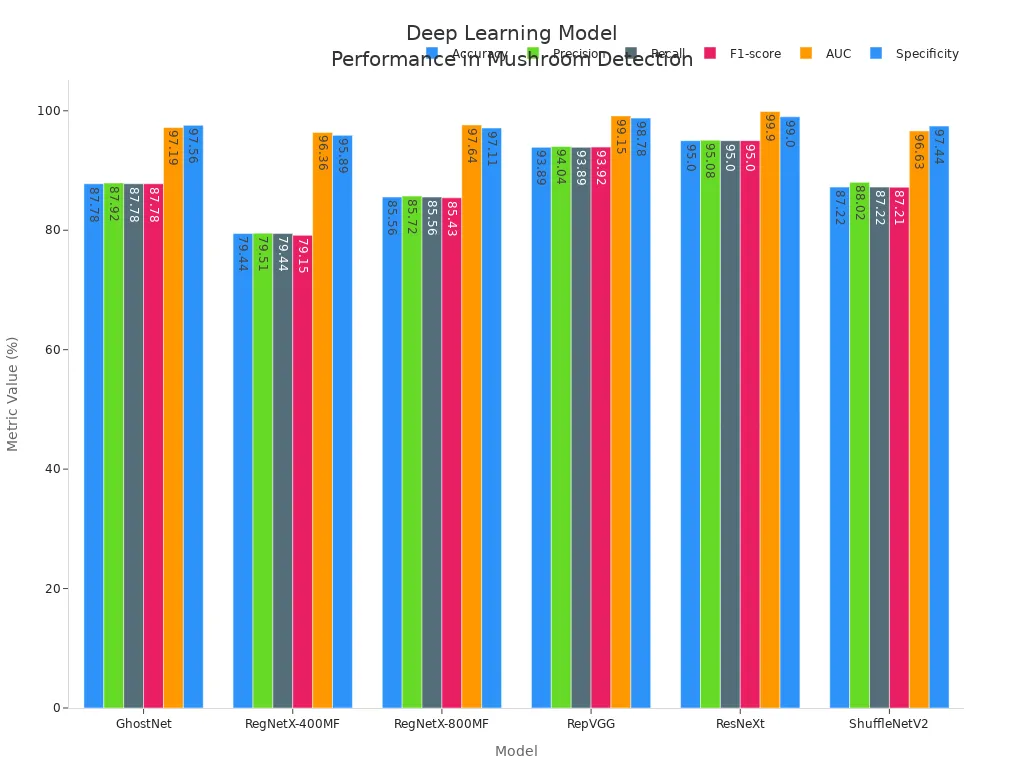
Researchers rely on deep learning to improve detection speed and accuracy. The ai-driven deep learning framework supports large-scale identification and classification of mushrooms. Multispectral images enhance the ability of deep learning models to distinguish between different mushroom species.
Explainable AI (XAI) in Detection
Explainable AI helps users understand how detection systems make decisions. Grad-CAM and Score-CAM visualize the decision-making process in deep learning models. These techniques show which features in multispectral images influence identification. Producers and researchers trust detection systems more when they see how models focus on relevant mushroom characteristics.
Grad-CAM and Score-CAM visualize model decisions, increasing trust.
These methods ensure models focus on important features for mushroom identification.
XAI techniques help identify biases and improve classification performance.
Explainable AI supports transparency in mushroom detection. Users can verify that deep learning models use multispectral images correctly for identification. This approach improves the reliability of detection systems and supports safe food production.
Freshness Prediction and Shelf Life
AI Models for Freshness
AI models have changed how producers measure freshness in mushrooms. These models use sensor data and machine learning algorithms to track changes in quality. Smart packaging works with AI to monitor mushrooms and predict spoilage. Sensors inside packaging collect data about temperature, humidity, and gas levels. The AI system analyzes this information and gives accurate freshness prediction results.
AI models integrated with smart packaging and machine learning algorithms predict mushroom freshness and shelf life.
These models use sensor data and advanced analytics to monitor and extend the shelf life of mushrooms.
Fungal-derived smart packaging achieves 95% accuracy in predicting food spoilage using AI-integrated sensors.
Recent advances in packaging technology can extend mushroom shelf life from 3-4 days to over a week.
Producers rely on shelf-life prediction models to keep mushrooms fresh for longer periods. These models help them maintain high quality and reduce waste. Mushroom freshness prediction allows growers to deliver mushrooms with better taste and texture. The prediction process also supports shelf life prediction, which improves planning and storage.
Practical Benefits for Industry
AI-driven freshness prediction brings many practical benefits to mushroom producers and retailers. The technology helps them track mushroom freshness and maintain quality throughout the supply chain. Producers use AI to predict demand and order the right amount of mushrooms. Retailers connect with farmers using AI apps, which reduces waste and increases sales.
Benefit | Description |
|---|---|
Predicting demand | AI analyzes past sales data to help producers and retailers order the right amount of mushrooms. |
Connecting farmers and buyers | AI apps link farmers with businesses, reducing waste and increasing sales opportunities. |
Tracking freshness | AI monitors storage conditions to ensure mushrooms remain fresh from production to sale. |
Supply chain efficiency | AI optimizes transportation routes and logistics, reducing spoilage and improving delivery times. |
Increased profits | Producers can sell more efficiently and reduce waste, leading to higher profit margins. |
AI-driven mushroom freshness prediction improves supply chain efficiency. The technology optimizes cultivation, harvesting, and logistics. Producers use sensors and machine learning to monitor growth conditions and predict crop yields. This process helps them plan harvests and minimize losses. AI also improves transportation and inventory management, which keeps mushrooms fresh and reduces spoilage. Mushroom freshness prediction supports better quality and meets consumer demand for freshness.
AI models for mushroom freshness prediction help producers deliver mushrooms with high quality and longer shelf life. The technology supports shelf-life prediction models and brings practical benefits to the mushroom industry.
Results and Validation
Accuracy in Mushroom Classification
Researchers have tested many algorithm designs to improve mushroom classification. These algorithms use x-ray images and multispectral data to identify mushrooms with high accuracy. Mushroom classification models often reach validation accuracy rates above 95%. Scientists measure performance using metrics such as precision, recall, and F1-score. These scores show how well the algorithm can detect mushrooms and avoid mistakes.
A typical mushroom classification system uses convolutional neural networks. These networks learn to spot patterns in mushrooms, such as shape and internal structure. The algorithm processes thousands of images to train the model. After training, the system can classify mushrooms in real-time. Mushroom classification accuracy depends on the quality of the images and the diversity of the training data. Researchers use real-time monitoring to check how well the algorithm works in different environments.
Metric | Value |
|---|---|
Accuracy | 96% |
Precision | 0.96 |
Recall | 0.96 |
F1-score | 0.96 |
High accuracy in mushroom classification helps producers deliver safe mushrooms to consumers. Real-time monitoring ensures that the algorithm maintains performance during daily operations.
Case Studies and Real-World Use
Many farms and research centers now use mushroom classification technology for real-time monitoring. These systems help workers identify mushrooms quickly and reduce errors. One notable project led by Kudzai Mafuwe in Kennett Square, Pennsylvania, uses AI for pest management in mushroom farming. The algorithm estimates the number of mushroom flies from images, saving time for crop scouts. This mushroom classification tool improves monitoring and supports better pest control.
Real-world applications of mushroom classification include:
Automated sorting of mushrooms in processing plants
Real-time monitoring of mushroom freshness and quality
Early detection of pests and diseases using AI algorithms
Improved supply chain management with accurate mushroom classification
Mafuwe's prototype shows that mushroom classification technology can work in other crop systems. Farms benefit from faster monitoring and better decision-making. Mushroom classification algorithms continue to evolve, offering new solutions for agriculture and food safety.
Future Impact of AI in Mushroom Detection
Advancements in Imaging and AI
AI continues to drive innovation in the detection of mushrooms. Researchers develop new imaging techniques that reveal details inside mushrooms, making identification faster and more accurate. Machine learning models now analyze multispectral and x-ray images with greater precision. These systems learn from thousands of examples, improving their ability to spot subtle changes in mushrooms that signal freshness or contamination.
Engineers design AI-powered mushroom x ray machines to process large batches quickly. These machines use deep-learning algorithms to classify mushrooms by quality and safety. The technology adapts to different mushroom species, helping producers maintain high standards. AI models also predict shelf life, allowing growers to plan harvests and reduce waste.
AI and imaging advancements will continue to transform mushroom detection. Producers will rely on these systems to deliver safer, fresher mushrooms to consumers.
Expanding Applications Beyond Mushrooms
AI and imaging technologies now benefit many areas of agriculture. Farmers use similar systems to detect pests in vineyards and identify diseases early. Automated monitoring of vine health helps growers respond quickly to problems. AI also supports the identification of suitable habitats for high-value medicinal plants, improving cultivation and promoting sustainable farming.
AI-powered detection systems adapt to other food safety contexts:
Predicting and detecting mycotoxins in crops and food products
Integrating non-invasive imaging and electronic noses for quality control
Using forecasting models for risk-based monitoring and sourcing
Application | Description |
|---|---|
Crop Disease Detection | Deep-learning algorithms identify and manage crop diseases effectively. |
Pest Detection in Viticulture | AI analyzes images to classify pests, enabling timely interventions. |
Optimization of Medicinal Plants | AI identifies suitable habitats, optimizing land use and resource allocation. |
Growers in viticulture use AI for automated monitoring and pest detection. Conservationists apply AI to optimize cultivation zones for medicinal plants. These applications show that AI and imaging technologies extend far beyond mushrooms, improving food safety and sustainability across agriculture.
The future of AI in agriculture looks promising. As technology evolves, more applications will emerge, helping producers manage crops, reduce waste, and protect consumers.
AI and machine learning, combined with mushroom x ray machine technology, drive major improvements in mushroom detection and freshness prediction. These tools help producers deliver safer and fresher mushrooms. Farmers see better food safety and longer shelf life. Researchers continue to develop new solutions for agriculture.
The future of mushroom detection looks bright. Producers and scientists can explore more ways to use AI for food safety and quality.
Faster detection
Improved accuracy
Greater confidence in mushroom quality
FAQ
How does AI improve mushroom detection accuracy?
AI models analyze x-ray and multispectral images. They identify patterns that signal freshness or contamination. These systems reach high accuracy rates, often above 95%. Farmers trust AI to deliver reliable results and improve food safety.
What types of mushrooms can x-ray machines detect?
X-ray machines detect many edible and wild mushroom species. The technology adapts to different shapes and sizes. Researchers train AI models with diverse datasets to recognize various types. Producers use these machines for quality control in commercial farms.
Is mushroom x-ray detection safe for consumers?
X-ray detection does not harm mushrooms or change their taste. The process stops microbial growth and preserves nutrients. Consumers receive mushrooms that meet safety standards and maintain freshness.
Can AI predict mushroom shelf life?
AI uses sensor data and machine learning to predict shelf life. Smart packaging tracks temperature and humidity. The system analyzes changes and estimates how long mushrooms stay fresh. Producers use these predictions to reduce waste and plan deliveries.
What challenges do traditional mushroom detection methods face?
Challenge | Impact |
|---|---|
Manual identification | Slow and error-prone |
Limited accuracy | Risk of misclassification |
Inconsistent results | Quality control issues |
Traditional methods rely on visual inspection. Workers may misidentify mushrooms, which increases safety risks.